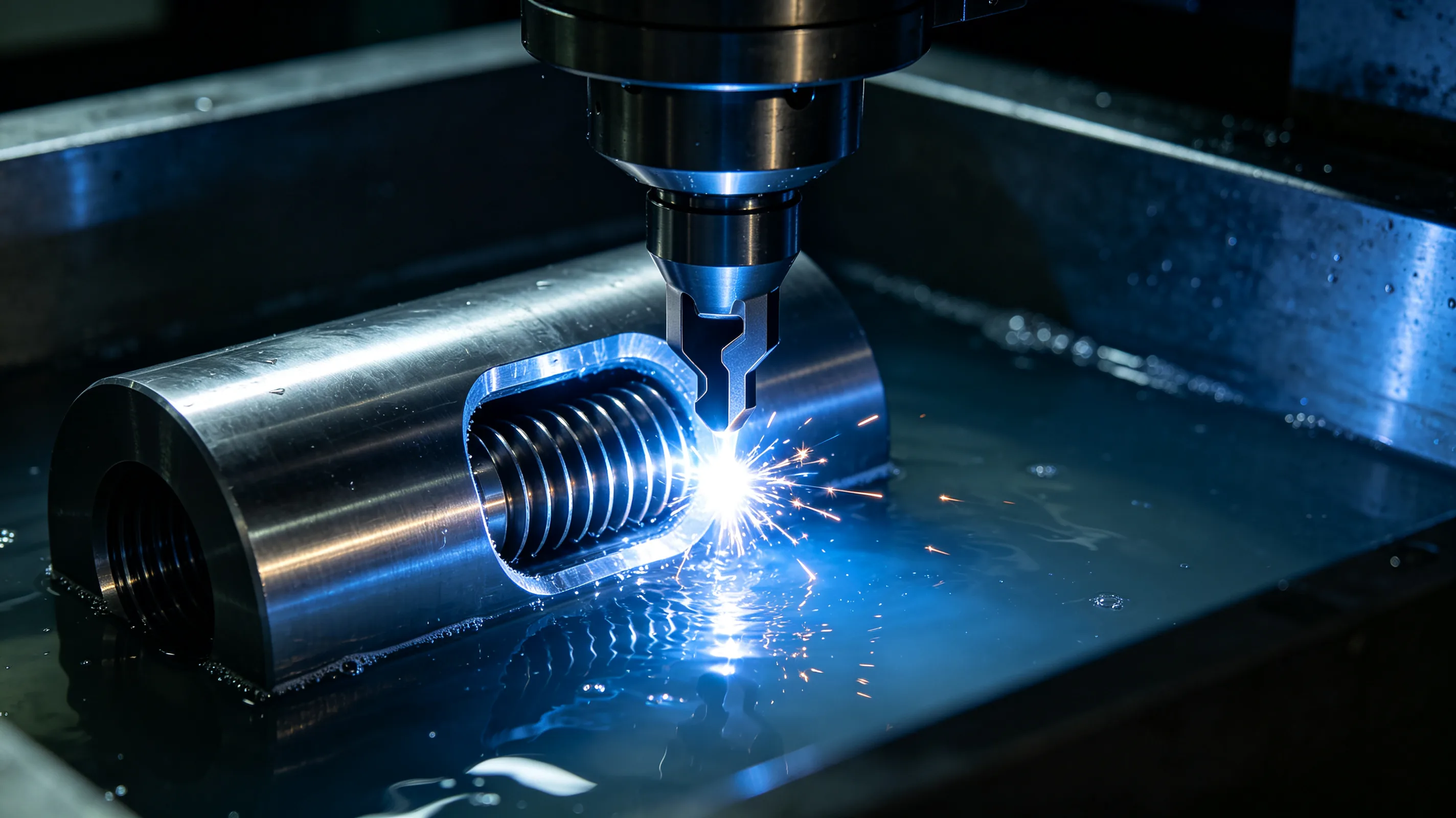
CNC vs EDM for Titanium Parts: Which Process Should You Choose?
Executive summary: The choice between CNC machining and EDM for titanium parts depends primarily on geometry complexity, tolerance requirements, surface integrity needs, and production quantity. CNC machining is generally the preferred process for components with accessible geometries, moderate to high production volumes, and fatigue-loaded surfaces because it offers higher material removal rates, superior surface integrity, and lower per-part cost at quantity. EDM is the better choice for components with deep cavities, sharp internal corners, thin walls, or hardened material that cannot be economically produced by cutting tools. EDM also excels at low-volume production of complex geometries where the tooling cost for CNC machining would be prohibitive. In production reality, the most cost-effective approach for many titanium components is a hybrid strategy: CNC machining for the bulk material removal and accessible features, EDM for the features that cannot be reached or that would require excessive tooling complexity.
How the two processes differ in material removal mechanism
CNC machining removes titanium by mechanical shearing. A rotating or moving cutting tool engages the workpiece, and material is removed as chips through plastic deformation. The cutting force is transmitted through the tool into the workpiece, which means the workpiece must be rigidly fixtured and the tool must be stiff enough to resist deflection. Titanium's low thermal conductivity concentrates heat at the cutting edge, which limits cutting speed and accelerates tool wear regardless of the machine tool power available.
EDM removes titanium by electrical erosion. Controlled electrical discharges between an electrode and the workpiece vaporise microscopic volumes of material. There is no mechanical cutting force, so the workpiece does not need to be as rigidly supported, and the tool electrode does not wear from abrasion. The process is unaffected by titanium's hardness, work hardening behaviour, or thermal conductivity because material removal depends on electrical rather than mechanical energy. The limitation is speed: a typical EDM operation removes material at 5 to 15 percent of the rate achievable in CNC milling of the same titanium alloy.
The difference in removal mechanism has practical consequences beyond speed. CNC machining produces a surface with compressive residual stresses and a clean, undeformed microstructure. EDM produces a surface with a recast layer containing microcracks and tensile residual stresses. For components that experience cyclic loading in service, this surface integrity difference can be the deciding factor in process selection. The article on EDM titanium machining provides a detailed discussion of surface integrity considerations and recast layer management strategies.
Geometric capability comparison
CNC machining is constrained by tool access. A rotating end mill or drill can only reach features that are accessible along a straight or slightly angled path from the tool approach direction. Internal corners have a radius equal to the cutter radius. Deep cavities require long-reach tools that are prone to vibration and deflection. Undercuts and internal features with compound angles require multi-axis machines and specialised tooling.
EDM is constrained by electrode access rather than tool access, but the constraints are different. Wire EDM can cut any through-thickness contour regardless of complexity because the wire passes completely through the workpiece. The minimum internal corner radius is equal to the wire radius, which can be as small as 0.05 mm. Sinker EDM can produce three-dimensional cavities with complex internal geometry using preformed electrodes, but each electrode change adds setup time and cost.
Thin-wall titanium components illustrate the geometric difference well. A titanium bracket with a wall thickness of 0.3 mm and a height of 15 mm is difficult to produce by CNC milling because the cutting force deflects the wall, causing dimensional variation and potential wall collapse. The same feature is straightforward on a wire EDM because no cutting force is applied. The geometry is cut through the solid stock, and the thin wall is defined by the wire path rather than by material removal between opposing cuts.
Tolerance and surface finish capabilities
CNC machining of titanium with sharp carbide tooling and rigid fixturing can hold tolerances of ±0.025 mm for most features and ±0.005 mm for precision-ground surfaces under stable conditions. Surface finish of Ra 0.4 to 0.8 µm is achievable with conventional finishing parameters. The surface is free of recast layer and heat-affected zone, making it suitable for fatigue-critical applications without secondary processing.
Wire EDM with multiple skim cuts can hold tolerances of ±0.005 to ±0.015 mm depending on the part thickness and the number of finishing passes. Surface finish of Ra 0.8 to 1.5 µm is achievable with multiple skim cuts, though the surface retains a thin recast layer typically 2 to 8 µm thick. For fatigue-critical applications, this layer should be removed by light machining or chemical milling. Sinker EDM produces rougher surfaces, typically Ra 3 to 6 µm, with a thicker recast layer.
| Capability | CNC machining (milling/turning) | Wire EDM | Sinker EDM |
|---|---|---|---|
| Typical tolerance | ±0.025 mm (standard) ±0.005 mm (precision) | ±0.005–0.015 mm | ±0.025–0.050 mm |
| Surface finish Ra | 0.4–1.6 µm | 0.8–1.5 µm (skim cut) | 3–6 µm |
| Recast layer | None | 2–30 µm | 10–30 µm |
| Material removal rate | High (reference) | 5–15% of CNC | 3–10% of CNC |
| Minimum corner radius | 0.5–3 mm (tool dependent) | 0.05–0.25 mm | 0.1–0.5 mm (electrode dependent) |
| Max workpiece thickness | Limited by machine travel | Up to 300 mm typical | Limited by tank depth |
Cost structure comparison by production quantity
The cost per titanium part differs significantly between CNC and EDM depending on production quantity. CNC machining has higher setup costs — programming, fixturing, and tooling — but lower per-part cost at quantity because the material removal rate is high and the cycle time is relatively short. EDM has lower setup costs for simple geometries but higher per-part cost because the cycle time is longer.
For quantities below 50 parts, EDM can be cost-competitive with CNC machining for complex geometries. The absence of specialised fixturing and the reduced programming time offset the longer cycle time. For quantities above 200 parts, CNC machining is almost always more economical because the per-part cycle time advantage outweighs the initial setup investment.
A hidden cost factor that affects both processes is the scrap rate. CNC machining of thin-wall titanium features carries a risk of dimensional variation or wall damage that increases the scrap rate for complex parts. EDM eliminates cutting force deflection but introduces risk from wire breakage, recast layer non-conformance, and dielectric contamination. A realistic cost comparison must include expected scrap rates based on the specific geometry and the supplier's process experience.
Many procurement teams make the mistake of comparing CNC and EDM costs based on cycle time alone. The more important comparison is the total cost per acceptable part, which includes setup, cycle time, tooling or electrode cost, inspection, and expected scrap. For a titanium part with complex internal features, the CNC route may have a lower quoted cycle time but a higher scrap rate and rework cost, making EDM the lower total cost option despite the longer cycle.
Hybrid machining: combining CNC and EDM for titanium components
In production practice, the decision is not always CNC or EDM. Many titanium components benefit from a hybrid approach where CNC machining handles the bulk material removal and accessible features, and EDM produces the features that cannot be reached or that would require impractical tooling.
A typical aerospace titanium bracket might be CNC machined from plate stock for the overall profile, mounting faces, and clearance pockets. Wire EDM then cuts the internal weight-reduction pockets with thin walls and sharp internal corners that would be difficult to produce with an end mill. The bracket is then finished with a light CNC pass on the mounting faces to ensure the critical surfaces are free of recast layer and within tolerance.
Hybrid processing requires coordination between the two operations. The CNC machining must leave sufficient stock for the EDM operation, typically 0.5 to 1.0 mm. The EDM operation must account for the heat-affected zone and recast layer on surfaces that will be finished by subsequent machining. The process sequence must be planned to avoid introducing distortion: EDM after rough CNC machining but before final finishing passes is a common sequence that balances material removal efficiency with dimensional control.
Decision framework for process selection
For a manufacturing engineer or procurement manager evaluating a titanium component, the following questions help determine whether CNC machining, EDM, or a hybrid approach is appropriate.
Question 1: Can all features be reached by a standard cutting tool? If yes, CNC machining is likely the most economical option. If no, EDM or hybrid processing is required for the inaccessible features.
Question 2: Is the component fatigue-loaded in service? If yes, the surface integrity requirements favour CNC machining or EDM with post-EDM finishing. As-EDM surfaces without recast layer removal are generally not acceptable for flight-critical or implantable components.
Question 3: What is the production quantity? For quantities above 200 parts, CNC machining is typically more economical unless the geometry forces the use of EDM. For quantities below 50 parts with complex geometry, EDM may be cost-competitive or lower cost.
Question 4: Are the thin-wall features susceptible to cutting force deflection? If the component has walls thinner than 0.5 mm with aspect ratios above 10 to 1, EDM eliminates the deflection risk and may achieve higher first-pass yield despite the longer cycle time.
For a review of your titanium component geometry and a process recommendation, submit your drawings through the RFQ portal. The titanium CNC machining services page provides an overview of conventional machining capabilities, and the wire EDM machining page covers EDM-specific process details.
"}