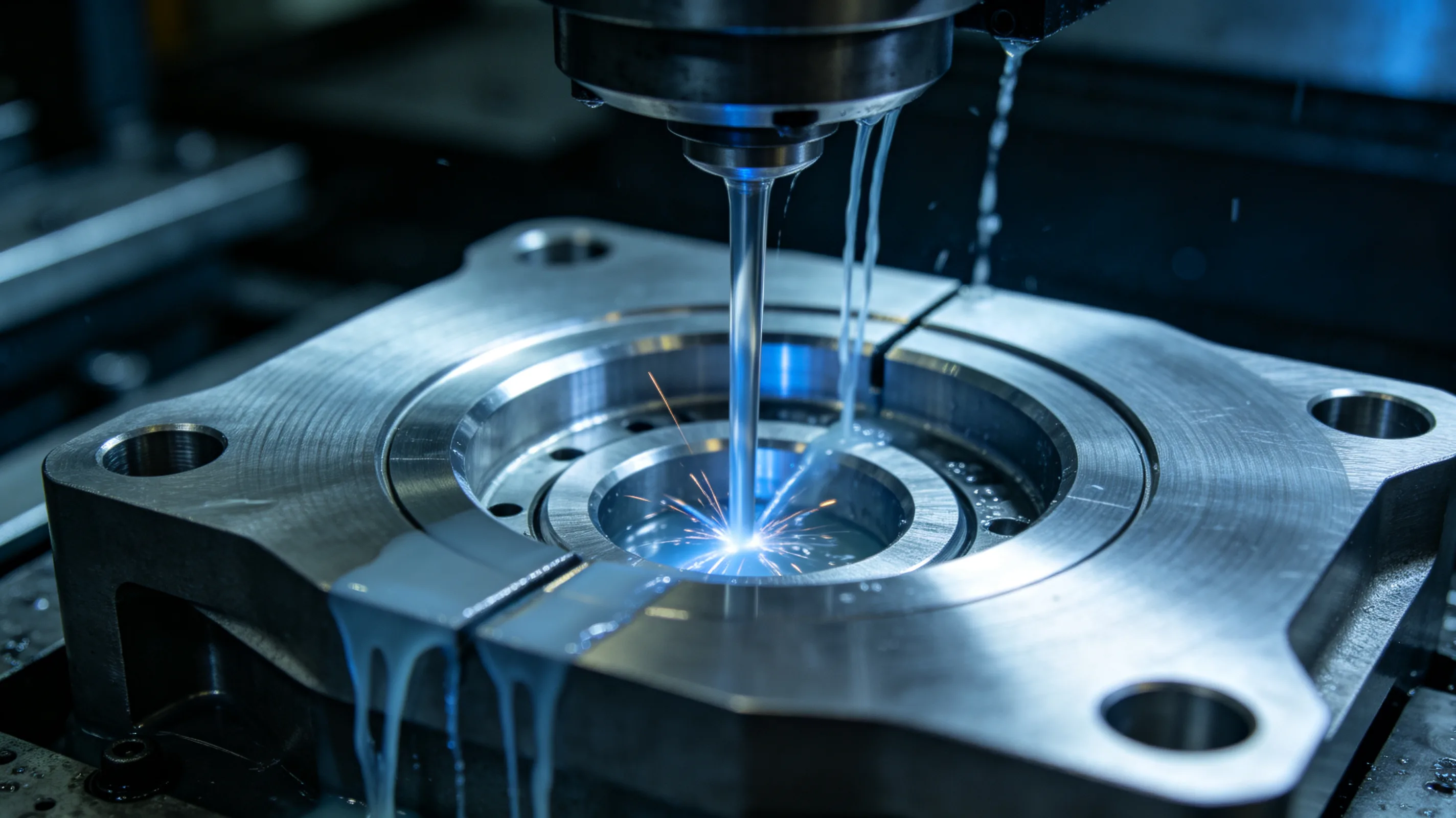
Titanium Wire EDM for Bearing Seats and Precision Features
Executive summary: Wire EDM is a practical production method for cutting precision bearing seats and dimensional features in titanium components because it achieves tight positional and dimensional tolerances without applying cutting force that could distort thin‑wall sections. For bearing seats in titanium housings and brackets, wire EDM can hold bore diameter tolerances of ±0.005 mm and positional tolerances of ±0.010 mm with multiple skim passes. The limitation is the recast layer on the cut surface, which for bearing interfaces that experience rolling contact fatigue should be removed by light machining or fine finishing. For landing gear components, actuator brackets, and medical device bearing housings where titanium is specified for its corrosion resistance and strength‑to‑weight ratio, wire EDM often produces bearing features with higher first‑pass yield than conventional boring or milling because the process eliminates deflection error from cutting forces.
Why bearing seats are challenging in titanium
Bearing seats in any material require controlled diameter tolerances, roundness, and surface finish. In titanium components, achieving these requirements is complicated by three material‑related factors. First, titanium’s low elastic modulus — approximately 110 GPa for Ti‑6Al‑4V compared to 200 GPa for steel — means that thin‑wall housing sections deflect more under cutting force during conventional machining. A bearing bore machined in a thin‑wall titanium housing may appear round when the part is fixtured but distort when released from the fixture because the elastic deformation during cutting is not uniform.
Second, titanium’s work hardening behaviour creates difficulty in achieving consistent surface finish during boring operations. The cutting edge encounters increasing hardness as it progresses through a pass, which can lead to surface tearing and dimensional variation in the bearing bore. Third, the thermal expansion of titanium during machining introduces dimensional uncertainty. Titanium’s coefficient of thermal expansion is about 8.6 µm/m·°C, which is close to steel, but its low thermal conductivity means localized heating in the cutting zone persists longer, creating thermal gradients that cause non‑uniform expansion during machining.
Wire EDM avoids all three problems. The wire electrode never contacts the workpiece mechanically, so there is no cutting force that could deflect thin housing walls. There is no work hardening because material removal is by electrical erosion rather than plastic deformation. The workpiece remains at a stable temperature because the dielectric fluid provides continuous cooling and thermal stabilisation. A bearing seat cut by wire EDM in a thin‑wall titanium housing will have the same dimensions and roundness when the part is removed from the machine as it had during cutting.
Wire selection and cutting parameters for titanium bearing features
The wire electrode is the primary process variable in wire EDM of titanium bearing seats. Standard brass wire is suitable for general titanium cutting but produces a rougher surface and thicker recast layer. Coated wire — typically zinc‑coated brass — improves cutting speed by approximately 20 to 30 percent for the same wire diameter and provides more stable erosion in thicker titanium sections. Micro‑grain wire with smaller diameter, typically 0.1 to 0.2 mm, is used for fine features with tight corner radii in bearing race profiles.
Wire diameter selection depends on the feature geometry and tolerance requirement. For bearing bores with diameters above 10 mm, 0.25 mm brass or coated wire is standard. For smaller bearing seats or features with corner radii below 0.3 mm, 0.15 mm or 0.10 mm wire is required. Smaller wire cuts more slowly — a 0.10 mm wire removes material at roughly half the rate of 0.25 mm wire — so the wire diameter should be the largest that can produce the required feature geometry.
Skim cut strategy determines the final surface quality and dimensional accuracy. A typical titanium bearing seat program uses one rough cut followed by two or three skim cuts. The rough cut removes the bulk of the material at the highest erosion rate and leaves approximately 0.15 to 0.25 mm of stock. The first skim cut removes the coarse recast layer and brings the dimension to within 0.05 mm of target. The second and third skim cuts refine the surface finish to Ra 0.8 to 1.2 µm and achieve the final dimension within tolerance.
Table 1: Wire EDM parameter ranges for titanium bearing seat features
| Parameter | Rough cut | Skim cut 1 | Skim cut 2 | Skim cut 3 |
|---|---|---|---|---|
| Wire diameter (mm) | 0.25 | 0.25 | 0.25 | 0.15–0.25 |
| Stock removal (mm) | Bulk material | 0.15–0.25 | 0.03–0.08 | 0.01–0.03 |
| Surface finish Ra (µm) | 3–5 | 1.5–2.5 | 1.0–1.5 | 0.6–1.2 |
| Dimensional tolerance (mm) | ±0.05 | ±0.02 | ±0.010 | ±0.005 |
| Recast layer thickness (µm) | 20–30 | 8–15 | 4–8 | 2–5 |
Surface integrity for rolling contact fatigue in bearing interfaces
Bearing seats in aerospace and medical titanium components experience rolling contact fatigue from the bearing race or rolling elements. The surface condition of the wire EDM cut is therefore critical for the service life of the bearing interface. The recast layer left by EDM contains microcracks and tensile residual stresses that can initiate fatigue cracks under cyclic bearing loads.
For bearing seats in non‑critical applications — such as low‑cycle or static bearing interfaces in industrial equipment — the as‑EDM surface with two or three skim cuts may be acceptable. The recast layer thickness of 2 to 5 µm after multiple skim cuts is thin enough that the risk of fatigue initiation under moderate loads is low in practice.
For flight‑critical bearing applications in aerospace structures, the recast layer should be removed. A post‑EDM finishing pass by light boring or fine machining removes the affected layer reliably. The component drawing should specify the surface integrity requirement for EDM‑bearing interfaces. Many aerospace procurement documents now include a note such as: No recast layer is permitted on bearing surfaces. EDM is permitted for material removal provided the recast layer is removed by subsequent machining. When this requirement is not stated on the drawing, the manufacturer and the procurement team should agree on the surface integrity standard before production begins.
A middle‑ground approach that some manufacturers use is to oversize the bearing bore by 0.1 mm during EDM cutting and then finish by diamond boring or fine reaming after EDM. This approach combines the positional accuracy of wire EDM with the surface integrity of a machined finish. The EDM operation establishes the bore position accurately relative to other features, and the finishing operation produces a recast‑free surface at the final dimension and roundness.
Practical considerations for wire EDM bearing seat production
Threading is one of the more frequent operational issues in wire EDM of titanium bearing seats. Titanium erosion debris can accumulate in the start hole and interfere with automatic wire threading, particularly in thicker sections above 50 mm. Dielectric filtration quality directly affects threading reliability. Suppliers cutting titanium bearing seats should maintain dielectric conductivity within the range specified by the machine manufacturer and change filtration media at shorter intervals than for steel EDM work.
Part positioning relative to the wire path affects bearing seat roundness. For bearing bores cut by wire EDM, the workpiece should be positioned so that the wire entry and exit points are on the same side of the bore to minimise the effect of wire vibration on roundness. Programming the wire path to include a lead‑in and lead‑out radius rather than cutting directly into the bore edge improves the roundness at the start point.
Multiple bearing seats in the same titanium component should be cut in a single setup to maintain positional relationship between bores. Each setup change introduces positioning error that accumulates across the features. A component with four bearing bores that are positionally related within ±0.020 mm should be programmed for continuous cutting with automatic rethreading rather than cut as separate operations with intermediate repositioning.
For thin‑wall titanium housings with bearing seats, the sequence of operations matters. The wire EDM cuts should be scheduled so that the bearing bores are cut as close to the final manufacturing stage as practical. Cutting bearing seats early in the process sequence risks dimensional change from subsequent machining‑induced stress relief. Cutting them after rough machining but before final finishing operations is a common sequence that balances process stability with surface integrity requirements.
For design engineers and procurement teams specifying bearing seats in titanium components, the wire EDM machining process page provides an overview of capability and tolerance ranges. For a process review of your titanium bearing component with specific tolerance and surface integrity requirements, submit your drawing through the engineering RFQ portal.