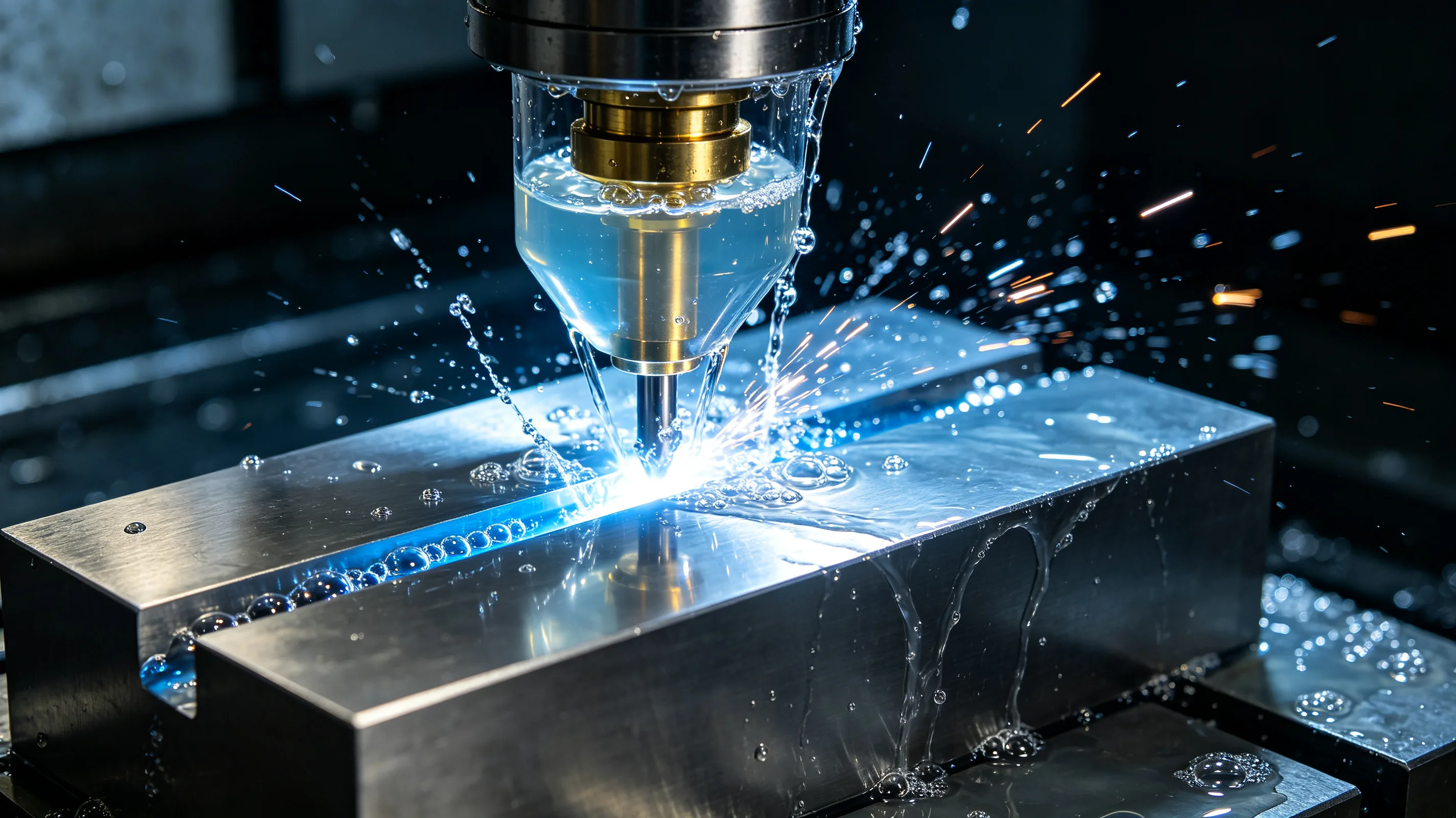
EDM Broaching for Titanium Parts: Complex Internal Profiles and Precision Features
Executive summary: EDM broaching uses a shaped electrode that advances linearly into the workpiece, eroding material along a defined path to produce internal profiles that cannot be cut by conventional broaching or standard CNC machining of titanium. The process is particularly useful for internal splines, keyways with closed ends, shaped through-holes, and complex contoured slots in titanium components where the material hardness, work hardening tendency, or geometry complexity makes conventional broaching impractical. The primary limitation is electrode wear: the shaped electrode erodes as it advances, and maintaining profile accuracy requires either multiple electrode passes with compensation or single-pass strategies with pre- worn electrode geometry. For aerospace and precision industrial titanium components that require internal profiles with tight tolerances and controlled surface integrity, EDM broaching often achieves feature geometries that would otherwise require multiple manufacturing steps or be impossible to produce by any single alternative process.
What EDM broaching does that conventional broaching cannot
Conventional broaching uses a multi-toothed cutting tool that is pushed or pulled through a pre-drilled or pre-machined hole. Each tooth removes a fixed increment of material, and the final tooth defines the finished profile shape. Broaching is efficient for high-volume production of internal profiles in steel and aluminium — an automotive transmission spline can be broached in seconds. But for titanium, conventional broaching presents persistent problems.
The cutting forces in conventional broaching are high because the broach tool engages the workpiece along multiple teeth simultaneously. Titanium's work hardening behaviour means that each tooth encounters material that was strain-hardened by the previous tooth, accelerating edge wear and causing dimensional drift across a production run. The cutting speed must be kept low to control heat generation, which reduces the productivity advantage that broaching normally has over milling. Tool regrinding costs are high, and the broach tool itself is expensive to manufacture in titanium-specific geometries.
EDM broaching eliminates the mechanical cutting force entirely. The shaped electrode advances into the workpiece by electrical erosion rather than mechanical shearing. There is no work hardening because material removal is not by plastic deformation. The electrode does not contact the workpiece, so there is no risk of tool jamming or breakage from cutting force overload. The process can produce internal profiles in titanium at any hardness level, including fully heat-treated components with tensile strength above 1,100 MPa that would be extremely difficult to broach conventionally.
There is a tradeoff that is sometimes overlooked in process selection. EDM broaching is slower than conventional broaching by a significant margin. A titanium internal spline that takes 30 seconds to cut by conventional broaching may take 15 to 45 minutes by EDM broaching. For high-volume production, this speed difference matters. For low-volume production of complex titanium components where the broach tool cost would be prohibitive, EDM broaching is often more economical despite the longer cycle time.
Types of internal profiles suited to EDM broaching of titanium
EDM broaching is most commonly used for titanium components that require internal profiles in the following categories.
Internal splines and serrations. Titanium shafts and housings that require internal spline profiles for torque transmission are a typical application. The EDM broaching electrode is shaped to the spline profile and advanced through a pre-machined starting bore. Spline profiles with module sizes down to 0.5 mm and pressure angles of 30 or 45 degrees can be produced with profile tolerances of ±0.025 mm. For aerospace actuation components where titanium shafts transmit control surface loads, internal splines cut by EDM broaching avoid the surface integrity concerns that conventional broaching introduces through cutting force and work hardening.
Keyways with closed or blind ends. A keyway that does not extend to the end of the bore — a closed-end keyway — cannot be produced by conventional broaching because the broach tool must exit the workpiece. EDM broaching can produce a keyway of any length within the bore because the electrode erodes material only where it is positioned. Blind keyways, where the keyway starts at the bore opening but does not extend through the full length, are also possible with EDM broaching. These features are common in titanium aerospace and medical components where space constraints prevent through-keyway designs.
Shaped through-holes with non-round cross-sections. Square, hexagonal, oval, or custom-shaped through-holes in titanium are produced by EDM broaching using an electrode shaped to the required cross-section. The electrode is advanced through the workpiece from one side, eroding the full profile in a single pass or multiple passes. The minimum cross-sectional dimension is typically 2 to 3 mm for practical EDM broaching, though smaller profiles are possible with smaller electrodes and reduced erosion parameters.
Contoured slots with varying cross-section along the length. Some titanium components require slots or cavities where the cross-section changes along the length. A variable-width slot or a slot with a tapered depth profile can be produced by EDM broaching using a shaped electrode that has the varying profile built into its geometry. The electrode advances stepwise or continuously, and the changing cross-section is eroded into the workpiece as the electrode progresses.
| Profile type | Typical size range | Achievable tolerance | Common titanium applications |
|---|---|---|---|
| Internal splines, module 0.5–2.0 mm | Bore diameter 10–100 mm | ±0.025 mm | Aerospace actuator shafts, torque transmission housings |
| Closed-end keyways | Width 3–20 mm, depth 2–10 mm | ±0.050 mm | Landing gear components, structural brackets |
| Non-round through-holes | Min dimension 2–50 mm | ±0.020 mm | Medical instrument housings, fluid control fittings |
| Contoured internal slots | Length 10–200 mm, depth 2–30 mm | ±0.050 mm | Aerospace structural components, custom industrial parts |
Electrode design and wear compensation for titanium
The electrode is the critical element in EDM broaching of titanium. Unlike wire EDM where the electrode is consumed continuously and replaced, a broaching electrode is a shaped form tool that erodes progressively with use. Electrode wear alters the profile geometry, and if not compensated, produces out-of-tolerance features.
Electrode materials for titanium EDM broaching are typically graphite or copper-tungsten. Graphite electrodes offer faster erosion rates and lower material cost but wear faster. Copper-tungsten electrodes wear more slowly and maintain profile accuracy longer but are more expensive to manufacture and erode at a slower rate. For titanium, graphite is generally preferred for roughing passes where profile accuracy is not critical, and copper-tungsten is used for finishing passes where dimensional control is required.
Wear compensation strategies fall into two categories. Multi-pass compensation uses a series of electrodes: a roughing electrode that removes the bulk material, one or more semi-finishing electrodes that bring the profile close to final dimension, and a finishing electrode that cuts the final profile. Each successive electrode is slightly larger or differently shaped to account for the wear of the previous electrode. Single-pass compensation uses a single electrode that is pre-worn or pre-shaped to account for the expected wear pattern, such that the finished profile meets tolerance at the end of the pass. Single-pass is faster but requires accurate wear prediction, which depends on consistent material and erosion conditions.
In production experience, multi-pass compensation is more reliable for titanium EDM broaching when tolerances below ±0.050 mm are required. The wear pattern of an electrode eroding titanium is not perfectly uniform because titanium's erosion characteristics vary with microstructure and surface condition. A multi-pass approach absorbs this variation by using the finishing electrode to correct the profile shape after the roughing and semi-finishing passes have removed the bulk of the material and stabilised the erosion conditions.
Common failure modes in EDM broaching of titanium
Several production problems occur frequently enough in EDM broaching of titanium that they warrant specific attention during process planning.
Dielectric starvation is the most common cause of profile geometry errors. The shaped broaching electrode advances into a closed or semi-closed cavity, and dielectric flow to the erosion zone becomes restricted. Insufficient dielectric flushing allows erosion debris to accumulate between the electrode and the workpiece, causing secondary discharges that erode the electrode and workpiece irregularly. The result is a rougher surface finish and loss of profile accuracy. High-pressure dielectric delivery through the electrode or through the workpiece is often necessary for deep broaching operations.
Electrode misalignment during entry causes profile distortion at the start of the broached feature. If the electrode is not aligned to the workpiece within 0.010 mm at the point of entry, the initial erosion is asymmetric, and the profile is shifted relative to the datum. Once the electrode has advanced a few millimetres, the side wall contact tends to self-align the electrode, but the entry region retains the misalignment error. Pre-alignment using a mechanical guide bushing or optical alignment before the first discharge is standard practice for precision titanium EDM broaching.
Recast layer accumulation in internal corners is a surface integrity concern that is more pronounced in EDM broaching than in wire EDM. The shaped electrode erodes material from the full profile simultaneously, and the internal corners receive less dielectric flushing than the straight wall sections. The recast layer in internal corners can be 2 to 3 times thicker than on flat surfaces. For fatigue-loaded titanium components with internal profiles, the corners should be inspected for recast layer thickness, and post-EDM finishing by electrochemical or abrasive methods should be specified if the fatigue requirement demands it.
Production planning and procurement considerations
EDM broaching of titanium requires process-specific experience that not all EDM suppliers possess. The electrode design, wear compensation, dielectric management, and finishing strategy differ significantly from standard wire EDM or sinker EDM work. Procurement teams evaluating suppliers for titanium components with EDM-broached internal profiles should confirm that the supplier has specific experience with shaped-electrode erosion of titanium alloys, not just general EDM capability.
Cycle time estimation for EDM broaching is less standardised than for conventional machining. A realistic estimate requires knowledge of the erosion rate for the specific titanium alloy, the electrode material and geometry, the number of passes required, and the expected electrode wear per pass. Suppliers who quote EDM broaching of titanium based on generic EDM parameters rather than titanium-specific data will often underestimate cycle time by 30 to 50 percent, leading to delivery delays and cost overruns.
The inspection of EDM-broached internal profiles in titanium components requires specialised fixturing and measurement methods. Profile tolerances of ±0.025 mm in internal splines or shaped holes are typically verified by optical comparison to a master profile or by coordinate measurement using a vision system. Contact probing of internal profiles is difficult because the probe diameter is often larger than the feature detail. The inspection method and acceptance criteria should be agreed between the manufacturer and the procurement team before production begins, because the cost and time required for non-standard inspection can be significant.
For design engineers and procurement teams evaluating EDM broaching for titanium component production, the wire EDM process page provides an overview of related electrical discharge capabilities. For a specific assessment of whether EDM broaching is the appropriate method for your titanium internal profile, submit your drawing through the engineering RFQ portal with a clear indication of the profile geometry, tolerance requirements, and surface integrity needs.