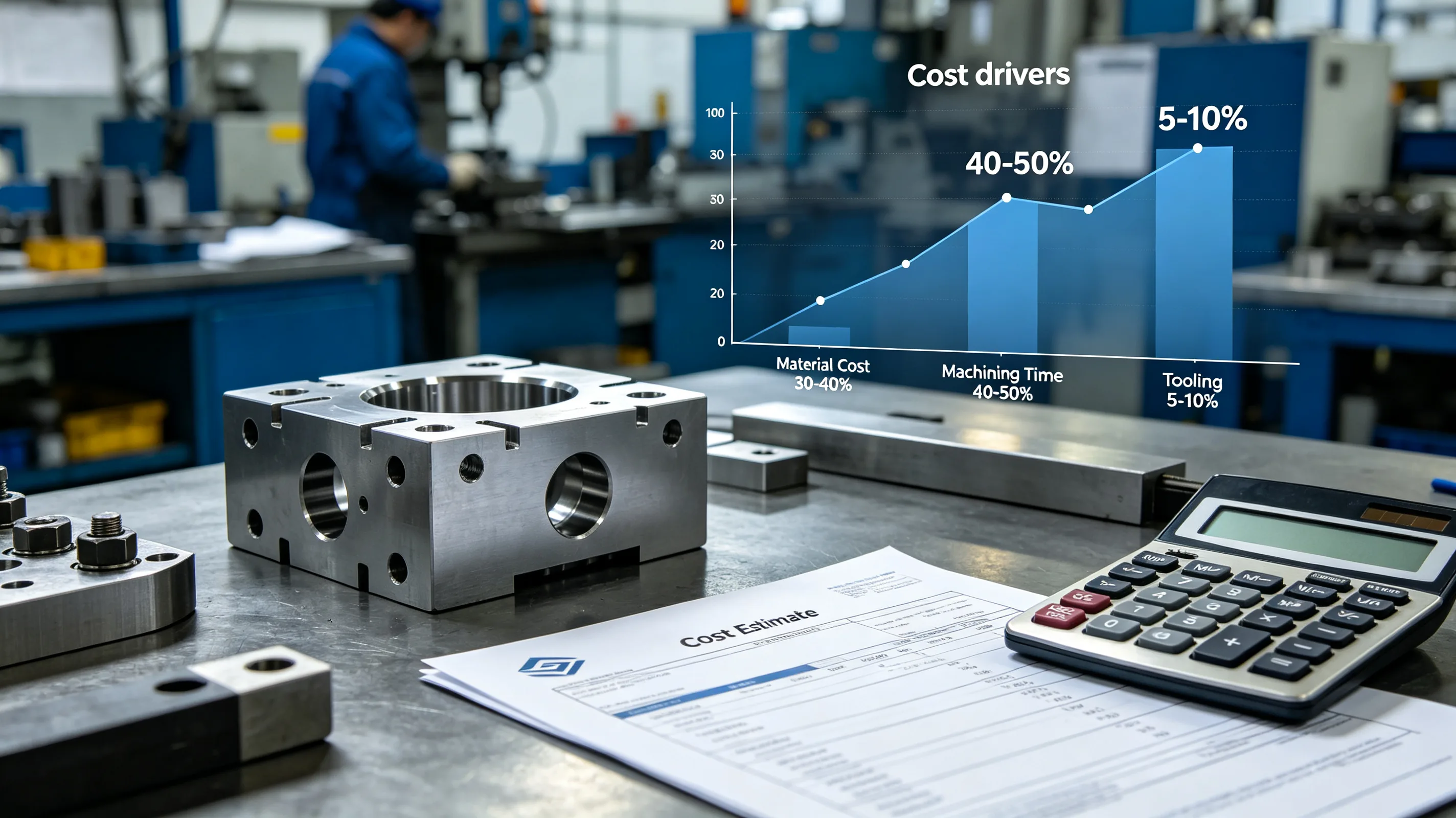
The cost of titanium CNC machined components is driven by factors that differ from those that determine the cost of steel or aluminum components. Material cost is higher, machining time is longer, tooling costs are greater, and inspection requirements are more extensive. Understanding these cost drivers helps procurement teams evaluate quotes accurately and design engineers make cost-effective design decisions. The supplier evaluation framework in the supplier selection guide provides context for how cost factors influence supplier capability assessment, and the manufacturer profile of a titanium-specialist illustrates how these cost controls are documented in practice.
Material cost
Titanium raw material cost is significantly higher than steel or aluminum. CP Grade 2 is typically 2 to 3 times the cost of stainless steel per kilogram. Ti-6Al-4V is 3 to 5 times the cost of stainless steel. Beta alloys can be 5 to 10 times the cost of stainless steel.
The material product form affects cost. Plate is generally less expensive than bar of equivalent cross-section. Sheet is more expensive per kilogram than plate because of the additional processing required. Forgings are more expensive than plate but may reduce total component cost by reducing the material that must be machined away.
Material availability affects cost and lead time. Ti-6Al-4V in standard sizes and product forms is widely available and competitively priced. Non-standard sizes and less common alloys may require special mill runs with extended lead times and premium pricing. Material costs are subject to surcharges based on raw material commodity prices, which can fluctuate significantly. To estimate the raw material weight for your component geometry, use our titanium weight calculator.
Machining time
Machining time is the largest cost component for most titanium components, typically accounting for 50 to 70 percent of the total component cost. Titanium machines at 20 to 30 percent of the cutting speed of steel, so the machining time for equivalent features is 3 to 5 times longer.
The material removal rate in titanium roughing is limited by thermal considerations rather than machine power. Increasing the material removal rate generates more heat at the cutting interface, which accelerates tool wear and can lead to tool failure. The economic material removal rate — the rate that minimizes total cost including tooling — is typically lower than the maximum rate the machine tool can achieve.
Complex features increase machining time disproportionately. Deep pockets require multiple passes and slow feed rates. Thin walls require multiple finishing passes. Tight tolerances require in-process probing and may require separate roughing and finishing operations on different machine tools.
Tooling cost
Tooling cost per component is higher for titanium than for steel or aluminum because tools wear faster and must be replaced more frequently. A carbide end mill that machines 50 steel components before replacement may machine only 5 to 10 titanium components before replacement.
The tool cost per component depends on the tool type and quality. Premium carbide grades and specialized coatings designed for titanium increase tool cost per unit but may reduce cost per component by extending tool life. The economic tool selection balances the higher tool cost against the reduced tool change frequency and improved process reliability.
Tool holders and fixturing are one-time costs that are spread across the production quantity. For low-volume production, the fixturing cost can be a significant fraction of the total component cost. For high-volume production, the fixturing cost is amortized and becomes negligible.
Geometry complexity
Geometry complexity affects cost through its influence on machining time, tooling, and fixturing. Simple geometries — flat surfaces, straight bores, external contours — can be machined quickly with standard tooling. Complex geometries — deep pockets, thin walls, tight internal corners, multiple angles — require specialized tooling, slower machining rates, and more extensive inspection.
The cost impact of geometry complexity is non-linear. A component with a single complex feature may cost 20 to 30 percent more than a simple component of the same size. A component with multiple complex features can cost 100 to 200 percent more.
The aspect ratio of thin walls is a specific geometry complexity factor that has a large cost impact. Walls with aspect ratios above 10 to 1 require specialized machining strategies that increase cycle time by 50 to 100 percent compared to walls with aspect ratios below 8 to 1.
Quantity effects
The component cost decreases with quantity as setup costs, tooling costs, and programming costs are spread over more components. The quantity effect is more significant for titanium than for steel because the setup and programming costs are higher relative to the per-component machining cost.
For quantities below 50 components, the setup and programming costs can account for 30 to 50 percent of the total cost. For quantities above 500 components, the per-component cost is dominated by the machining time and tooling costs.
Because material cost, machining time, and tooling interact differently for every geometry, an accurate estimate requires a specific part review — submit your drawing through our engineering RFQ portal and receive a detailed quotation within 48 hours.
Table 1: Cost factors for titanium CNC machining
| Cost factor | Typical contribution | Primary control |
|---|---|---|
| Material | 15–0% of total | Grade selection, stock form optimization |
| Machining time | 50–0% of total | Feature geometry simplification |
| Tooling | 5–5% of total | Tool selection, tool life optimization |
| Setup and programming | 5–0% of total | Quantity grouping, repeat orders |
| Inspection | 3–0% of total | Tolerance rationalization |