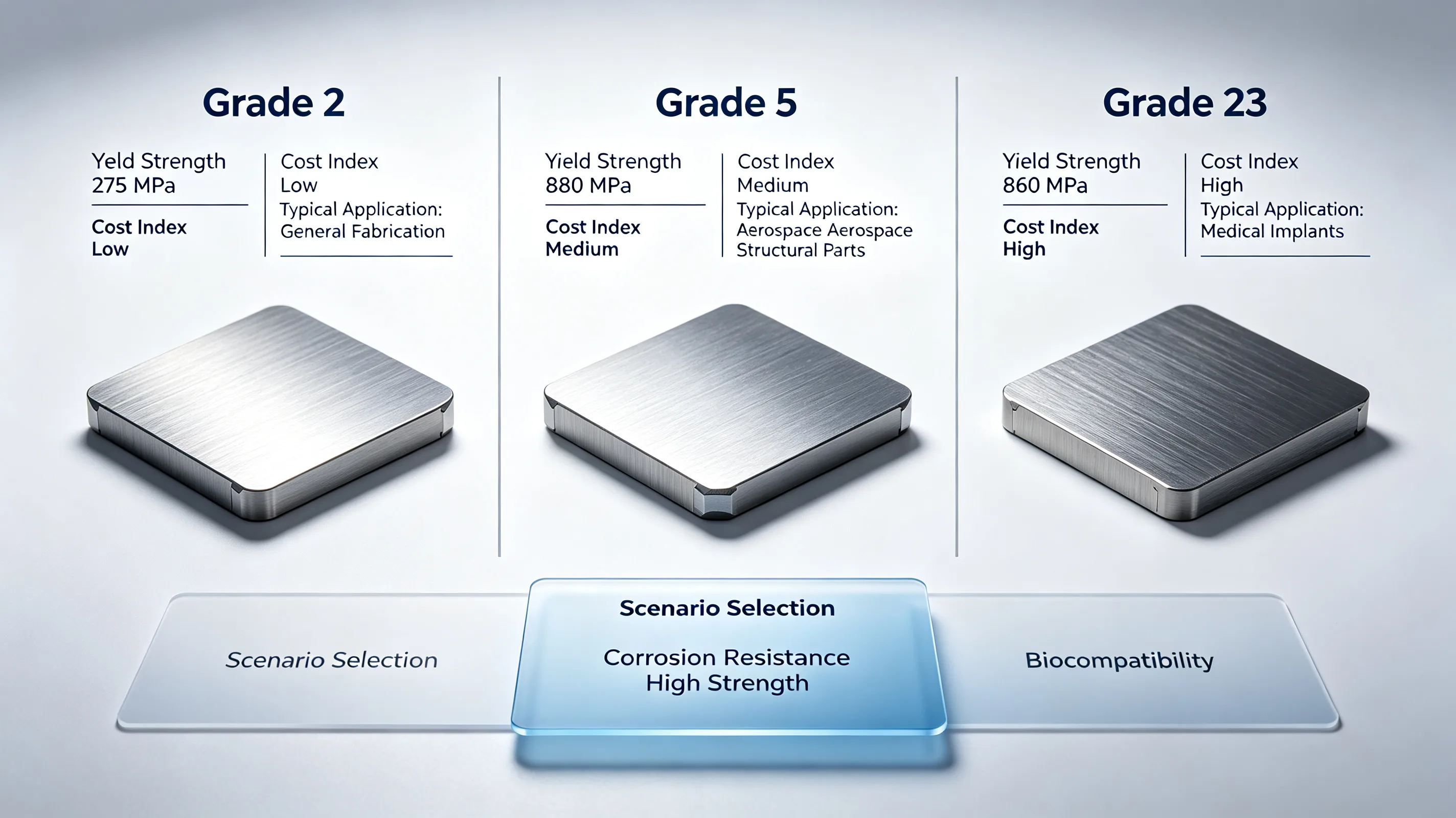
The choice between Grade 2, Grade 5, and Grade 23 titanium is not a materials engineering question — it is a procurement decision that affects component cost by 40 to 60 percent, lead time by 8 to 20 weeks, and supplier qualification requirements in ways that are rarely captured in a standard RFQ process. Grade 2 serves non-load-bearing chemical processing and marine components where moderate tensile strength around 345 MPa is acceptable, but it cannot substitute for Grade 5 in aerospace structural applications requiring 895 MPa tensile strength. Grade 5 offers roughly three times the tensile strength of Grade 2 with comparable general corrosion resistance, making it the standard for high-stress aerospace and automotive components, though its lower thermal conductivity — approximately 6.7 W/m·K versus 16.4 W/m·K for Grade 2 — introduces machining heat concentration problems that many procurement teams underestimate during cost estimation. Grade 23 provides improved fracture toughness and damage tolerance for medical implants and critical aerospace rotating components due to reduced interstitial oxygen and iron content, but carries longer lead times because of stricter mill certification and raw material traceability requirements. None of these grades universally outperforms the others across all metrics — the correct selection depends on balancing mechanical requirements against manufacturing constraints, certification complexity, and real supply chain reliability. For a broader overview of all titanium alloy categories, see the titanium grades complete guide.
The Cost Reality: What Each Grade Actually Costs in Production
The material price per kilogram tells only part of the story. The total delivered cost of a titanium component — including material, machining, heat treatment, certification, and quality assurance — differs far more between grades than raw material pricing alone suggests.
Grade 2 sheet and plate typically costs 30 to 50 percent less than Grade 5 on a per-kilogram basis, though the price gap narrows for bar stock and shrinks further for small-diameter wire. More importantly, Grade 2 machines at approximately 60 to 80 surface feet per minute with carbide tooling, produces continuous chips that evacuate easily, and requires only air furnace stress relief rather than vacuum heat treatment. The total manufacturing cost difference between a Grade 2 component and an equivalent Grade 5 component often reaches 40 to 60 percent when machining, heat treatment, and certification are combined.
Grade 5 and Grade 23 machine at 30 to 50 surface feet per minute — roughly half the speed of Grade 2 — and generate cutting forces roughly 40 percent higher. Carbide tools cutting Grade 5 typically require indexing or replacement after 15 to 25 minutes of accumulated cutting time, compared to 40 to 60 minutes for Grade 2 under comparable conditions. Heat treatment for both grades requires vacuum or inert gas furnaces to prevent alpha case formation — an oxygen-enriched surface layer that must be removed by chemical milling or machining, adding 15 to 25 percent to processing cost.
Grade 23 commands a premium of approximately 15 to 30 percent over Grade 5 because of stricter compositional control during mill processing and the limited number of mills qualified to produce ELI-grade material with certified traceability. During the 2021 to 2023 titanium supply cycle, Grade 23 lead times extended to 26 to 32 weeks for mill-ordered material, compared to 8 to 14 weeks for Grade 2 and 12 to 18 weeks for Grade 5, creating scheduling risks that many project plans did not anticipate.
Total Cost Comparison by Grade
| Cost Factor | Grade 2 | Grade 5 | Grade 23 |
|---|---|---|---|
| Relative material cost (per kg) | Baseline | 1.5–2.0x Grade 2 | 1.8–2.6x Grade 2 |
| Typical machining speed (SFM) | 60–80 | 30–50 | 30–50 |
| Tool life (minutes per cutting edge) | 40–60 | 15–25 | 15–25 |
| Heat treatment furnace required | Air | Vacuum or inert gas | Vacuum or inert gas |
| Heat treatment cost adder | None | +15–25% to processing | +15–25% to processing |
| Typical mill lead time (weeks) | 8–14 | 12–18 | 18–32 |
| Certification complexity | Standard | Standard | Enhanced traceability |
| Third-party testing required | Rarely | Occasionally | Often required |
The cost differences extend beyond machining and heat treatment. Certification requirements for Grade 23 typically demand full mill traceability from ingot to finished product, including compositional verification at multiple processing stages. Many aerospace and medical procurement specifications for Grade 23 also require independent third-party testing of mechanical properties from each heat-treated lot, adding 2 to 4 weeks to the production schedule and several hundred dollars per lot in testing costs.
When Grade 2 Delivers Better Value Than Grade 5
The most frequent procurement error in titanium component sourcing is specifying Grade 5 when Grade 2 would serve the application at substantially lower cost. When wall thickness is not constrained by weight or packaging limitations, Grade 2 can frequently serve the structural role at a material cost saving of 30 to 50 percent, with the added benefit of better corrosion performance and simpler fabrication.
Grade 2 is the correct choice when:
- The required tensile strength is below 380 MPa (yield) or 515 MPa (ultimate)
- The component will operate below 200 degrees Celsius in corrosive environments
- The component geometry requires extensive cold forming, bending, or welding
- Weight reduction is not a primary design objective
- The component serves in chemical processing, marine, or industrial equipment rather than aerospace or medical
The section thickness trade-off: Grade 2 requires approximately 2.5 to 3 times the section thickness of Grade 5 to match load capacity. This thickness penalty must be weighed against the material price difference. In many market conditions, the thicker Grade 2 solution costs less overall for non-aerospace applications, particularly when the simpler fabrication requirements are factored in. A pressure vessel liner in Grade 2, for example, can often be fabricated and welded in 30 percent less time than an equivalent Grade 5 assembly, offsetting the increased material volume.
A practical example: A chemical processing pipe spool rated for 5 MPa operating pressure at 150 degrees Celsius. Grade 2 requires a 5 mm wall thickness. Grade 5 requires a 2 mm wall thickness. The Grade 2 material cost is approximately 60 percent of the Grade 5 cost per kilogram, but 2.5 times more material is needed. The net material cost is approximately 1.5 times the Grade 5 material cost — but the Grade 2 component requires no vacuum heat treatment, no alpha case removal, and can be welded without post-weld heat treatment. The total fabricated cost of the Grade 2 spool is typically 10 to 20 percent lower than the Grade 5 equivalent.
When Grade 5 Is the Only Practical Option
Grade 5 justifies its higher cost when the application demands strength that Grade 2 cannot provide, or when weight constraints make thicker sections unacceptable. In aerospace structural components, medical device applications, and high-performance automotive parts, Grade 5 is the standard for good reason.
Grade 5 is required when:
- Tensile strength above 515 MPa is necessary (Grade 2 cannot reach this range regardless of cold work)
- The component serves in a flight-critical or safety-critical structural role
- Operating temperatures exceed 200 degrees Celsius for extended periods
- Weight reduction is a design requirement that cannot be met with thicker sections
- The component must meet aerospace material specifications such as AMS 4911 or AMS 4928
For a detailed discussion of Grade 5 properties and machining characteristics, see the Grade 5 titanium guide.
The heat treatment reality: Grade 5 in the annealed condition delivers approximately 895 MPa tensile strength. In the solution-treated and aged condition, it can reach 1100 to 1200 MPa. However, STA treatment requires vacuum or inert gas furnaces with temperature uniformity within ±10 degrees Celsius across the load, and the cooling rate from solution temperature must be controlled to achieve the desired alpha-beta microstructure. Not all suppliers with vacuum furnace capacity can achieve this level of control. Procurement teams specifying Grade 5 STA should verify the supplier’s furnace capability and temperature uniformity survey results, not just the presence of vacuum equipment.
When Grade 23 Premium Is Justified
Grade 23 (Ti-6Al-4V ELI) costs 15 to 30 percent more than Grade 5 and carries 6 to 14 weeks longer lead time. The premium is justified only when the application requires the enhanced fracture toughness or biocompatibility that the reduced interstitial content provides. For a detailed discussion of Grade 23 properties, see the Grade 23 titanium guide.
Grade 23 is justified when:
- The component is a permanent surgical implant requiring biocompatibility per ASTM F136
- The application involves cyclic loading with stress concentrations that would make Grade 5 crack propagation life unacceptable
- The component operates at cryogenic temperatures where Grade 23’s lower ductile-to-brittle transition temperature matters
- The procurement specification explicitly requires ELI-grade material for fracture-critical aerospace rotating components
The fracture toughness difference in practice: Grade 23 typically delivers fracture toughness values of 75 to 90 MPa·m½ compared to 60 to 75 MPa·m½ for Grade 5. In aerospace rotating components and medical implants subjected to cyclic loading, this higher fracture toughness translates directly into longer crack propagation life. A component that meets the static strength requirement in Grade 5 may fail prematurely under cyclic loading if the application involves stress concentrations or surface discontinuities, whereas Grade 23 would tolerate the same defect population for a significantly longer service period.
A procurement consideration: The lead time difference between Grade 5 and Grade 23 can reach 14 weeks. For programs where Grade 23 material availability threatens the production schedule, a qualified substitution to Grade 5 with a modified fracture toughness acceptance criterion may be acceptable, provided the design authority approves the change. Some programs maintain dual-grade qualification specifically to allow this substitution flexibility. The material substitution must be validated through the applicable change management process, but the scheduling flexibility alone can prevent program delays.
How Supplier Capability Requirements Differ by Grade
The most common procurement mistake in titanium sourcing is evaluating suppliers based on general CNC capacity rather than grade-specific processing capability. Grade 2, Grade 5, and Grade 23 each require different equipment, process controls, and operator experience. A supplier that performs well on Grade 2 work may lack the capability for Grade 5 or Grade 23.
Grade 2 supplier requirements are the least demanding. Standard CNC equipment with conventional coolant systems (10 to 20 bar) is adequate. Welding can be performed with standard GTAW equipment without post-weld heat treatment. Stress relief, when required, can be performed in air furnaces. A supplier with general metalworking experience can typically achieve acceptable results on Grade 2 components after a reasonable learning period.
Grade 5 supplier requirements are substantially more demanding. High-pressure coolant systems (50 to 70 bar minimum, 70+ bar preferred) are necessary to achieve acceptable tool life and surface finish. Vacuum or inert gas furnace capability is required for solution treatment and aging. Welding operators must be qualified for alpha-beta alloys, and post-weld heat treatment is typically required to restore ductility in the heat-affected zone. The learning curve for effective Grade 5 machining can extend several months for shops transitioning from aluminum and steel work.
Grade 23 supplier requirements include everything required for Grade 5, plus stricter controls. Furnace atmosphere control must be tighter to prevent oxygen pickup above 0.13 percent. Passivation bath chemistry must be qualified specifically for Grade 23, as the lower oxygen content produces a different electrochemical response than Grade 5. Cleanroom or controlled-environment processing may be required for medical implant applications. Suppliers must maintain enhanced traceability systems that track material from ingot to finished component.
Supplier Capability Assessment by Grade
| Capability Requirement | Grade 2 | Grade 5 | Grade 23 |
|---|---|---|---|
| High-pressure coolant (50+ bar) | Nice-to-have | Required | Required |
| Vacuum furnace for heat treatment | Not needed | Required | Required |
| Controlled atmosphere (O₂ < 50 ppm) | Not needed | Required | Critical |
| Alpha-beta alloy welding qualification | Not needed | Required | Required |
| Post-weld heat treatment capability | Rarely needed | Required | Required |
| Full material traceability system | Standard | Standard | Enhanced |
| Cleanroom or controlled environment | Not needed | Not needed | Often required |
| AS9100D or ISO 13485 certification | Nice-to-have | Often required | Usually required |
Procurement Decision Matrix: Grade 2 vs Grade 5 vs Grade 23
The following decision matrix provides a structured framework for procurement teams to determine which grade to specify based on the application requirements.
| Decision Factor | Choose Grade 2 | Choose Grade 5 | Choose Grade 23 |
|---|---|---|---|
| Required tensile strength | Below 515 MPa | 515–1100 MPa | 860–930 MPa (with fracture toughness requirement) |
| Operating temperature | Below 200°C | Up to 400°C (600°F) | Up to 400°C (600°F) |
| Weight sensitivity | Low | High | High |
| Cyclic loading severity | Low to moderate | Moderate to high | High (with stress concentrations) |
| Corrosion environment | Standard industrial | Similar to Grade 2 | Similar to Grade 5 |
| Biocompatibility required | No | No | Yes (implants) |
| Cold forming required | Yes | Limited | Limited |
| Welding complexity | Low | Moderate (requires PWHT) | Moderate (requires PWHT) |
| Budget sensitivity | High | Moderate | Low (mission-critical) |
| Schedule flexibility | High | Moderate | Low (longest lead time) |
How RFQ Requirements Differ for Each Grade
The level of specification required in the RFQ varies significantly between grades. Grade 2 RFQs are relatively straightforward — the main risk is under-specifying the required condition (annealed versus stress relieved) and the applicable ASTM standard. Grade 5 and Grade 23 RFQs require more detailed specification to avoid costly mismatches.
For Grade 2 RFQs, specify the ASTM standard (typically ASTM B265 for sheet, ASTM B348 for bar, or ASTM B381 for forgings), the required condition (annealed is standard), and any special corrosion testing requirements if the component serves in a specific chemical environment.
For Grade 5 RFQs, in addition to the ASTM standard, specify:
- The required condition: annealed, solution treated and aged (STA), or stress relieved
- The acceptable alpha case depth after heat treatment (typically 0.010 to 0.025 mm for fatigue-critical applications)
- Whether post-weld heat treatment is required for welded assemblies
- The acceptable oxygen and iron limits if tighter than the grade specification (particularly important for fracture-critical applications)
- Certification requirements: mill test reports, mechanical property verification, and traceability documentation
For Grade 23 RFQs, in addition to the Grade 5 requirements, specify:
- The ELI oxygen limit (0.13 percent maximum) and iron limit (0.10 percent maximum) per ASTM F136 or ASTM B348
- Biocompatibility testing requirements if the component serves as a medical implant (per ISO 10993 or applicable standard)
- Cleanliness and surface finish requirements specific to medical or aerospace applications
- Independent third-party testing of mechanical properties from each heat-treated lot
- Full material traceability from ingot to finished component
Common RFQ Omissions by Grade
| Specification Element | Grade 2 | Grade 5 | Grade 23 |
|---|---|---|---|
| Grade without standard revision year | Common | Less common | Rare |
| Condition not specified | Common | Common | Occasional |
| Alpha case depth not specified | Not applicable | Very common | Common |
| Post-weld heat treatment not specified | Rare | Common | Common |
| Certification format not defined | Common | Common | Common |
| Surface finish without functional context | Common | Common | Common |
A well-structured RFQ that accounts for grade-specific requirements reduces the risk of receiving components that meet the material specification but do not satisfy the application requirements. The difference between a specification that says “titanium, aerospace grade” and one that says “Ti-6Al-4V per ASTM B348 Grade 5, annealed, with maximum alpha case depth 0.015 mm after heat treatment” can determine whether a program meets its first-article deadline or enters the costly cycle of rework and requalification.
Material Availability and Supply Chain Considerations
The material supply situation differs significantly across the three grades, and these differences affect procurement planning in ways that go beyond price.
Grade 2 supply is the most stable of the three. Multiple domestic and international mill sources produce Grade 2 in all product forms. Mill lead times of 8 to 14 weeks are typical, and spot material is frequently available from service centers at a modest premium over mill pricing. The broad supply base means that supply disruptions affecting one mill can usually be absorbed by others without significant market impact.
Grade 5 supply is adequate but subject to periodic tightness driven by aerospace demand cycles. During peak aerospace production periods, Grade 5 mill lead times can extend to 18 to 22 weeks, and spot material premiums can reach 20 to 30 percent over contract pricing. Procurement teams should maintain qualified backup sources for Grade 5 material and consider forward purchasing for programs with confirmed production schedules.
Grade 23 supply is the most constrained of the three. The limited number of mills holding ELI certification and passing the more stringent compositional control requirements creates a supply bottleneck that affects both lead time and pricing. During the 2021 to 2023 supply cycle, Grade 23 lead times extended to 26 to 32 weeks, and some programs experienced material allocation from mills. Procurement teams planning Grade 23 programs should confirm mill availability early in the planning cycle, ideally before the component design is finalized, to avoid scheduling conflicts.
The substitution option: When Grade 23 lead times extend beyond program schedules, Grade 5 with a modified fracture toughness acceptance criterion can serve as a qualified substitute in many applications, provided the design authority approves. Some manufacturers maintain dual-grade qualification for critical components specifically to allow this flexibility. The substitution must be validated through engineering change management, but the scheduling flexibility alone can prevent program delays.
Three Critical Procurement Rules for Titanium Grade Selection
Rule 1: Never specify Grade 5 or Grade 23 based on strength alone. If the application can be served by a thicker section of Grade 2, the total cost will almost always be lower, and the fabrication will be simpler. Evaluate the section thickness penalty before committing to an alloyed grade.
Rule 2: Always verify Grade 23 requirements before specifying it. Grade 23 adds 15 to 30 percent material cost and 6 to 14 weeks lead time over Grade 5. If the application does not require ELI-level fracture toughness or biocompatibility, Grade 5 is almost always the more practical choice.
Rule 3: Qualify suppliers for the specific grade, not titanium in general. A supplier’s experience with Grade 2 does not translate to Grade 5 capability. A supplier’s Grade 5 experience does not automatically qualify them for Grade 23. Verify equipment capability, process qualifications, and operator experience for the specific grade you intend to source.
For engineering teams and procurement professionals evaluating titanium suppliers, reviewing grade-specific process qualifications and asking targeted questions about mill source relationships and certification lead times before committing to a delivery schedule will prevent mismatches that would otherwise emerge during first-article inspection. A titanium CNC machining manufacturer with documented grade-specific qualifications demonstrates this evaluation in practice.
For a grade-specific quotation, submit your requirements through our RFQ portal.