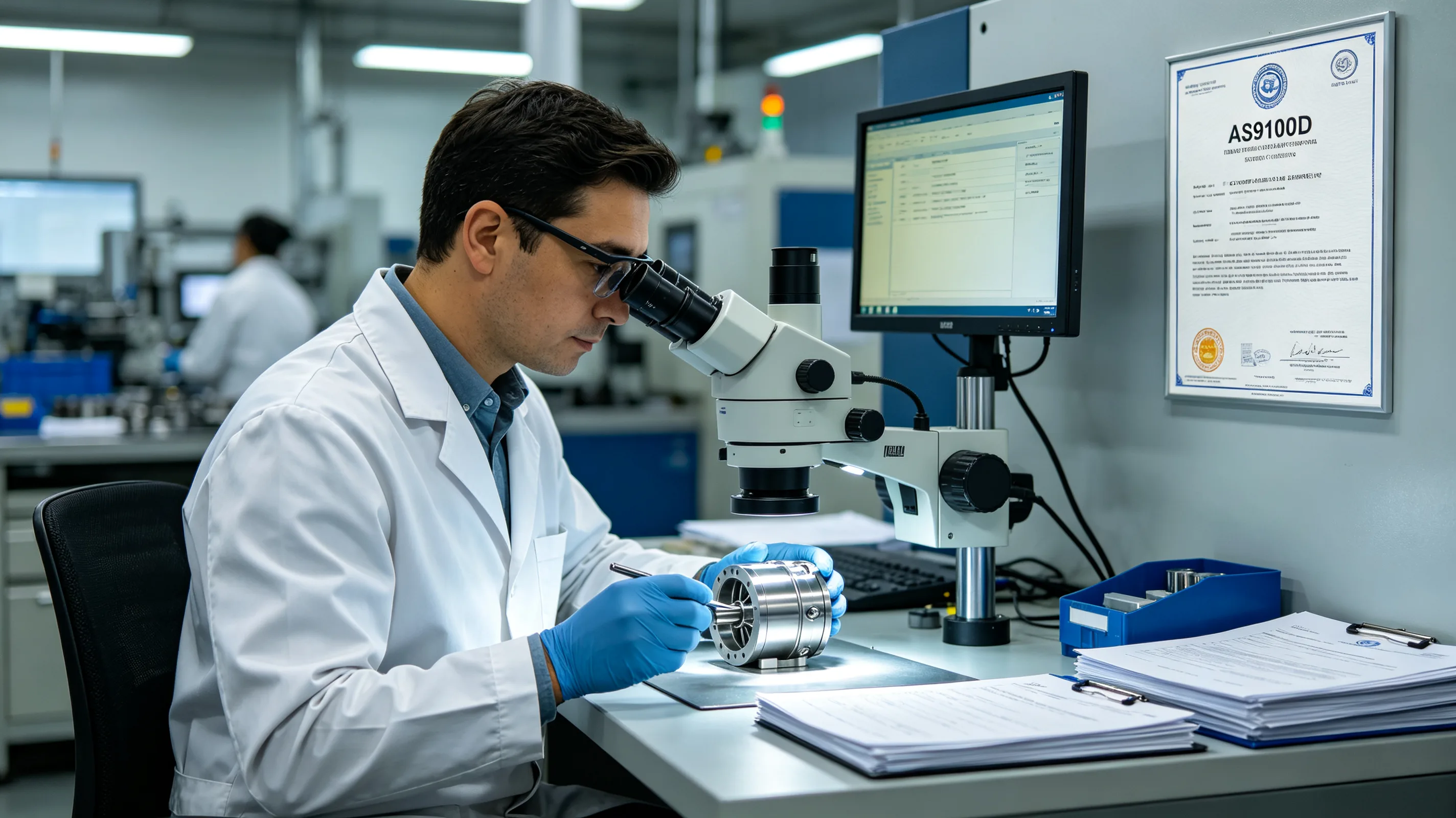
AS9100D is the quality management system standard for aerospace manufacturing, replacing the earlier AS9100C revision. For titanium CNC machining suppliers, AS9100D certification demonstrates that the organization has implemented a quality management system that meets aerospace industry requirements for design, development, production, and delivery of aerospace products. Understanding what AS9100D certification actually covers — and what it does not cover — is important for procurement teams evaluating titanium machining suppliers for aerospace work. The manufacturing capabilities page provides an overview of the production systems that operate under AS9100D quality controls, and our AS9100D titanium CNC machining supplier page documents the quality and traceability systems behind that certification.
What AS9100D certification covers
AS9100D is based on ISO 9001:2015 with additional aerospace-specific requirements. The standard requires the supplier to have a documented quality management system that includes risk management, configuration management, product safety, and counterfeit part prevention. For titanium machining suppliers, the certification applies to the production processes — CNC machining, inspection, material handling, and delivery.
The certification audit evaluates whether the supplier’s quality system meets the standard requirements, not whether any specific part or process meets specification. A supplier can be AS9100D certified for titanium CNC machining while still producing non-conforming parts from time to time — the certification demonstrates that the supplier has systems in place to detect and correct non-conformances, not that non-conformances never occur.
For procurement teams, AS9100D certification provides confidence that the supplier has established processes for material traceability, inspection record keeping, non-conformance management, and corrective action. These are the process areas that most commonly cause problems in aerospace titanium procurement — missing material certifications, incomplete inspection records, and recurring quality issues that are not systematically addressed.
Risk management and process control requirements
AS9100D requires the supplier to identify and manage risks throughout the production process. For titanium machining, this means the supplier must have documented risk assessments for each part or part family, identifying the process steps where quality could be affected and the controls in place to prevent defects.
The risk assessment should cover material receiving — verifying that incoming titanium stock has the required certifications and that the material is properly identified and segregated. It should cover the machining process itself — tool wear monitoring, coolant condition, and inspection frequency. It should cover post-machining operations — deburring, cleaning, surface treatment, and final inspection. A supplier that performs thorough risk assessments will have fewer quality surprises than one that relies on final inspection alone to catch defects.
Configuration management is a specific AS9100D requirement that matters for titanium components subject to engineering changes. When an aerospace customer revises a drawing or specification, the supplier must have a system to ensure that the latest revision is used for production and that obsolete documents are removed from the workstations. Configuration management failures are a common source of non-conformances in aerospace production, and AS9100D certification indicates that the supplier has addressed this risk.
Material traceability requirements
Material traceability is one of the most important AS9100D requirements for titanium machining. The standard requires that the supplier maintain traceability from the raw material supplier through each production operation to the finished component. For titanium, this means the supplier must be able to link each finished component back to the specific heat number and material certification for the stock it was machined from.
The traceability system must include the material certification documents themselves — mill test reports or material test reports that document the chemical composition and mechanical properties of the material. These documents must be reviewed when the material is received to verify that the material meets the purchase specification. For aerospace titanium, the material certification must include the results of the required testing — tensile strength, yield strength, elongation, and any additional tests specified by the procurement standard.
Traceability also extends to process chemicals and consumables that could affect the material properties. Coolants, cleaning agents, and surface treatment chemicals must be specified and controlled to prevent contamination or degradation of the titanium surface. While not all AS9100D audits verify consumable traceability in detail, a robust system will include controls for these items.
What AS9100D does not guarantee
AS9100D certification does not guarantee that a supplier can machine titanium to the required tolerances for every component type. The certification audits the quality management system, not the technical capability. A supplier may be certified for general aerospace machining but lack the specific experience with thin-wall titanium features, deep-pocket machining, or tight-tolerance work that a particular component requires.
The certification does not guarantee that the supplier has the specific equipment needed for titanium — high-pressure coolant systems, suitable spindle power, or appropriate machine tools for the component size range. These capability factors are evaluated through the supplier’s own risk assessment process but are not specifically verified by the certification audit.
For procurement teams, AS9100D certification is a prerequisite for aerospace titanium machining work, but it should be supplemented by a technical capability assessment that addresses the specific requirements of the component or program. A titanium-specialist manufacturer profile is a practical starting point for that technical capability assessment. The certification answers the question “does the supplier have a quality management system?” but not “can the supplier machine this specific titanium component to the required tolerances?”
Table 1: AS9100D key requirements for titanium machining suppliers
| Requirement | What it means for titanium machining | Verification method |
|---|---|---|
| Risk management | Documented risk assessment for each part family | Audit of risk documentation |
| Configuration management | Controlled drawing revision system | Audit of document control |
| Material traceability | Heat number traceability, MTC verification | Production record audit |
| Non-conformance management | Documented corrective action system | Audit of non-conformance records |
| Process control | Defined process parameters, inspection points | Audit of work instructions |
| Supplier management | Approved supplier list for titanium stock | Audit of purchasing system |
When evaluating an AS9100D-certified supplier for your program, submit your RFQ and request the quality documentation relevant to your component.