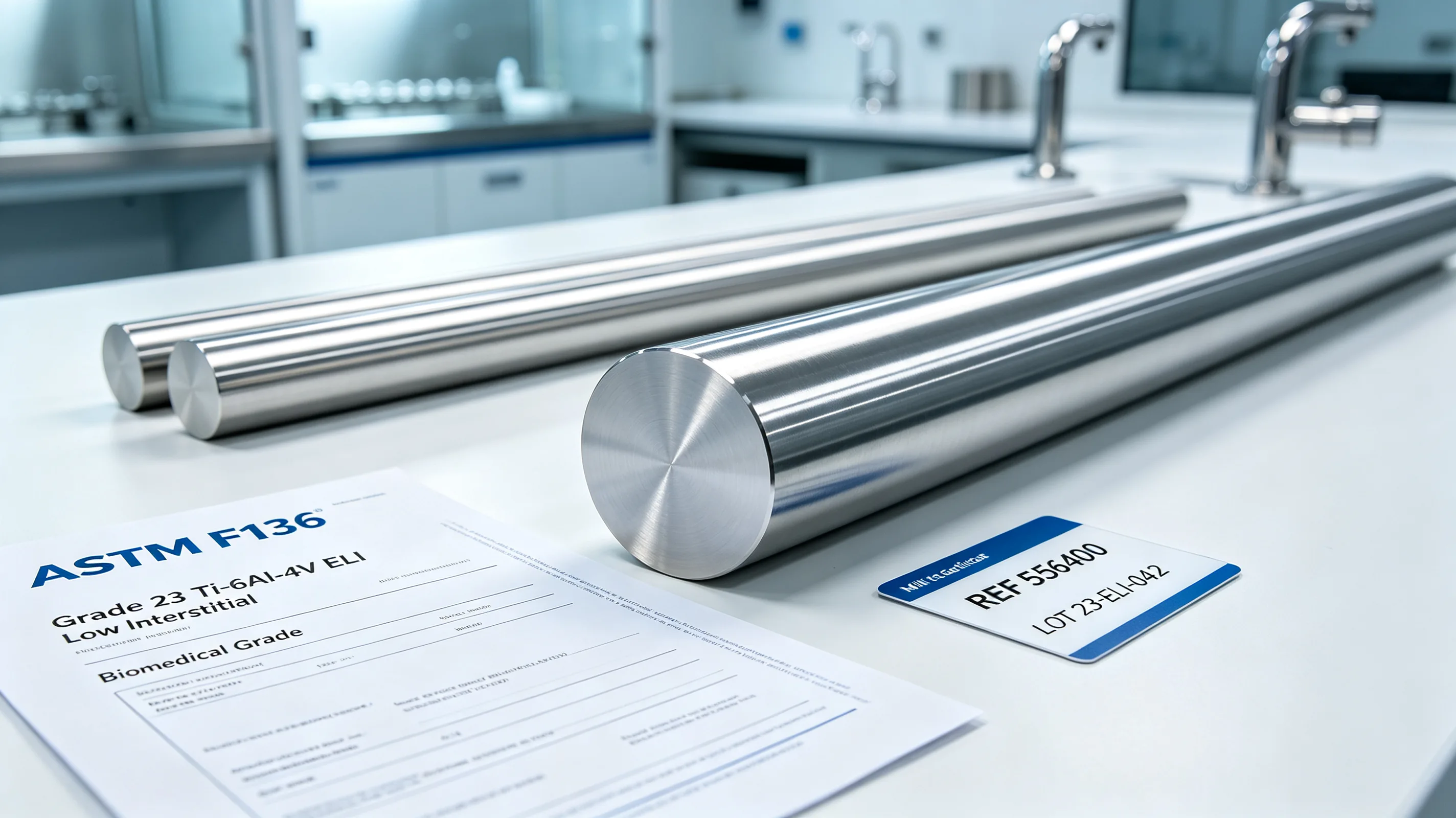
ASTM F136 is the governing material standard for wrought Ti-6Al-4V ELI (Extra Low Interstitial) titanium used in surgical implant applications. It defines the chemical composition limits, mechanical property minima, microstructure requirements, and certification obligations that distinguish implant-grade material from commercial-grade Ti-6Al-4V. Understanding what ASTM F136 actually requires — and what it does not — is essential for medical device manufacturers sourcing material, design engineers specifying implant alloys, and procurement teams evaluating supplier certifications. ASTM F136 is frequently referenced alongside ASTM F1472, which covers standard Ti-6Al-4V for surgical implants, and the distinction between these two standards is one of the most common sources of specification errors in medical device manufacturing. For a broader overview of titanium grades used in medical applications, see the Grade 23 titanium guide and the medical titanium implants manufacturing standards article.
What Is ASTM F136?
ASTM F136, formally titled “Standard Specification for Wrought Titanium-6Aluminum-4Vanadium ELI (Extra Low Interstitial) Alloy for Surgical Implant Applications (UNS R56401),” is the primary material standard for the medical-grade variant of Ti-6Al-4V. It was developed by ASTM Committee F04 on Medical and Surgical Materials and Devices and is maintained as an active standard with periodic revisions.
The standard covers the following product forms:
- Bar and billet
- Sheet, strip, and plate
- Wire
- Forgings (when specified as ELI grade)
ASTM F136 does not cover cast Ti-6Al-4V ELI (which falls under ASTM F1108), finished implant components, or material intended for applications other than surgical implants. It is a raw material standard, not a component standard. The distinction matters because many procurement documents mistakenly reference ASTM F136 for finished-component requirements that are better addressed by ISO 13485 or FDA design control documentation.
Chemical Composition Requirements Under ASTM F136
The defining feature of ASTM F136 is its restrictive control of interstitial elements — particularly oxygen — that distinguish it from standard Ti-6Al-4V specifications.
Table 1: ASTM F136 chemical composition limits (percent by weight)
| Element | ASTM F136 (Grade 23 ELI) | ASTM F1472 (Grade 5, surgical) | Significance of difference |
|---|---|---|---|
| Oxygen, max | 0.13 | 0.20 | The key differentiator — lower O improves fracture toughness |
| Nitrogen, max | 0.05 | 0.05 | Same limit in both standards |
| Carbon, max | 0.08 | 0.08 | Same limit in both standards |
| Hydrogen, max | 0.015 (bar), 0.012 (sheet) | 0.015 (bar), 0.012 (sheet) | Same limit in both standards |
| Iron, max | 0.25 | 0.30 | Tighter Fe limit in F136 improves ductility |
| Aluminum | 5.5–6.5 | 5.5–6.5 | Identical range |
| Vanadium | 3.5–4.5 | 3.5–4.5 | Identical range |
| Titanium | Balance | Balance | — |
| Residuals, each max | 0.10 | 0.10 | Same limit |
| Residuals, total max | 0.40 | 0.40 | Same limit |
The 0.07 percent oxygen difference between ASTM F136 (0.13 percent max) and ASTM F1472 (0.20 percent max) is small in absolute terms but large in engineering effect. Oxygen is a potent alpha-phase strengthener in titanium: each 0.01 percent increase raises tensile strength by approximately 8 MPa while reducing elongation by roughly 0.5 percentage points. The lower oxygen limit in ASTM F136 produces material with slightly lower strength but significantly higher fracture toughness and ductility — properties that are critical for implant components subject to fatigue loading.
Why oxygen control matters for implants
The biological environment in which implants function imposes constraints that commercial-grade Ti-6Al-4V does not satisfy. Reduced interstitial content translates to:
- Higher fracture toughness (KIC): Typically 70–85 MPa√m for ASTM F136 material versus 50–65 MPa√m for standard Grade 5. This difference is decisive in load-bearing orthopedic implants where crack propagation must be minimized.
- Improved fatigue crack growth resistance: ASTM F136 material exhibits slower crack propagation rates under cyclic loading, directly extending the safe inspection interval for implant components.
- Reduced notch sensitivity: Threaded implant designs — bone screws, pedicle screws, dental abutments — rely on this property to maintain structural integrity at stress concentrations.
Mechanical Property Requirements
ASTM F136 specifies minimum mechanical properties for the annealed condition. Material supplied in other conditions (cold-worked, aged) must meet the requirements specified in the procurement document and may require additional testing.
Table 2: ASTM F136 minimum mechanical property requirements (annealed condition)
| Property | Requirement | Typical values for ASTM F136 material |
|---|---|---|
| Tensile strength, min | 860 MPa (125 ksi) | 895–960 MPa |
| Yield strength, 0.2% offset, min | 795 MPa (115 ksi) | 830–900 MPa |
| Elongation, min | 10% | 12–15% |
| Reduction of area, min | 25% | 30–40% |
These values are approximately 5–10 percent lower than the corresponding requirements for standard Ti-6Al-4V per ASTM F1472. The reduction is not a quality compromise — it is the direct consequence of the lower interstitial content that provides the fracture toughness advantage.
Microstructure requirements
ASTM F136 does not mandate a specific microstructure but requires that the material be free of continuous alpha-case layers and undesirable grain boundary phases. The microstructure is typically evaluated at 100–500× magnification per ASTM E3 metallographic preparation standards. Most implant manufacturers specify a microstructure consisting of equiaxed primary alpha in a transformed beta matrix, with primary alpha volume fraction typically in the 40–60 percent range for annealed bar stock.
Alpha case formation during thermal processing must be removed by machining or chemical milling before the material is used in implant components. Alpha case — an oxygen-enriched surface layer that forms during hot working or heat treatment without inert atmosphere protection — is brittle and can initiate cracking under fatigue loading. ASTM F136 compliance requires that the supplier demonstrate adequate atmosphere control during any thermal processing operations.
Certification and Traceability Requirements
ASTM F136 requires that each lot of material be accompanied by a mill test report (MTR) certifying:
- Chemical composition per the limits in Table 1 above
- Mechanical properties per Table 2 above
- Melt identification and lot number
- Product form and dimensions
- Heat treatment condition (if applicable)
- The number of pieces and their individual identification marks
The certification requirements under ASTM F136 are identical in scope to those for other titanium mill product standards. What differs in practice is the level of traceability expected by implant manufacturers. Medical device companies typically require:
- EN 10204 Type 3.1 certification as the minimum acceptable documentation level
- Type 3.2 certification (third-party witnessed inspection) for critical implant components at many major OEMs
- Direct mill-to-manufacturer traceability — material distributed through service centers must retain original mill identification, and any re-certification by intermediate distributors must reference the original mill lot
The practical certification problem
A recurring issue in medical device procurement is the acceptance of EN 10204 Type 2.2 certifications (declaration of compliance without test results) for ASTM F136 material. Type 2.2 documents do not include actual test data — they state only that the material “conforms” to the standard. Most implant manufacturers and regulatory auditors require Type 3.1 or higher. Procurement teams should verify the certification level required by their quality system before placing orders, because the lead time difference between Type 2.2 and Type 3.1 material can be 4 to 8 weeks.
ASTM F136 vs ASTM F1472: When Each Standard Applies
ASTM F1472 covers standard Ti-6Al-4V (Grade 5, UNS R56400) for surgical implant applications. The standard exists because some implant components do not require ELI-level fracture toughness — particularly non-load-bearing devices, temporary fixation hardware, and surgical instruments.
Table 3: Decision guide — ASTM F136 vs ASTM F1472
| Application scenario | Recommended standard | Rationale |
|---|---|---|
| Permanent load-bearing orthopedic implant (hip stem, knee component) | ASTM F136 | ELI fracture toughness required for long-term fatigue performance |
| Permanent spinal implant (pedicle screw, rod, cage) | ASTM F136 | Fatigue-critical; notch sensitivity at thread roots requires ELI properties |
| Permanent dental implant | ASTM F136 | Small cross-section; reduced notch sensitivity critical |
| Temporary fixation hardware (bone plate, external fixator pin) | ASTM F136 or F1472 | Evaluate based on expected service duration and loading severity |
| Surgical instrument (drill, tap, reamer) | ASTM F1472 | Instrument-grade; ELI properties not required for short-term use |
| Non-load-bearing implant (mesh, staple) | ASTM F1472 or CP-Ti per ASTM F67 | Strength requirements lower; ELI premium unjustified |
Three Practical Procurement Rules for ASTM F136 Material
Rule 1: Verify the certification level before the order, not during receiving inspection.
The default certification provided by many titanium mills for ASTM F136 material is EN 10204 Type 3.1. However, some distributors offer Type 2.2 documentation at a lower price. If your quality system requires test data for each lot — which most ISO 13485-certified manufacturers do — Type 2.2 material will fail receiving inspection. Specify the required certification level in the purchase order and verify supplier capability to deliver it.
Rule 2: Confirm beta transus temperature with each lot if heat treatment is planned.
ASTM F136 does not require the supplier to report beta transus temperature on the MTR. If you plan to perform solution treatment and aging or any thermal processing that requires knowing the beta transus (typically 980–1,010°C for ELI grade), request this data from the mill. The beta transus of ELI material is approximately 10–20°C lower than standard Grade 5 due to reduced oxygen content.
Rule 3: Never accept ASTM F136 material with alpha case from the mill.
Alpha case is not permitted under ASTM F136, but material that has been hot-rolled or forged without adequate atmosphere control may arrive with an alpha case layer. Specify in the purchase order that any alpha case must be removed and that the supplier must certify the removal method and the final surface condition. The cost of removing alpha case after receiving inspection is typically 2–5 percent of material value — small enough to overlook but large enough to cause process delays when it is discovered during first-article inspection.
For medical device engineering teams and procurement professionals evaluating titanium suppliers for implant-grade components, verifying that the supplier has documented experience with ASTM F136 certification requirements, maintains cleanroom-capable production areas, and provides EN 10204 Type 3.1 documentation as standard practice will prevent the most common causes of receiving rejection. A titanium CNC machining and fabrication partner with documented medical-device process qualifications can provide the material sourcing and certification support needed.
For a quotation on ASTM F136-certified Grade 23 components with full certification and material traceability, submit your requirements through our RFQ portal.