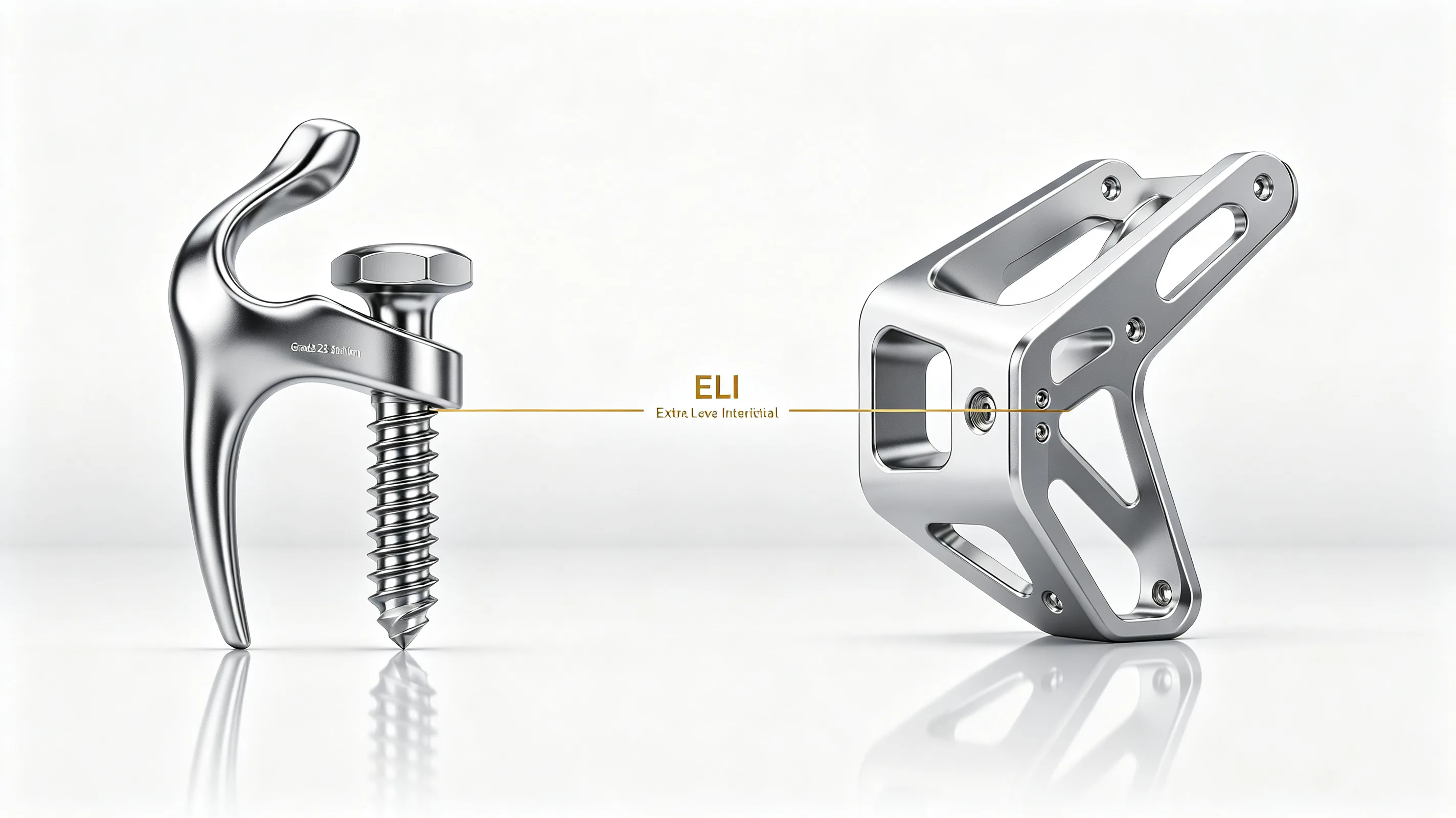
Grade 23 titanium, also designated Ti-6Al-4V ELI, is a version of the standard Ti-6Al-4V alloy with controlled lower limits on interstitial elements — oxygen, carbon, and iron. The reduced interstitial content improves ductility and fracture toughness while maintaining essentially the same strength as the standard grade. These characteristics make Grade 23 the standard material for surgical implant applications and for aerospace components requiring enhanced damage tolerance. For a comparison with the standard Grade 5 composition, see the Grade 5 titanium guide.
Composition and property differences from Grade 5
The primary difference between Grade 23 and Grade 5 is the maximum oxygen content. Grade 23 limits oxygen to 0.13 percent by weight, compared to 0.20 percent for Grade 5. The lower oxygen content reduces solid-solution strengthening in the alpha phase, producing a material with slightly lower strength but significantly higher ductility and fracture toughness.
The tensile strength of Grade 23 in the annealed condition is 860 to 960 MPa, compared to 900 to 1000 MPa for Grade 5. The yield strength is 790 to 900 MPa, compared to 830 to 950 MPa. The elongation is 12 to 18 percent, compared to 10 to 15 percent for Grade 5. The fracture toughness is typically 20 to 40 percent higher than Grade 5, depending on the specific heat treatment condition.
The lower interstitial content also improves the material’s response to fatigue loading. Grade 23 has a higher fatigue crack growth resistance than Grade 5, which is important for components subject to cyclic loading where crack propagation rates determine the inspection interval and service life. The improvement in fatigue performance is most pronounced in the low-cycle, high-stress regime relevant to orthopedic implants.
All other physical properties — density 4.43 g/cm³, elastic modulus 105 to 115 GPa, thermal conductivity 7 W/m·K — are identical to Grade 5. The thermal and mechanical processing responses are also similar, with the exception that Grade 23 requires slightly more careful control during heat treatment because its lower interstitial content makes it more sensitive to oxygen pickup during thermal processing.
Biocompatibility and medical applications
Grade 23 is the most widely specified titanium alloy for permanent medical implants. Its combination of high strength, excellent corrosion resistance, and proven biocompatibility makes it suitable for load-bearing orthopedic and dental applications. The material has been used in clinical applications for more than four decades, and its long-term performance is well documented.
The biocompatibility of Grade 23 is determined by its surface oxide layer, which forms spontaneously in air and in bodily fluids. The oxide layer is chemically stable and isolates the underlying metal from the biological environment. The release of metal ions from Grade 23 in vivo is minimal, and the concentrations are well below levels associated with adverse biological responses.
Common orthopedic applications include hip stems, femoral heads, knee components, bone plates, screws, and spinal fixation hardware. The alloy is also used for dental implants, maxillofacial plates, and cardiovascular device components. For each application, the specific heat treatment and surface finish are optimized for the mechanical and biological requirements.
The surface condition of Grade 23 implants affects both mechanical performance and biological response. Roughened surfaces promote bone integration for cementless implants. Polished surfaces are used for articulating components where wear resistance is required. The surface treatment — which may include grit blasting, plasma spraying, or acid etching — is specified as part of the implant design and must be applied without compromising the material’s corrosion resistance or fatigue strength.
Aerospace applications requiring enhanced toughness
In aerospace applications, Grade 23 is specified where fracture toughness or damage tolerance is the governing design criterion rather than absolute strength. The higher fracture toughness of Grade 23 compared to Grade 5 provides greater resistance to crack propagation, which translates into longer inspection intervals and higher residual strength in the presence of damage.
Grade 23 is used in aerospace for components subject to high cyclic loads where crack growth must be predictable and slow. Examples include pressure vessel hardware, structural fittings, and components in fatigue-critical locations. The material is also used in cryogenic applications where the improved low-temperature ductility of the ELI grade provides additional margin against brittle fracture.
The aerospace specification for Grade 23 typically requires additional verification testing beyond the ASTM material standard. Flight-critical components may require fracture toughness testing on each production lot, with minimum K₁c values specified in the procurement document. The testing adds to the material cost and lead time but provides the confidence required for safety-critical applications.
Machining considerations for Grade 23
Grade 23 machines similarly to Grade 5 in most respects. The cutting speed range, feed rates, and coolant requirements are essentially the same. The slightly lower hardness of Grade 23 compared to STA Grade 5 can provide a marginal improvement in tool life, typically 5 to 10 percent, but the difference is small enough that tooling strategies developed for Grade 5 apply directly to Grade 23.
The primary machining difference between Grade 23 and Grade 5 is in the surface integrity requirements for medical implant components. Implant surfaces must be free of embedded contaminants, including carbide particles from tool wear and iron particles from machining or handling. Medical device manufacturers typically specify dedicated tooling for implant production to avoid cross-contamination from other materials.
The surface finish requirements for medical implant components are often specified as a maximum Ra value with additional requirements for the absence of surface defects visible at specified magnification. These requirements influence the finishing parameters selected — typically lower feed rates and sharp tools to produce clean, defect-free surfaces. The article on achieving Ra 0.4μm in titanium covers the finishing parameters applicable to Grade 23, and the alloy selection guide provides context on when Grade 23 is the appropriate choice compared to other titanium grades.
Cleanliness requirements for medical implant production extend to the machining environment itself. Implant machining is typically performed in a controlled area separate from general production, with dedicated coolant systems and chip handling to prevent contamination. The machined components are cleaned and passivated after machining to restore the protective oxide layer before packaging and sterilization.
Table 1: Grade 23 vs Grade 5 property comparison
| Property | Grade 5 (Ti-6Al-4V) | Grade 23 (Ti-6Al-4V ELI) | Significance |
|---|---|---|---|
| Max oxygen content | 0.20% | 0.13% | Controls ductility and toughness |
| Tensile strength, annealed | 900–000 MPa | 860–60 MPa | Slightly lower for ELI |
| Elongation | 10–5% | 12–8% | Higher ductility for ELI |
| Fracture toughness | 50–0 MPa√m | 70–00 MPa√m | 20–0% higher for ELI |
| Fatigue crack growth rate | Baseline | Reduced | Longer inspection intervals |
| Density / Modulus | 4.43 / 105–15 | 4.43 / 105–15 | Identical |
| Machinability | Baseline | Similar to slightly better | Marginal improvement |