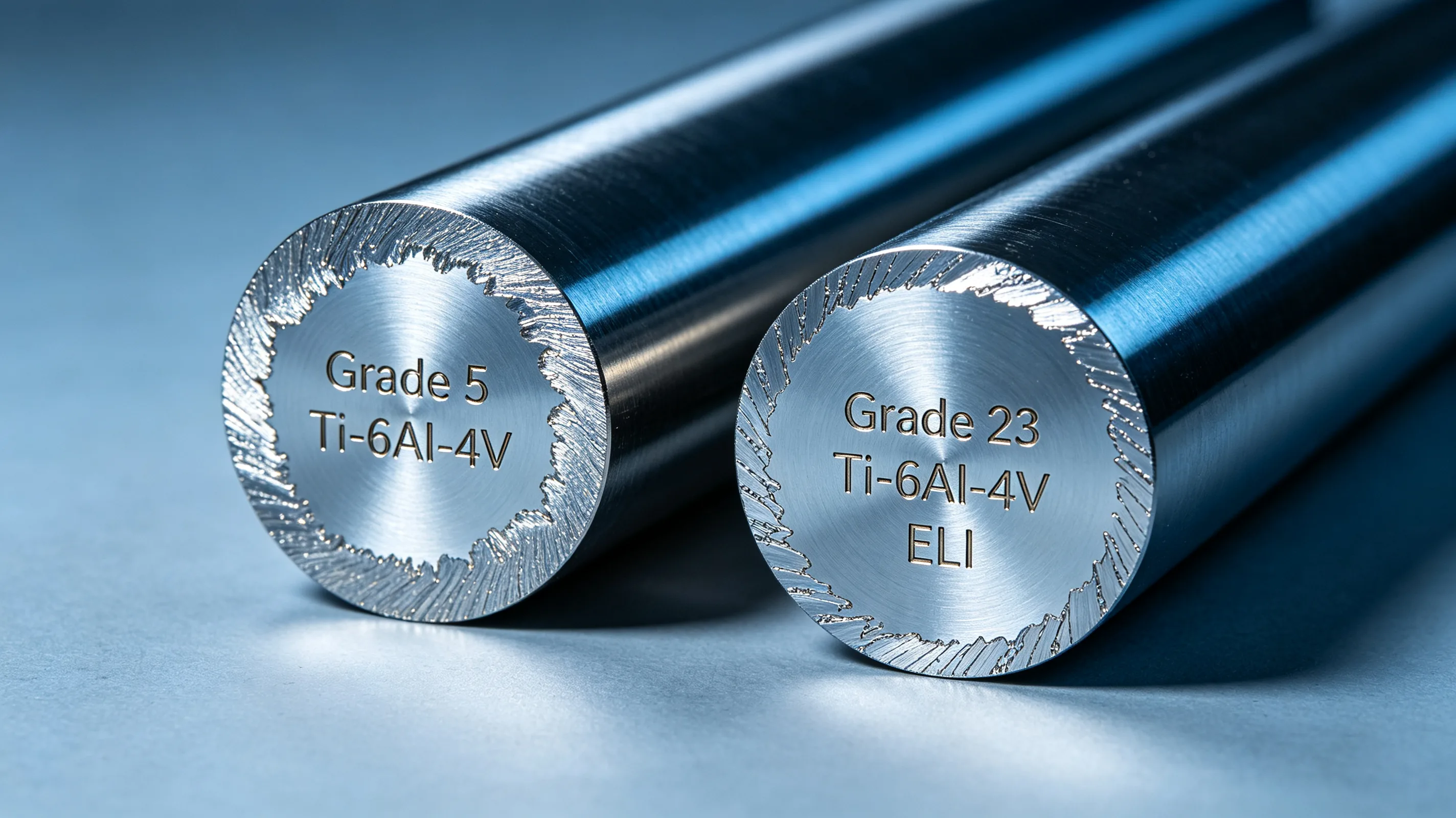
Grade 23 (Ti-6Al-4V ELI) and Grade 5 (Ti-6Al-4V) are the same base composition — 6 percent aluminum, 4 percent vanadium, balance titanium — separated by a single number: the maximum oxygen content. Grade 5 allows 0.20 percent oxygen. Grade 23 limits oxygen to 0.13 percent. That 0.07 percent difference produces a material with measurably different engineering properties: Grade 23 offers 30–40 percent higher fracture toughness and better fatigue crack growth resistance at the cost of 4–8 percent lower tensile strength and a 15–30 percent material price premium. Neither grade is universally superior. The correct choice depends on whether the application needs the toughness or can tolerate the standard grade’s lower ductility. For a complete overview of all titanium alloy classifications, see the titanium grades complete guide. For detailed reference data on each grade, see the Grade 23 titanium guide, the Grade 5 titanium guide, and the ASTM F136 standard guide.
Chemical Composition: What Actually Differs
The composition difference between Grade 23 and Grade 5 is smaller than most engineers assume. Of the seven controlled elements, only two differ between the specifications.
Table 1: Composition comparison — Grade 23 vs Grade 5 (percent by weight)
| Element | Grade 5 (ASTM F1472) | Grade 23 ELI (ASTM F136) | Difference |
|---|---|---|---|
| Oxygen, max | 0.20 | 0.13 | −35% |
| Iron, max | 0.30 | 0.25 | −17% |
| Nitrogen, max | 0.05 | 0.05 | None |
| Carbon, max | 0.08 | 0.08 | None |
| Hydrogen, max | 0.015 (bar), 0.012 (sheet) | 0.015 (bar), 0.012 (sheet) | None |
| Aluminum | 5.5–6.5 | 5.5–6.5 | None |
| Vanadium | 3.5–4.5 | 3.5–4.5 | None |
The oxygen reduction from 0.20% to 0.13% is the entire story. The iron reduction from 0.30% to 0.25% has a measurable but secondary effect on ductility. The other five controlled elements are identical between the two specifications.
What the composition difference means metallurgically
Oxygen dissolves interstitially in the alpha-phase titanium lattice. Each oxygen atom occupies an octahedral site between titanium atoms and impedes dislocation motion. This interstitial solid-solution strengthening mechanism is highly efficient: approximately 8–10 MPa of additional tensile strength per 0.01 percent oxygen, with a corresponding ductility penalty of roughly 0.5 percentage points of elongation.
Standard Grade 5 at 0.20 percent oxygen receives the full benefit of this mechanism — higher strength, lower ductility. Grade 23 at 0.13 percent oxygen is de-strengthened by 45–60 MPa relative to Grade 5, but gains 3–5 percentage points of elongation and, more importantly, a 30–40 percent improvement in fracture toughness. The trade-off is favorable for fatigue-critical applications because the increase in toughness is proportionally much larger than the decrease in strength.
Mechanical Properties: The Quantitative Comparison
Table 2: Room-temperature mechanical property comparison — Grade 23 vs Grade 5
| Property | Grade 5 (annealed) | Grade 23 ELI (annealed) | Advantage | Engineering impact |
|---|---|---|---|---|
| Tensile strength, min (MPa) | 895 | 860 | Grade 5 (+4%) | Grade 5 carries higher static load capacity |
| Yield strength, 0.2% offset, min (MPa) | 828 | 795 | Grade 5 (+4%) | Grade 5 supports higher proof stress |
| Elongation, min (%) | 10 | 10 | Same spec | ELI typically achieves higher actual values (12–15%) |
| Reduction of area, min (%) | 25 | 25 | Same spec | ELI typically achieves 30–40% |
| Fracture toughness KIC (MPa√m) | 50–65 | 70–85 | Grade 23 (+30–40%) | Critical for implant fatigue life |
| Fatigue crack growth rate (da/dN) | Baseline | ~20–30% lower | Grade 23 | Longer inspection intervals |
| Notch sensitivity | Higher | Lower | Grade 23 | Safer for threaded and notched designs |
| Density (g/cm³) | 4.43 | 4.43 | Equal | No weight penalty for ELI |
| Elastic modulus (GPa) | 114 | 114 | Equal | Identical stiffness behavior |
| Thermal conductivity (W/m·K) | 7.2 | 7.2 | Equal | Identical machining heat behavior |
| Max service temperature (°C) | 400 | 400 | Equal | No temperature benefit for ELI |
The table shows that the only meaningful mechanical property advantage for Grade 5 is in tensile and yield strength — both approximately 4 percent higher. The Grade 23 advantages are in fracture toughness (30–40 percent higher), fatigue crack growth resistance (20–30 percent lower), and notch sensitivity (lower). None of the physical properties differ.
The fracture toughness gap in context
The KIC difference between Grade 23 (70–85 MPa√m) and Grade 5 (50–65 MPa√m) is not a marginal improvement. In fracture-critical design, allowable crack size before unstable propagation scales with the square of fracture toughness. A Grade 23 component with KIC of 80 MPa√m can tolerate a crack approximately 1.6 times larger at the same applied stress than a Grade 5 component with KIC of 60 MPa√m before failure. For medical implants where crack detection during service is limited and inspection intervals are long — hip stems, spinal rods, dental implants — this difference determines whether the design achieves the required fatigue life.
Machinability and Manufacturing Differences
A common assumption among procurement teams is that Grade 23, being “softer” due to lower oxygen, machines faster or with longer tool life than Grade 5. The actual difference is smaller than expected.
Cutting speed and tool life: Grade 23 in the annealed condition has approximately 5–10 percent longer tool edge life than Grade 5 in the same condition at equivalent cutting parameters. The difference is detectable in production tool life tracking but is not large enough to justify a separate tooling strategy. A tooling program developed for Grade 5 — carbide insert grade, cutting speed of 30–50 m/min (100–165 SFM), feed rate of 0.10–0.30 mm/rev (0.004–0.012 in/rev) — is directly applicable to Grade 23 without modification.
Surface integrity requirements — this is where the real difference lies: The machining difference between Grade 23 and Grade 5 in medical implant production is not in the cutting mechanics — it is in the surface integrity requirements. Medical implant specifications typically require:
- Surface roughness Ra ≤ 0.4 μm for most machined surfaces, and Ra ≤ 0.1 μm for articulating surfaces
- Zero embedded carbide particles from tool wear (verified at 50–200× microscopic inspection)
- Zero iron contamination from tool holders, fixtures, or previous material runs
- Dedicated tooling for implant production to eliminate cross-contamination
These requirements apply to the manufacturing process, not to the material itself. A supplier with medical-grade capability can machine Grade 5 to these standards. A supplier without medical-grade capability cannot machine either grade to implant specifications, regardless of which is selected.
Cost implications: The total manufacturing cost of a Grade 23 component versus an equivalent Grade 5 component breaks down as follows:
Table 3: Cost comparison — Grade 23 vs Grade 5 component
| Cost element | Grade 5 | Grade 23 | Difference | Notes |
|---|---|---|---|---|
| Raw material (per kg, bar stock) | Baseline | +15–30% | $15–30/kg premium | Varies with product form and quantity |
| Machining (per hour) | Baseline | Baseline | Negligible | Same speeds, feeds, tooling |
| Heat treatment (vacuum anneal) | Baseline | Baseline | Negligible | Same cycle parameters |
| Certification documentation | EN 10204 3.1 | EN 10204 3.1 | Negligible | Same documentation scope |
| Fracture toughness testing | Not required unless specified | Typically required for medical lots | +$500–1,500/lot | Per-lot cost, not per-part |
| Surface finish (medical-grade) | Same cost as Grade 23 | Same cost as Grade 23 | Negligible | Surface finish requirement drives cost, not the grade |
The total component cost premium for Grade 23 versus Grade 5 ranges from 10–25 percent, driven almost entirely by the raw material price difference. The manufacturing and certification costs are equivalent for the same component specification.
Cryogenic Performance: Where Grade 23 Has No Substitute
The one application area where Grade 23 is irreplaceable by Grade 5 is cryogenic service. Standard Ti-6Al-4V (Grade 5) undergoes a ductile-to-brittle transition at temperatures below approximately −100°C. Fracture toughness drops below 40 MPa√m at liquid nitrogen temperature (−196°C), and the material becomes unsafe for pressure-containing cryogenic components.
Grade 23 maintains KIC above 60 MPa√m at −196°C and remains ductile at liquid hydrogen temperature (−253°C). This cryogenic toughness is a direct consequence of the reduced oxygen content — oxygen embrittlement at low temperatures scales with interstitial oxygen concentration, and the 0.13 percent limit in Grade 23 keeps the material above the embrittlement threshold.
Applications where Grade 23 is required and Grade 5 is not a substitute:
- LNG processing equipment — pumps, valves, piping operating at −162°C
- Liquid hydrogen storage and transport vessels — operating at −253°C
- Cryogenic pressure vessels per ASME Section VIII Division 1 and 2
- Low-temperature aerospace structural components per NASA and ESA requirements
- Superconducting magnet containment structures
Decision Guide: Grade 23 vs Grade 5
Table 4: Selection criteria — when to specify each grade
| Application scenario | Best choice | Why |
|---|---|---|
| Permanent load-bearing orthopedic implant (hip, knee, trauma) | Grade 23 | Fracture toughness and fatigue resistance required for decades-long service |
| Permanent spinal implant (pedicle screw, rod, cage) | Grade 23 | Notch sensitivity at thread roots demands ELI properties |
| Dental implant | Grade 23 | Small cross-section; reduced notch sensitivity critical |
| Aerospace structural component, room temperature | Grade 5 | Grade 5 strength adequate; Grade 23 premium unnecessary |
| Aerospace component, cryogenic service (−150°C and below) | Grade 23 | Grade 5 embrittles at cryogenic temperatures |
| LNG processing equipment | Grade 23 | Cryogenic toughness required by code |
| Surgical instrument (drill, saw, reamer) | Grade 5 | ELI properties not needed; Grade 5 saves 15–30% |
| Temporary fixation hardware (external fixator, bone clamp) | Grade 5 or Grade 23 | Evaluate based on expected service duration |
| High-performance automotive component (connecting rod, valve) | Grade 5 | STA-condition Grade 5 offers 1,070 MPa tensile strength — higher than Grade 23 |
| Marine propeller or shaft | Grade 5 | Corrosion requirements identical; Grade 5 more cost-effective |
| Non-load-bearing implant (mesh, staple, clip) | CP-Ti Grade 4 or Grade 5 | ELI premium is unjustified for non-load-bearing components |
Three Practical Rules for the Grade 23 vs Grade 5 Decision
Rule 1: If the application does not require fracture-critical or cryogenic performance, specify Grade 5.
The 15–30 percent material cost premium for Grade 23 buys fracture toughness and cryogenic ductility. If your application operates above −100°C and is not subject to cyclic fatigue loading where crack propagation determines component life, Grade 5 provides equivalent performance at lower cost. The most common specification error we encounter is Grade 23 being specified for components where standard Grade 5 is adequate — particularly non-implant surgical tools, temporary fixation hardware, and room-temperature structural brackets.
Rule 2: For load-bearing medical implants, Grade 23 is the default — never substitute Grade 5 without regulatory review.
FDA and ISO 13485 quality systems require material verification per the specification listed in the device design history file. If the design specifies Grade 23, substituting Grade 5 is a design change requiring regulatory notification, biocompatibility re-evaluation, and in most cases, a new 510(k) submission. The cost savings are not worth the regulatory risk.
Rule 3: Verify the mill certification for Grade 23 — not all material labeled “ELI” meets ASTM F136.
Grade 23 must be certified per ASTM F136 with EN 10204 Type 3.1 documentation. Material labeled “Grade 23 equivalent” or “Ti-6Al-4V ELI — composition per mill certificate” without an explicit ASTM F136 reference may not satisfy regulatory auditors. The purchase order must state “Grade 23 Ti-6Al-4V ELI per ASTM F136 with Type 3.1 certification” — nothing less.
For engineering teams and procurement professionals evaluating Ti-6Al-4V specifications for medical, cryogenic, or fracture-critical applications, confirming that the selected grade is justified by the actual service conditions — and verifying that the supplier has documented experience with the specified grade’s certification and quality requirements — will prevent the most common specification errors. A titanium CNC machining and manufacturing partner with documented capability across both Grade 5 and Grade 23 can provide the material procurement support and certification verification needed for either grade.
For a grade-specific quotation with correct certification and traceability, submit your requirements through our RFQ portal.