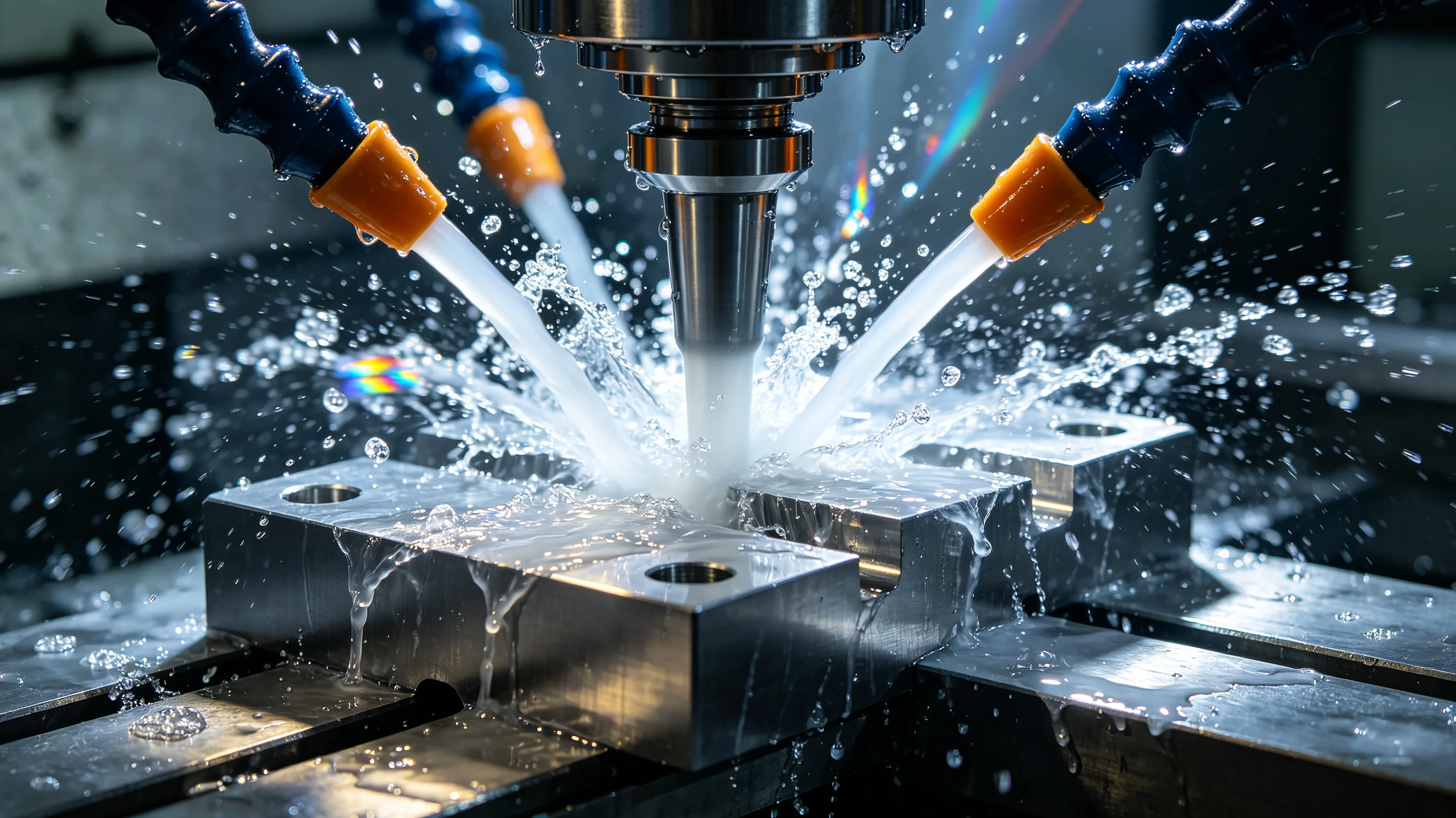
Coolant strategy in titanium machining is not a peripheral consideration — it is a primary process parameter that directly determines whether the cutting edge survives the operation. At the temperatures present at the titanium cutting interface — which can exceed 1000°C at the tool edge, as discussed in the article on why titanium is difficult to machine — coolant serves three simultaneous functions that are each critical: removing heat from the tool edge, lubricating the chip-tool contact zone, and evacuating chips from the cut area. A coolant system that performs adequately for steel or aluminum will fail at all three functions when machining titanium.
- Why titanium demands fundamentally different coolant performance
- Coolant pressure requirements for heat removal and chip evacuation
- Concentration control and coolant chemistry
- Coolant temperature stability over production runs
- Coolant delivery methods and their limitations
Why titanium demands fundamentally different coolant performance
In steel machining, coolant primarily serves two functions: lubricating the cutting interface and flushing chips away from the work area. Heat removal is a secondary benefit because the chip itself carries away most of the cutting heat. In titanium, this distribution shifts dramatically. The chip carries less heat because it is thinner and hotter, and the workpiece absorbs almost none of the cutting energy due to low thermal diffusivity. The tool absorbs the balance — which means the coolant must remove heat directly from the tool edge to prevent thermal softening of the binder phase.
The difference is visible in the temperature distribution during cutting. In steel machining, approximately 75 to 80 percent of the cutting heat leaves with the chip, 10 to 15 percent goes into the tool, and 5 to 10 percent goes into the workpiece. In titanium machining, the chip carries 50 to 60 percent, the tool absorbs 25 to 35 percent, and the workpiece takes the remainder. The tool in titanium cutting absorbs approximately three times more heat than the same tool cutting steel under comparable conditions. This is why a coolant system designed for steel will not keep the tool edge below the critical temperature threshold in titanium.
The lubricity requirement is also different. Titanium’s chemical reactivity means that at high temperatures, the chip-tool interface experiences adhesion that is stronger than in steel cutting. The coolant must provide a barrier film that reduces this adhesion. Without adequate lubricity, the microwelding at the interface accelerates, built-up edge forms, and the tool edge degrades rapidly. The lubricity requirement increases with cutting temperature, which means that coolant performance matters most at the exact point where the system is under the greatest thermal stress.
Chip evacuation in titanium is fundamentally different from chip evacuation in steel or aluminum. Titanium chips are not the tightly curled, easily managed chips of steel turning. They are segmented, often stringy, and they pack densely when confined. In deep-hole drilling, packed chips can seize the drill within a single hole cycle. In deep-pocket milling, chip accumulation in the pocket prevents fresh coolant from reaching the cutting edge and creates a localized thermal environment that accelerates tool failure.
Coolant pressure requirements for heat removal and chip evacuation
The coolant pressure required for titanium machining is determined by the chip evacuation requirement, not the heat removal requirement. Flood coolant at low pressure –5 to 10 bar — can remove heat from the general cutting zone, but it cannot force coolant into the tool-chip interface where the temperature is highest, and it cannot evacuate chips from deep features.
Through-spindle coolant delivery at 50 bar is the minimum effective pressure for general titanium machining. At this pressure, the coolant jet penetrates the chip-tool interface and provides lubrication and cooling at the point of contact. It also provides enough hydraulic force to break chips and flush them out of the cut zone. The improvement between 30 bar and 50 bar is noticeable — tool life increases, surface finish stabilizes, and chip-related process interruptions decrease.
At 70 bar and above, the coolant performance changes qualitatively. The high-pressure jet not only lubricates and cools but also acts as a hydraulic chip breaker. The coolant stream hits the chip at sufficient force to bend and break it, producing shorter, more manageable chip segments. This is particularly important in drilling and deep-pocket milling where chip evacuation is the primary process limitation. Shops that have upgraded from 50 bar to 70 bar systems report measurable improvements in process reliability, particularly for deep-hole drilling operations in titanium.
Above 100 bar, the coolant system requires specialized tooling and sealing. Tool holders must have sealed interfaces that prevent coolant leakage between the holder and the spindle. The coolant itself must be filtered to a finer level — typically below 50 microns — because high pressure can force contaminated particles through seals, causing wear on the coolant delivery system. The gains from increasing pressure above 100 bar are real but diminishing, and the system complexity and maintenance requirements increase significantly.
The pressure delivered at the cutting edge is not the same as the pressure at the pump. Losses in the coolant delivery system — through filters, seals, rotating unions, and tool holder channels — can reduce the pressure by 20 to 30 percent between the pump and the cutting edge. A system rated at 70 bar at the pump may deliver 50 bar at the tool, which is still effective but not at the expected performance level. This is why system pressure should be verified at the tool holder interface during process development, not assumed from the pump specification. BOZE’s titanium CNC machining capabilities include 70-bar through-spindle coolant systems that are verified at the tool holder as part of the standard machine qualification process.
Concentration control and coolant chemistry
Coolant concentration in titanium machining should be maintained in a tighter range than for general machining. The typical recommendation for semi-synthetic coolants in titanium is 8 to 10 percent concentration by volume. Below 8 percent, the lubricity drops and the coolant’s ability to form a barrier film at the chip-tool interface is reduced. Above 12 percent, the coolant becomes too viscous and may not penetrate the cutting interface effectively, and the higher chemical activity can cause skin irritation for operators and increased residue on machined parts.
Concentration drift is a persistent problem in production environments. Water evaporates from the coolant sump faster than the coolant concentrate, causing the concentration to increase over time if only water is added. When coolant is lost through chip carry-off and splashing, and fresh makeup coolant is added, the concentration can fluctuate significantly. In a typical production environment without active concentration control, the coolant concentration can vary from 5 to 15 percent over a production week.
The practical solution is daily concentration verification using a refractometer, with documented adjustments. Shops that maintain a daily concentration check report more consistent tool life and fewer surface finish issues than those that rely on weekly or bi-weekly checks. The time required for a refractometer check is approximately two minutes per machine, which is trivial compared to the cost of a scrapped part from a coolant-related tool failure.
Coolant chemistry selection affects titanium machining performance in ways that go beyond concentration. Coolants with high extreme-pressure additive content provide better lubricity at the high temperatures present in titanium cutting. Coolants formulated for aluminum or general-purpose machining may not contain sufficient EP additives for titanium. The coolant manufacturer’s recommendation for titanium-specific applications should be followed rather than assuming that a general-purpose coolant is adequate.
Tramp oil contamination is a secondary but significant issue. Hydraulic oil and way lubricant that leak into the coolant system reduce the coolant’s ability to wet the tool surface and form a lubricating film. Tramp oil also promotes bacterial growth, which degrades coolant performance over time. Skimmers and oil separators that remove tramp oil from the coolant sump should operate continuously in titanium machining environments.
Coolant temperature stability over production runs
Coolant temperature rises during production runs as the heat from cutting, spindle motors, and hydraulic systems is transferred to the coolant. In a machine running continuously for several hours, coolant temperature can rise from an initial 25°C to 40°C or higher. This temperature rise has direct consequences for tool life and process stability.
As coolant temperature increases, its viscosity decreases, and its ability to maintain a continuous lubricating film at the tool-chip interface is reduced. The higher temperature also reduces the temperature differential between the coolant and the cutting zone, which reduces the rate of heat transfer. The net effect is that as the coolant temperature rises through a production run, the tool operates at progressively higher temperatures even though the cutting parameters have not changed.
The change in tool temperature with coolant temperature is not linear. A coolant temperature increase from 25°C to 35°C may produce a tool edge temperature increase of 50 to 80°C, because the coolant’s heat removal efficiency drops faster than the temperature differential would suggest. This means that tool life predictions based on process development trials, which are typically conducted with cold coolant, overestimate the tool life that can be achieved in production.
Coolant chillers that maintain the coolant temperature within a range of 25 to 30°C are common in titanium machining environments that require consistent process performance. The chiller investment is justified by the improvement in tool life consistency and the reduction in unexpected tool failures. Without temperature control, the first parts of a production run are machined with effective cooling, and the later parts are machined with progressively less effective cooling, creating a systematic variation in tool life and surface quality across the run.
For shops that do not have coolant chillers, scheduling roughing and finishing operations on separate shifts or at different times of the day can reduce the impact of coolant temperature variation. Roughing operations, which generate the most heat, should be scheduled when the coolant system is cold. Finishing operations, which are more sensitive to temperature variation, should be scheduled after the coolant temperature has stabilized but before it reaches the maximum operating temperature.
Coolant delivery methods and their limitations
Through-spindle coolant is the preferred delivery method for titanium machining because it delivers coolant directly to the cutting edge through the tool holder and the tool itself. The coolant path is short and direct, with minimal pressure loss. The coolant reaches the cutting interface at the moment of engagement, providing immediate cooling and lubrication.
Flood coolant applied through external nozzles is significantly less effective for titanium. The coolant stream must travel from the nozzle to the cutting zone, and it can be deflected by the rotating tool and the chip stream. In deep pockets and internal features, external coolant may not reach the cutting edge at all. For operations where through-spindle coolant is not available, external nozzles should be positioned as close to the cutting zone as possible, ideally within 25 mm of the tool edge, and directed to follow the tool rotation so that coolant is carried into the cut.
High-pressure external coolant systems that deliver 50 bar through focused nozzles can approach the performance of through-spindle coolant for some operations, but they require careful nozzle positioning and are limited by the geometry of the part and the tool. For five-axis machining where the tool orientation changes continuously, external coolant is difficult to maintain at the cutting interface.
Minimum quantity lubrication, which delivers a small volume of lubricant in a compressed air stream, is not suitable for titanium machining. The heat removal requirement in titanium is too high for MQL systems, which rely on the chip to carry away most of the cutting heat. In titanium, where the tool absorbs a larger share of the heat, the coolant must provide active cooling that MQL systems cannot deliver.
Coolant filtration is a supporting requirement that is often overlooked. High-pressure coolant systems require filtration to prevent particles from damaging seals and nozzles. For through-spindle delivery, filtration to 20 to 50 microns is typical. Contaminated coolant accelerates wear on the coolant delivery system and can block internal coolant channels in the tool, reducing flow at the point where it is most needed.
Table 1: Coolant pressure levels and effectiveness in titanium
| Pressure range | Heat removal | Chip evacuation | Tool life improvement vs flood | System requirements |
|---|---|---|---|---|
| 5–0 bar (flood) | Marginal at cutting edge | Poor in deep features | Baseline | Standard coolant system |
| 10–0 bar | Moderate | Limited | 10–0% | Enhanced pump, standard tooling |
| 30–0 bar | Good | Effective for shallow features | 20–0% | Through-spindle tooling |
| 50–0 bar | Good | Effective for most features | 40–0% | Sealed tool holders, filtration |
| 80–00+ bar | Excellent | Effective for deep features | 60–0% | Specialist tooling, fine filtration |
Table 2: Coolant maintenance parameters for titanium production
| Parameter | Target range | Monitoring frequency | Consequence of deviation |
|---|---|---|---|
| Concentration | 8–0% volume | Daily | Reduced lubricity, tool life drop |
| Temperature | 25–0°C | Continuous (chiller) | Progressive tool life reduction |
| Tramp oil | Below 1% | Weekly | Reduced wetting, bacterial growth |
| Filtration | 20–0 microns | Weekly filter check | Seal damage, nozzle blockage |
| pH | 8.5–0.5 | Weekly | Corrosion risk, bacterial growth |
For a coolant strategy assessment matched to your titanium operations, request an engineering review.