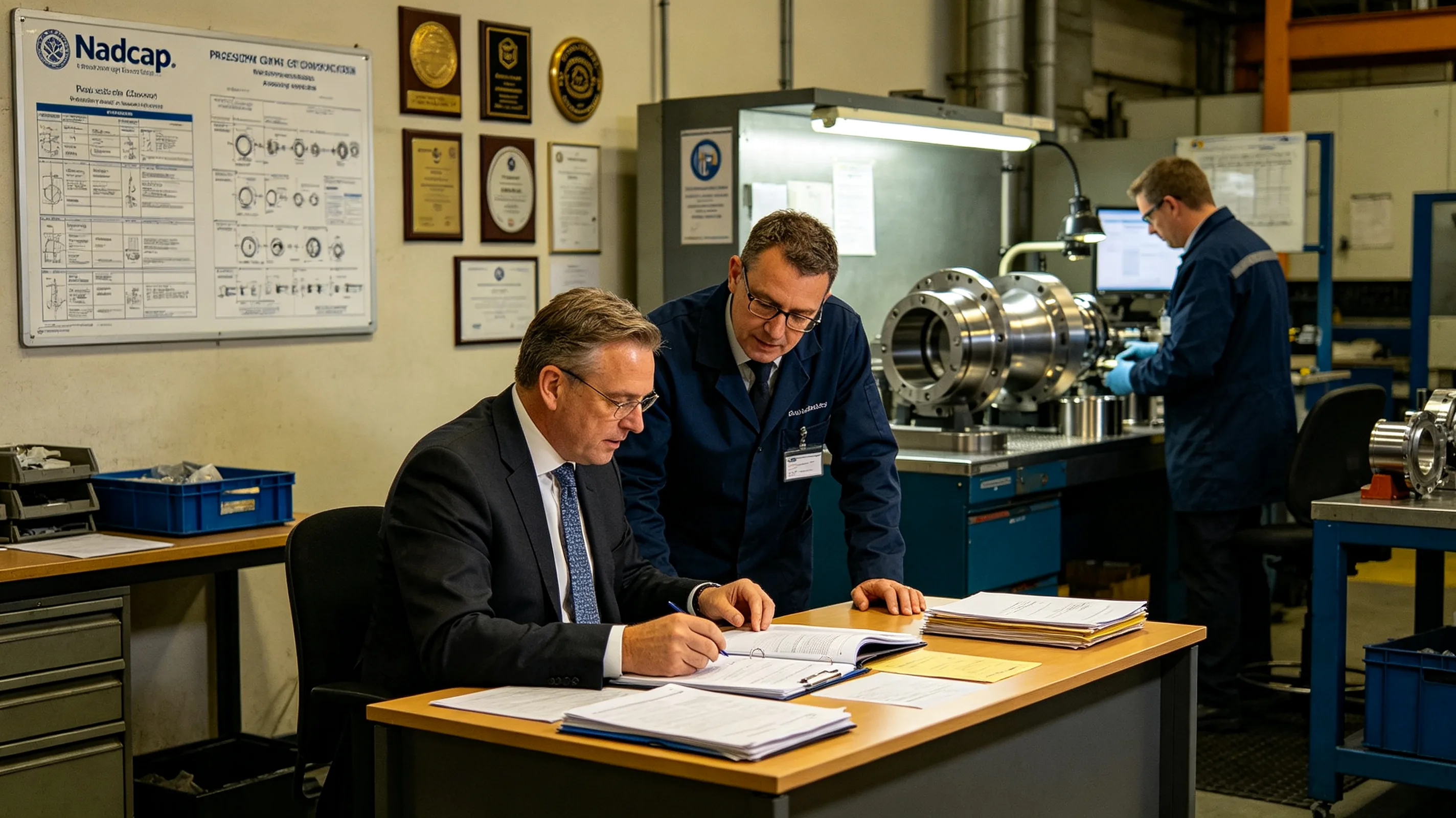
NADCAP certification is a process accreditation system for aerospace manufacturing, managed by the Performance Review Institute. Unlike AS9100D, which certifies the overall quality management system, NADCAP accreditation is specific to individual processes — a supplier may be NADCAP accredited for heat treatment but not for NDE, or for surface treatment but not for welding.
NADCAP vs AS9100D
AS9100D certification covers the supplier’s quality management system as a whole. NADCAP accreditation covers specific technical processes and verifies that the supplier’s process meets the applicable aerospace industry standards and customer requirements.
A supplier can be AS9100D certified without being NADCAP accredited for any specific process. However, many aerospace primes and tier-one suppliers require NADCAP accreditation for certain processes — typically heat treatment, surface treatment, NDE, and welding. The accreditation demonstrates that the supplier’s process has been independently audited against the applicable standards and found compliant.
The NADCAP audit is performed by auditors who are technical experts in the specific process being audited. Unlike AS9100D auditors, who are quality system generalists, NADCAP auditors have hands-on experience with the processes they audit. The audit focuses on process parameters, equipment capability, operator qualification, and quality records specific to the accredited process.
NADCAP for titanium heat treatment
NADCAP accreditation for titanium heat treatment is one of the most common and most rigorous process accreditations. The audit verifies that the heat treatment furnace is capable of maintaining the required temperature uniformity, that the temperature survey is performed at the required frequency, and that the furnace atmosphere is controlled to prevent contamination of the titanium.
For titanium heat treatment, the NADCAP requirements include vacuum furnace capability with a leak rate that does not exceed the specified maximum, temperature uniformity within ±5°C across the furnace work zone, and a control system that records and documents the heat treatment cycle. The audit also verifies that the operator is qualified and that the heat treatment procedure is documented and approved.
NADCAP for NDE
NADCAP accreditation for non-destructive evaluation covers methods such as fluorescent penetrant inspection, magnetic particle inspection, ultrasonic inspection, and radiographic inspection. For titanium components, penetrant inspection is the most common NDE method, and NADCAP accreditation verifies that the penetrant materials, application process, inspection conditions, and inspector certification meet the applicable standards.
The penetrant inspection NADCAP audit verifies that the penetrant materials are within their expiration dates, that the inspection station has adequate lighting — typically 1000 lux minimum at the inspection surface — and that the inspector holds a current certification to the applicable national standard.
NADCAP significance for supplier evaluation
NADCAP accreditation provides independent verification that the supplier’s process meets industry standards. For procurement teams, NADCAP accreditation simplifies the supplier qualification process — instead of conducting their own process audit, they can accept NADCAP accreditation as evidence of process capability. The relationship between NADCAP process accreditation and overall quality system certification is discussed in the AS9100D overview, and our AS9100D titanium machining supplier page shows how these systems are implemented in production.
However, NADCAP accreditation does not guarantee that every component produced by the accredited process meets specification. The accreditation verifies process capability and process control, but individual component quality still depends on the operator’s attention to detail and the effectiveness of the quality management system.
Table 1: NADCAP process accreditations relevant to titanium manufacturing
| Process | NADCAP standard | Key audit focus |
|---|---|---|
| Heat treatment | AMS 2750 | Temperature uniformity, furnace atmosphere, vacuum capability |
| Surface treatment | AMS 2700 | Solution concentration, process control, operator qualification |
| Penetrant inspection | ASTM E1417 | Penetrant materials, inspection conditions, inspector certification |
| Ultrasonic inspection | ASTM E2375 | Equipment calibration, reference standards, inspector certification |
| Welding | AWS D17.1 | Weld procedure qualification, welder certification, shielding gas control |
When qualifying a supplier for NADCAP-accredited titanium processes, request our capability documentation through the engineering RFQ portal.