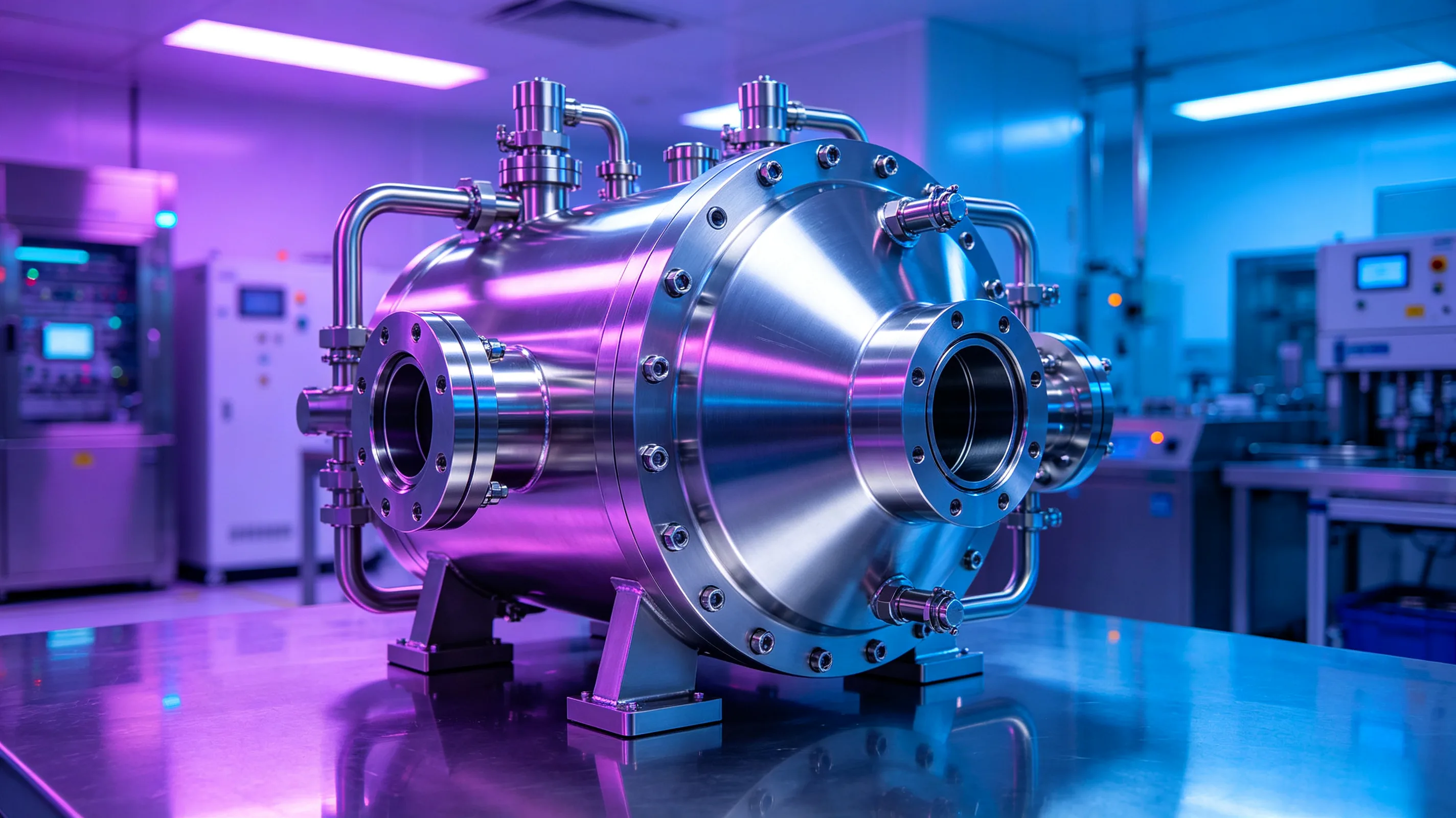
Titanium is used in semiconductor manufacturing equipment for components that require corrosion resistance in reactive gas environments, magnetic transparency for plasma containment, and dimensional stability across thermal cycling. The precision requirements for semiconductor titanium components are among the tightest in any industry, and the manufacturing environment requirements — cleanroom assembly, ultra-clean surfaces — add complexity beyond what is typical for aerospace or medical work.
Material requirements for semiconductor applications
The titanium alloys used in semiconductor equipment are typically CP Grade 2 or Ti-6Al-4V, depending on the strength requirements. CP Grade 2 is preferred for components that must remain non-magnetic and for components exposed to corrosive process gases. Ti-6Al-4V is used where higher strength is required, such as structural support components and clamping hardware.
The material purity requirements for semiconductor titanium are more stringent than for general industrial applications. The material must be free of inclusions that could outgas or generate particles in the vacuum environment. The titanium stock is typically specified with additional ultrasonic inspection to verify internal soundness, and surface defects are not permitted on any surface that will be exposed to the process environment.
Material certifications for semiconductor titanium components typically include chemical composition, mechanical properties, and ultrasonic inspection results. The certifications are retained as part of the component quality record, and traceability from the mill heat number through each production operation to the finished component is required.
Precision machining requirements
The tolerance requirements for semiconductor titanium components are among the tightest in precision machining. Critical features — sealing surfaces, mating flanges, alignment features — are typically specified at ±0.013 to ±0.025 mm. These tolerances must be maintained across components that can be 300 mm or more in diameter. The titanium CNC tolerance guide provides capability data that applies directly to semiconductor component machining.
The machining of semiconductor titanium components is performed in temperature-controlled environments to manage thermal expansion. The machine tools themselves are often temperature-controlled, with coolant chillers maintaining the coolant temperature within ±1°C of the setpoint. In-process probing is used to verify critical dimensions before the component is removed from the machine.
Surface finish requirements for sealing surfaces are typically Ra 0.2 to 0.4 μm, achieved through precision turning or grinding. The surface finish must be free of machining marks that could create leak paths in vacuum seals. Surface finish verification is performed using profilometers calibrated to national standards.
Surface cleanliness and passivation
Semiconductor titanium components require surface cleanliness levels that exceed aerospace or medical requirements. The surfaces must be free of organic contaminants, metallic residues, and particles that could outgas or generate contamination in the process chamber.
The cleaning process for semiconductor titanium components typically involves multiple stages — solvent cleaning to remove machining oils, aqueous cleaning with ultrapure water, and passivation to restore the protective oxide layer. The cleaning process is validated to demonstrate that it achieves the required cleanliness level, and the cleaning parameters are documented and controlled in production.
Passivation of semiconductor titanium components is performed using nitric acid solutions that remove embedded contaminants and restore the protective oxide layer. The passivation process parameters — acid concentration, temperature, and exposure time — are selected to achieve a consistent oxide layer thickness without etching or damaging the surface. The passivated surface is verified by water break testing or contact angle measurement.
Vacuum compatibility
Components for vacuum semiconductor equipment must be designed and manufactured to minimize outgassing and particle generation. The surface finish must be smooth enough to prevent particle trapping, and the component must be free of blind holes, crevices, or other features that could trap contaminants.
The materials used in vacuum components must have low vapor pressure at the operating temperature of the process chamber. Titanium’s vapor pressure is acceptably low for most semiconductor processes, but the surface condition — cleanliness, oxide layer thickness, and roughness — affects the outgassing rate. Components that are improperly cleaned or passivated can outgas at rates that exceed the vacuum system’s pumping capacity.
Threaded features in vacuum titanium components require special attention. Threads are potential particle generation sites and can trap contaminants. Threads that are exposed to the vacuum environment are typically specified with rolled rather than cut thread forms, and the threads are cleaned using ultrasonic cleaning to remove all machining residues before passivation.
For semiconductor titanium components with ultra-clean and precision requirements, submit your RFQ and our engineers will review the machining, cleaning, and passivation plan for your application.
Table 1: Semiconductor titanium component requirements
| Requirement | Typical specification | Manufacturing implication |
|---|---|---|
| Dimensional tolerance | ±0.013–0.025 mm | Temperature-controlled machining, in-process probing |
| Surface finish, sealing | Ra 0.2–0.4 μm | Precision turning or grinding |
| Material purity | Ultrasonic inspection required | Certified material with NDE |
| Surface cleanliness | Organic-free, particle-free | Validated multi-stage cleaning |
| Passivation | Consistent oxide layer | Controlled nitric acid process |
| Vacuum compatibility | Low outgassing, no particle generation | Smooth surfaces, clean assembly |