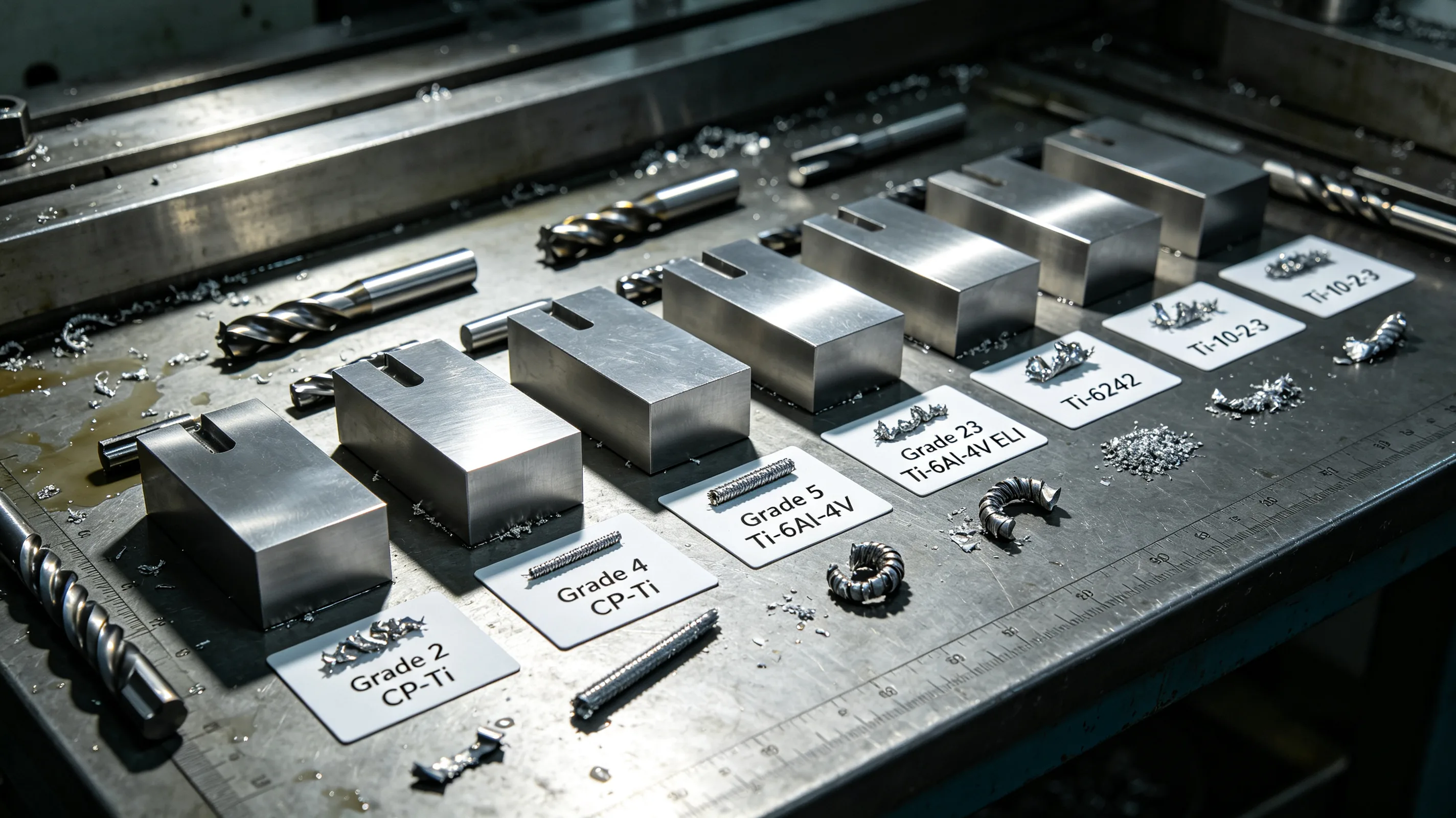
Titanium Machinability Rating: How Different Titanium Grades Compare
Executive summary: Titanium machinability varies widely by grade. Commercially pure Grade 2 machines roughly twice as easily as Ti-6Al-4V Grade 5. Alpha-beta alloys such as Grade 5 and Grade 23 sit in the moderate-to-difficult range. High-strength beta alloys such as Ti-5553, Ti-10-2-3, and Beta-C are among the most challenging aerospace metals to cut, with machinability ratings below 15 relative to free-machining steel. Grade selection should therefore be treated as a process decision, not only a materials decision. Choosing a grade with higher strength than necessary increases machining cost, scrap risk, and lead time without improving the part.
How machinability ratings are determined for titanium
Machinability ratings compare how long a tool lasts or how fast a material can be cut under standardized conditions. The reference is usually free-machining steel such as AISI 1112, assigned an index of 100. A material with a rating of 50 wears the tool twice as fast for the same cutting speed, or requires half the cutting speed for equivalent tool life.
Titanium ratings are approximate because titanium machining is sensitive to cutting speed, coolant, tool coating, and workpiece geometry. A grade that rates 25 in roughing may behave differently in finishing. The ratings here are practical ranges based on carbide tooling, flood or high-pressure coolant, and conventional milling or turning. They are useful for relative comparison and cost estimation, not for precise parameter selection.
Table 1: Titanium machinability rating by grade and alloy class
| Grade / alloy | Alloy class | Machinability index | Relative tool life | Typical cutting speed (m/min) |
|---|---|---|---|---|
| Grade 1 CP titanium | Unalloyed alpha | 45–55 | Moderate | 50–90 |
| Grade 2 CP titanium | Unalloyed alpha | 35–45 | Moderate-short | 40–80 |
| Grade 3 CP titanium | Unalloyed alpha | 30–40 | Short | 35–70 |
| Grade 4 CP titanium | Unalloyed alpha | 25–35 | Short | 30–60 |
| Grade 5 Ti-6Al-4V | Alpha-beta | 15–25 | Very short | 25–60 |
| Grade 23 Ti-6Al-4V ELI | Alpha-beta | 15–25 | Very short | 25–55 |
| Grade 9 Ti-3Al-2.5V | Near-alpha | 25–35 | Short | 35–70 |
| Grade 12 Ti-0.3Mo-0.8Ni | Near-alpha | 30–40 | Short | 40–75 |
| Ti-5553 | Beta | 8–15 | Very short | 15–35 |
| Ti-10-2-3 | Beta | 8–15 | Very short | 15–35 |
| Beta-C / Ti-3Al-8V-6Cr-4Mo-4Zr | Beta | 8–15 | Very short | 15–30 |
Commercially pure grades: easier but not easy
Commercially pure titanium grades 1 through 4 are the most machinable titanium alloys. They are single-phase alpha alloys with no strengthening intermetallic phases. As oxygen and iron content increase from Grade 1 to Grade 4, strength increases and machinability decreases. Grade 1 is the softest and most formable. Grade 4 approaches some alpha-beta alloys in strength and becomes noticeably harder to cut cleanly.
Even within the CP grades, the difference between Grade 1 and Grade 4 is significant. A part that machines easily in Grade 2 may require slower speeds and more frequent tool changes in Grade 4. The same thermal conductivity problem exists — all titanium alloys conduct heat poorly — but the lower strength of CP grades reduces cutting force and heat generation. This makes CP grades a practical choice when strength requirements are modest.
CP grades produce long, stringy chips in turning and drilling. Chip breaking is important to prevent tangling around the tool or workpiece. Sharp tools with positive rake angles work well because the material is less prone to edge chipping than stronger alloys.
Alpha-beta alloys: the industrial standard with moderate difficulty
Ti-6Al-4V Grade 5 dominates titanium machining because it offers the best balance of strength, corrosion resistance, and cost. Its machinability rating of 15 to 25 makes it roughly twice as difficult as Grade 2 CP titanium. The difficulty comes from the alpha-beta microstructure: harder alpha phase particles in a tougher beta matrix create abrasive and adhesive wear at the same time.
Grade 23 Ti-6Al-4V ELI has slightly lower oxygen content and improved ductility compared with Grade 5. The machinability is similar to Grade 5, although the lower oxygen content can produce marginally better surface finish in finishing operations. The differences are small enough that most shops use the same parameters for both grades and adjust based on measured results.
Grade 9 Ti-3Al-2.5V and Grade 12 Ti-0.3Mo-0.8Ni are near-alpha alloys with better formability and weldability than Grade 5. Their machinability sits between CP Grade 4 and Grade 5. They are common in tubing and pressure vessel applications where moderate strength and good fabricability are needed.
Beta alloys: maximum strength, minimum machinability
Beta titanium alloys such as Ti-5553, Ti-10-2-3, and Beta-C offer tensile strengths above 1,200 MPa and are used in high-strength aerospace landing gear and fasteners. These alloys are also among the most difficult engineering metals to machine. Their machinability ratings of 8 to 15 reflect severe tool wear, high cutting forces, and tight process windows.
The beta phase is tougher and more ductile than the alpha phase at cutting temperatures. This produces higher cutting forces and more heat. Beta alloys also tend to work harden aggressively, so cutting parameters must be selected to avoid rubbing. High-pressure coolant, rigid setups, and premium carbide or PCD tooling are typically required for economical production.
The cost multiplier for beta alloys is substantial. A beta titanium part may cost three to five times more to machine than an equivalent Grade 5 part, and the supplier base is smaller because fewer shops have the tooling, coolant systems, and experience to produce consistent results.
Table 2: When to choose each titanium grade from a machining perspective
| Application priority | Recommended grade range | Machining implication |
|---|---|---|
| Maximum corrosion resistance, easy forming | Grade 1–2 | Lowest machining cost among titanium grades |
| Balanced strength, corrosion, and cost | Grade 2–4 | Moderate machining cost, predictable process |
| High strength-to-weight ratio | Grade 5 | Standard aerospace choice, requires titanium-capable equipment |
| High strength plus fracture toughness | Grade 23 | Similar to Grade 5, medical/aerospace critical structures |
| Highest strength, aerospace landing gear | Beta alloys | Highest machining cost, limited supplier base |
How grade selection drives total part cost
The material price per kilogram is only part of the cost equation. Machining cost usually dominates for precision components. A component machined from Grade 5 may have material cost twice that of Grade 2, but the machining cost may be only 30 to 50 percent higher. Conversely, switching from Grade 5 to a beta alloy can triple machining cost even if material cost increases by a smaller percentage.
Design teams sometimes over-specify grade because the strength margin feels safer. In practice, Grade 2 often provides adequate corrosion resistance and moderate strength for chemical and marine hardware. Grade 5 is the right default for aerospace structural parts. Beta alloys should be reserved for applications where the strength or hardenability benefit is essential to the design.
For a broader overview of titanium grade classification and properties, see the titanium grades complete guide. For the underlying reasons titanium is hard to cut regardless of grade, see why titanium is difficult to machine.
Procurement rules for grade-driven machinability
Rule 1 — Specify the lowest grade that meets the design requirement. Do not default to Grade 5 out of habit. If Grade 2 or Grade 9 meets the strength and corrosion needs, the part will be easier and cheaper to produce.
Rule 2 — Treat beta alloys as a specialty process. Require evidence of prior beta titanium experience, including tool life data and inspection records, before placing a production order.
Rule 3 — Quote comparable grades separately. When material selection is flexible, ask suppliers to quote multiple grades. The machining cost difference is often larger than the material cost difference.
For production titanium CNC machining across all grades, see the titanium CNC machining services page or request a quote with your grade and geometry requirements.