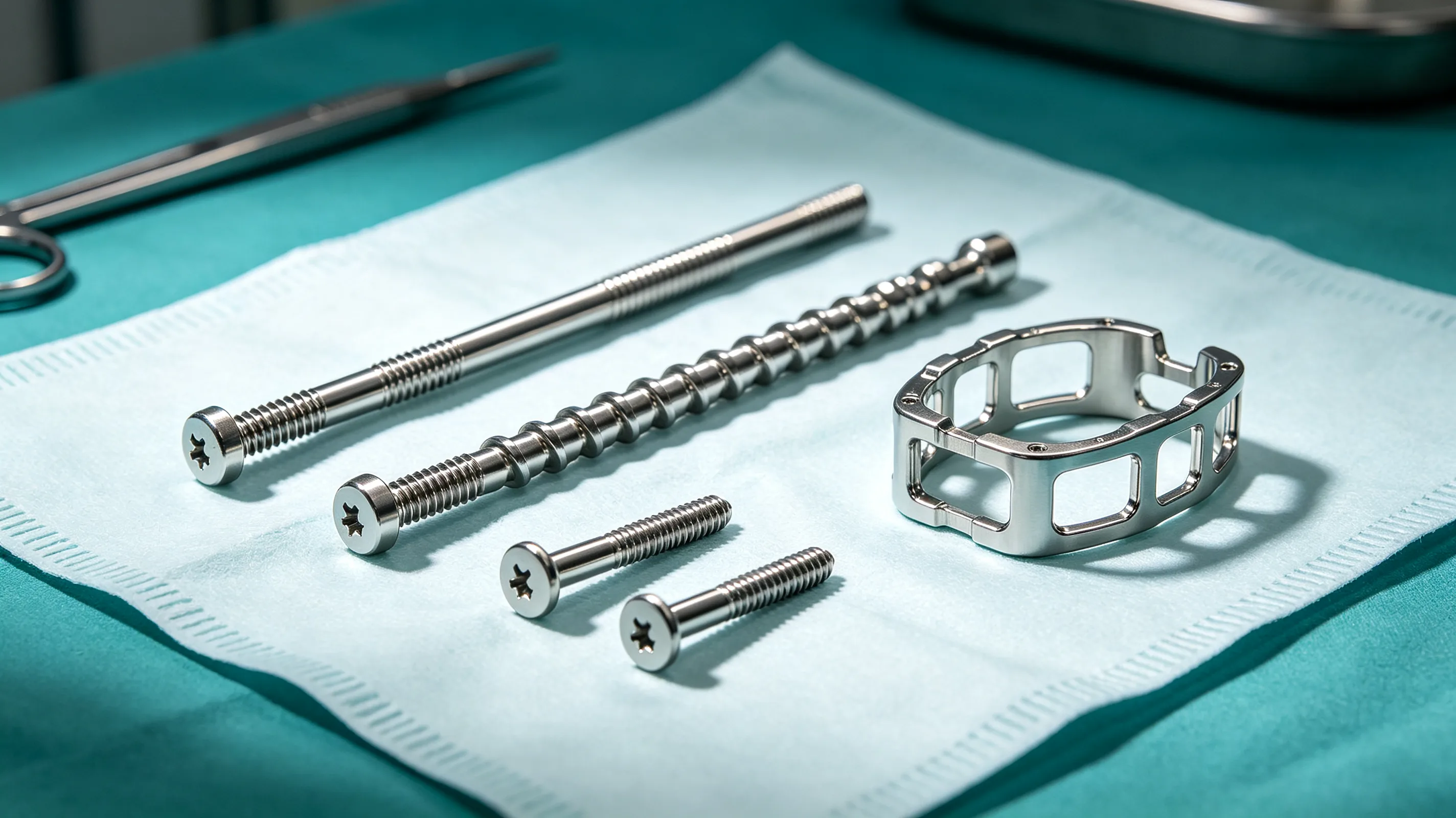
Grade 23 Ti-6Al-4V ELI is the predominant material for spinal implant systems — pedicle screws, spinal rods, interbody cages, and associated connectors — across all major spine device manufacturers globally. Its dominance in spinal surgery is not accidental: the combination of high fatigue strength, excellent fracture toughness, MRI compatibility, and proven osseointegration makes it the safest and most reliable choice for load-bearing spinal constructs that must withstand the demanding biomechanical environment of the human spine for the patient’s lifetime. For a comprehensive overview of Grade 23 material properties, see the Grade 23 titanium guide and the ASTM F136 standard guide. For comparisons with alternative spinal implant materials, see the Grade 23 vs Grade 5 comparison and the medical titanium implants standards article.
Why Grade 23 for Spinal Implants?
Spinal implants operate in a uniquely demanding biomechanical environment. Unlike hip or knee implants where the primary loading is compressive and the motion is well-characterized, spinal constructs experience multiaxial loading — compression, tension, bending, and torsion — often simultaneously. The fatigue life requirement is measured in decades, the allowable deflection is tightly constrained by adjacent anatomy, and the consequences of implant fracture are catastrophic.
Grade 23 addresses these demands through three material characteristics:
Fracture toughness (70–85 MPa√m): Spinal rods and pedicle screws are notched by design — threads, locking features, and the transition regions between screw head and shaft are unavoidable stress concentrators. Standard Ti-6Al-4V (Grade 5) with KIC of 50–65 MPa√m is more susceptible to crack initiation at these stress concentrations under cyclic loading. Grade 23’s 30–40 percent higher fracture toughness provides a safety margin that is directly relevant to spinal implant fatigue life.
Fatigue crack growth resistance: Grade 23 exhibits 20–30 percent slower crack propagation rates than Grade 5 under equivalent cyclic loading conditions. For a spinal rod that experiences approximately 4 million loading cycles per year (assuming 10,000 steps per day), this translates to a meaningful increase in the number of cycles before a crack reaches critical length.
MRI compatibility: All titanium alloys produce significantly less MRI artifact than stainless steel (316L) or cobalt-chrome alloys. Grade 23 is non-ferromagnetic and produces minimal distortion on 1.5T and 3T MRI systems, allowing postoperative imaging to assess fusion status and adjacent segment condition without the shadowing artifact that obscures these assessments with other implant materials.
Spinal Implant Types and Their Material Requirements
Pedicle Screws
Pedicle screws are the most fatigue-critical component in a spinal construct. The screw shaft, thread root, and the junction between the screw head and shaft are all regions of elevated stress concentration.
Material requirements for pedicle screws:
- ASTM F136 or ISO 5832-3 certification (Grade 23 ELI)
- Thread root design that minimizes stress concentration (rolled threads preferred over cut threads)
- Surface condition free of machining burrs, notches, and alpha case
- Hardness typically ≤ 36 HRC to avoid brittle fracture at thread roots
- Passivation per ASTM F86 for corrosion resistance
Pedicle screw diameters range from 4.5 mm to 8.5 mm, with 5.5 mm and 6.5 mm being the most common. At these diameters, the material must achieve the minimum mechanical properties specified in ASTM F136 while maintaining sufficient toughness to resist crack initiation at the thread root. Grade 23 is the only Ti-6Al-4V variant that reliably satisfies both requirements in a threaded configuration.
Spinal Rods
Spinal rods transmit bending and torsional loads between pedicle screw anchor points. Rod diameters are typically 5.5 mm or 6.0 mm for adult constructs, with 3.5 mm and 4.5 mm rods used in pediatric and cervical applications.
Material requirements for spinal rods:
- ASTM F136 or ISO 5832-3 certification
- Consistent straightness and diameter tolerance (±0.05 mm typical)
- Surface finish Ra ≤ 0.4 μm to minimize notch effects
- Cold-worked or STA-condition material for higher strength when required
- Uniform microstructure — no alpha case or surface contamination
Spinal rods are typically supplied in the annealed condition, which provides adequate strength (860 MPa tensile minimum) while maintaining the ductility needed for intraoperative contouring. For constructs requiring higher stiffness — particularly in deformity correction — cold-worked Grade 23 rods with tensile strength up to 1,000 MPa are available.
Interbody Cages
Interbody cages replace the intervertebral disc and support fusion between adjacent vertebral bodies. They are manufactured in a wide range of geometries — lordotic, kyphotic, bullet-nose, expandable — and may incorporate porous surfaces or lattice structures to promote bone ingrowth.
Material requirements for interbody cages:
- ASTM F136 or ISO 5832-3 certification
- Porous surface or lattice structure for osseointegration (plasma-sprayed titanium coating, additive manufactured porous structure, or sintered beads)
- Radiographic visibility — Grade 23 provides sufficient radiopacity for postoperative positioning assessment while allowing bony fusion assessment through the implant
- Surface treatment per ASTM F86
Interbody cages are increasingly manufactured using additive manufacturing (selective laser melting or electron beam melting) with Grade 23 powder. AM-produced cages allow lattice structures with controlled porosity (60–80 percent porosity, 300–700 μm pore size) that match the mechanical properties of cancellous bone while providing a scaffold for bone ingrowth.
Table 1: Typical spinal implant specifications by component type
| Component | Typical material spec | Typical surface finish | Typical manufacturing method | Key quality attribute |
|---|---|---|---|---|
| Pedicle screw | ASTM F136 Grade 23 | Ra ≤ 0.4 μm, rolled threads | Swiss-type CNC turning + thread rolling | Thread root fatigue strength |
| Spinal rod (annealed) | ASTM F136 Grade 23 | Ra ≤ 0.4 μm | Centerless grinding + polishing | Straightness, surface integrity |
| Spinal rod (cold-worked) | ASTM F136 Grade 23 | Ra ≤ 0.4 μm | Cold drawing + stress relief | Consistent strength along length |
| Interbody cage (machined) | ASTM F136 Grade 23 | Ra ≤ 0.8 μm (bone contact), Ra ≤ 0.4 μm (instrument interface) | 5-axis CNC milling | Pore geometry accuracy |
| Interbody cage (AM) | Grade 23 powder per ASTM F136 | As-built + chemical milling | Selective laser melting / EBM | Pore interconnectivity, density |
| Connector / cross-link | ASTM F136 Grade 23 | Ra ≤ 0.8 μm | CNC machining | Fit tolerances with rod/screw |
Surface Treatment Requirements for Spinal Implants
Spinal implants require specific surface treatments to ensure corrosion resistance, biocompatibility, and, where applicable, osseointegration.
ASTM F86 passivation: All spinal implant components must be passivated per ASTM F86 (Standard Practice for Surface Preparation and Marking of Metallic Surgical Implants). The passivation process removes surface iron contamination and promotes formation of a stable oxide layer. The typical process is nitric acid passivation (20–40 percent HNO₃ at 50–60°C for 20–30 minutes), followed by DI water rinsing.
Osseointegration surface treatments for interbody cages:
- Plasma-sprayed titanium coating: Produces a porous surface with 200–500 μm thickness and 40–60 percent porosity
- Additive manufactured lattice: Integrated porous structure with controlled pore geometry
- Sintered bead coating: Titanium beads (200–400 μm diameter) sintered to the cage surface
- Hydroxyapatite (HA) coating: Applied to titanium surfaces for enhanced bone bonding (less common in current practice)
Marking per UDI requirements: Spinal implants must be marked with Unique Device Identification (UDI) per FDA and EU MDR requirements. Laser marking is the preferred method for titanium implants, producing permanent identifiers without surface contamination. The marking depth is typically 0.01–0.03 mm and must not create stress concentrations that affect fatigue performance.
Manufacturing Quality Requirements Specific to Spinal Implants
Gamma case and alpha case control
Alpha case formation during hot working or heat treatment is not permitted under ASTM F136. For spinal implants, the consequences of alpha case are particularly severe because the thin cross-sections of pedicle screws (as small as 4.5 mm diameter) mean that even a 0.1 mm alpha case layer represents a significant fraction of the load-bearing cross-section. All thermal processing of Grade 23 for spinal implants must be conducted under vacuum or inert atmosphere, and any alpha case detected during incoming inspection must be fully removed before machining.
Notch sensitivity in threaded designs
Pedicle screw thread roots are the most fatigue-critical feature in a spinal construct. The notch sensitivity of Grade 23 is lower than Grade 5, but the manufacturing process must still be controlled to avoid introducing additional stress concentrations. Rolled threads are strongly preferred over cut threads for pedicle screws because the rolling process introduces compressive residual stresses at the thread root that inhibit crack initiation. Cut threads, which produce tensile residual stresses, have been associated with a measurable increase in thread-root fatigue failures in laboratory testing.
Dimensional tolerances
Spinal implant components require tighter dimensional tolerances than most orthopedic implants because the interface between components (screw head to rod, rod to connector) must provide stable fixation without slippage under cyclic loading.
Table 2: Typical dimensional tolerances for spinal implant components
| Feature | Typical tolerance | Verification method |
|---|---|---|
| Screw thread major diameter | ±0.05 mm | Optical comparator + CMM |
| Screw head internal hex | ±0.03 mm | Go/no-go gage + CMM |
| Rod diameter | ±0.025 mm | Laser micrometer |
| Rod straightness | 0.05 mm / 300 mm | Straightness gage |
| Cage height | ±0.05 mm | CMM |
| Cage lordosis angle | ±0.5° | CMM |
| Pore size (AM cages) | ±50 μm | Micro-CT |
Regulatory Considerations for Spinal Implant Material Procurement
Spinal implant manufacturers operating under FDA 21 CFR Part 820 or ISO 13485 must maintain documented material verification for every production lot. For Grade 23 material, this requires:
- EN 10204 Type 3.1 certification as minimum — actual test data from the mill
- CoC documenting ASTM F136 or ISO 5832-3 compliance
- Material traceability from mill to finished component (lot number on each implant)
- Biocompatibility documentation per ISO 10993 (typically provided by material supplier or implant manufacturer)
For multi-market distribution (United States, EU, Japan, China), material certified to both ASTM F136 and ISO 5832-3 from a single mill lot is the preferred procurement strategy — see the ISO 5832-3 vs ASTM F136 comparison for detailed guidance on dual-standard certification.
Three Practical Rules for Spinal Implant Material Procurement
Rule 1: Specify ASTM F136 or ISO 5832-3 with Type 3.1 certification — never accept Type 2.2 documentation.
Spinal implants are Class II or Class III medical devices under FDA classification. The design history file must contain documented verification that material properties meet the specified standard. EN 10204 Type 2.2 documentation (declaration of compliance without test data) does not satisfy this requirement. Type 3.1 documentation is the minimum acceptable certification level for spinal implant material.
Rule 2: Verify thread-forming process for pedicle screws — rolled threads are the standard of care.
The fatigue performance of a pedicle screw is determined more by the thread-forming process than by any other manufacturing variable. Rolled threads produce compressive residual stresses at the thread root and a smoother surface finish than cut threads. If the supplier uses cut threads, verify that fatigue testing has been performed on the specific thread geometry to demonstrate equivalent fatigue performance to rolled-thread designs.
Rule 3: Confirm that the material supplier can provide dual-standard certification if the implant will be distributed globally.
A spinal implant system sold in the United States, European Union, and Japan will require material certification to ASTM F136 (FDA), ISO 5832-3 (EU MDR), and potentially JIS T 7401-3 (Japan). Sourcing Grade 23 material that is certified to both ASTM F136 and ISO 5832-3 from a single mill lot avoids the need for separate material sourcing for each regulatory market.
For spinal device engineering teams and procurement professionals evaluating Grade 23 titanium suppliers, verifying that the supplier maintains ISO 13485 quality system certification, provides EN 10204 Type 3.1 documentation as standard, has documented experience with spinal implant tolerances and thread rolling processes, and can provide dual-standard certification for global distribution will prevent the most common material sourcing issues in spinal implant manufacturing. A titanium CNC machining manufacturer with documented spinal implant production experience can provide the material sourcing, process qualification, and certification support needed.
For a quotation on ASTM F136-certified Grade 23 spinal implant components with full material traceability, submit your requirements through our RFQ portal.