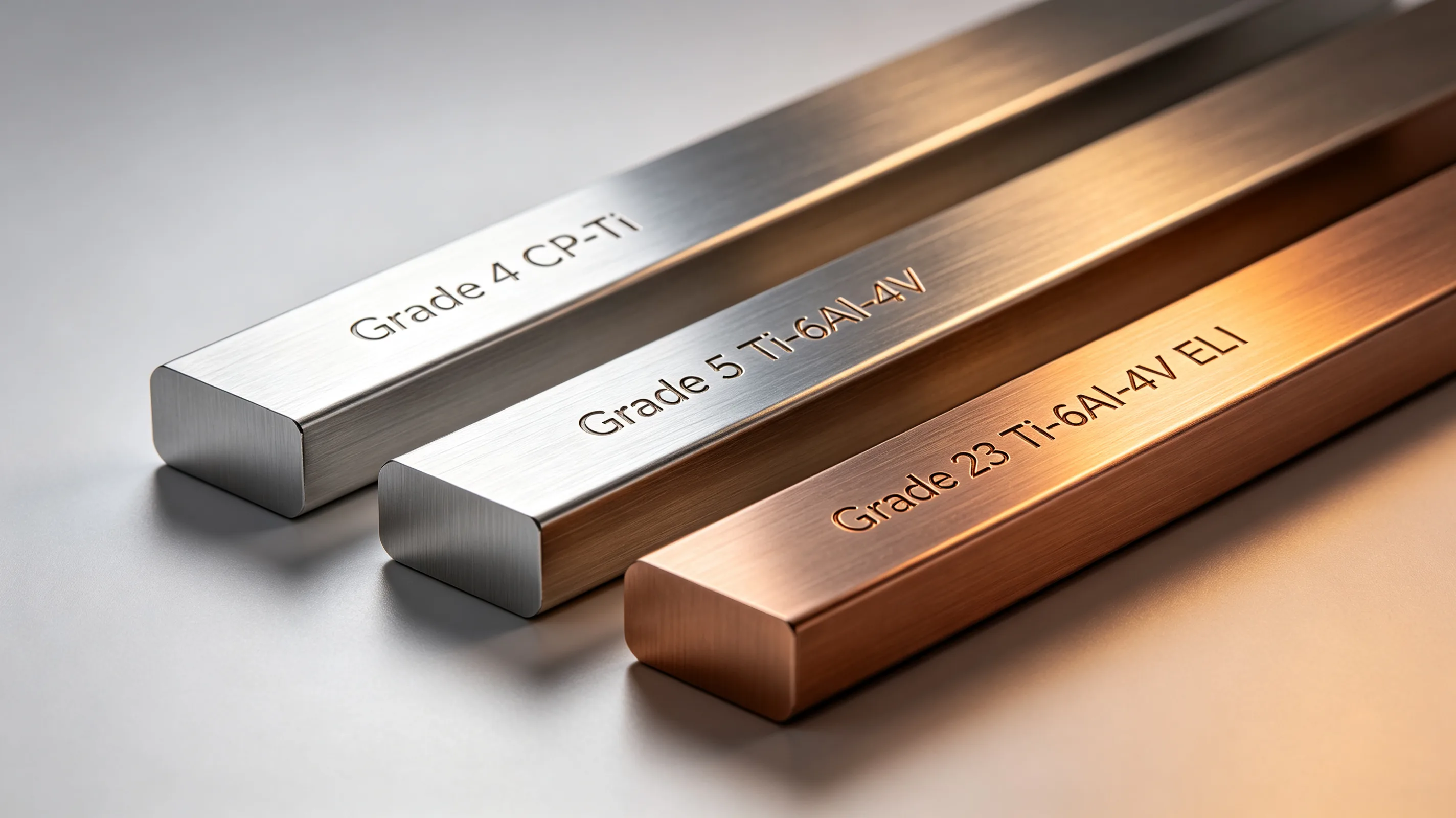
Grade 4 (CP-Ti), Grade 5 (Ti-6Al-4V), and Grade 23 (Ti-6Al-4V ELI) represent three distinct points on the titanium material spectrum: commercially pure alpha-phase (Grade 4), standard alpha-beta alloy (Grade 5), and extra-low-interstitial alpha-beta alloy (Grade 23). Each occupies a different position on the strength-ductility-toughness triangle, and each has a correspondingly different set of applications, applicable standards, processing characteristics, and cost structures. Engineers frequently choose between these three grades because they span the most commonly specified titanium materials in medical device manufacturing, aerospace fabrication, and high-performance industrial equipment. Understanding where each grade fits — and more importantly, where the trade-offs between them justify the cost premium of moving up the spectrum — is essential for any procurement or design decision involving titanium. For detailed reference data on each individual grade, see the Grade 3 vs Grade 4 comparison for CP-titanium property context, the Grade 5 titanium guide, and the Grade 23 titanium guide. For the applicable standards context, see the ASTM F136 standard guide and the medical titanium implants standards article. For a complete overview of all titanium classifications, see the titanium grades complete guide and the titanium grade chart classification guide.
What Distinguishes These Three Grades?
The three grades are separated by two fundamental metallurgical differences: alloy composition and interstitial content.
Grade 4 is commercially pure titanium — no intentional alloying additions. Its strength comes entirely from the oxygen content (0.40 percent maximum), which acts as a solid-solution strengthener in the hexagonal close-packed alpha lattice. It is the strongest CP grade but remains significantly weaker than any alpha-beta alloy.
Grade 5 (Ti-6Al-4V) is an alpha-beta alloy with 6 percent aluminum (alpha stabilizer) and 4 percent vanadium (beta stabilizer). The alloying additions create a two-phase microstructure that provides substantially higher strength than CP grades through a combination of solid-solution strengthening (aluminum in alpha phase) and precipitation strengthening (beta-phase transformation products).
Grade 23 (Ti-6Al-4V ELI) is the same alpha-beta alloy as Grade 5 but with reduced interstitial content — oxygen limited to 0.13 percent maximum versus 0.20 percent for Grade 5. The lower oxygen content reduces strength slightly but dramatically improves fracture toughness and ductility.
Table 1: Composition comparison across the three grades
| Element | Grade 4 (CP-Ti) | Grade 5 (Ti-6Al-4V) | Grade 23 (Ti-6Al-4V ELI) |
|---|---|---|---|
| Titanium | 99.0% min (by difference) | Balance | Balance |
| Oxygen, max | 0.40% | 0.20% | 0.13% |
| Iron, max | 0.50% | 0.30% | 0.25% |
| Carbon, max | 0.08% | 0.08% | 0.08% |
| Nitrogen, max | 0.05% | 0.05% | 0.05% |
| Hydrogen, max | 0.015% | 0.015% | 0.015% (bar) / 0.012% (sheet) |
| Aluminum | — | 5.5–6.5% | 5.5–6.5% |
| Vanadium | — | 3.5–4.5% | 3.5–4.5% |
The composition difference between Grade 4 and Grade 5/23 is the presence of aluminum and vanadium. The difference between Grade 5 and Grade 23 is only the oxygen (and marginally iron) limits.
Mechanical Properties: The Strength-Ductility-Toughness Triangle
Table 2: Mechanical property comparison — Grade 4 vs Grade 5 vs Grade 23
| Property | Grade 4 (CP, annealed) | Grade 5 (annealed) | Grade 23 ELI (annealed) |
|---|---|---|---|
| Tensile strength, min (MPa) | 550 | 895 | 860 |
| Yield strength, 0.2% offset, min (MPa) | 485 | 828 | 795 |
| Elongation, min (%) | 15 | 10 | 10 |
| Reduction of area, min (%) | 25 | 25 | 25 |
| Fracture toughness KIC (MPa√m) | Not typically measured (~80–100 estimated for CP) | 50–65 | 70–85 |
| Density (g/cm³) | 4.51 | 4.43 | 4.43 |
| Elastic modulus (GPa) | 105 | 114 | 114 |
The property trajectory across the three grades is not linear. Key observations:
Strength: Grade 5 is the strongest of the three, with approximately 60 percent higher tensile strength than Grade 4. Grade 23 is approximately 4 percent weaker than Grade 5 — a negligible difference for most applications.
Ductility: Grade 4 has the highest minimum elongation (15 percent), followed by Grade 5 and Grade 23 (both 10 percent minimum). However, Grade 23 typically achieves 12–15 percent actual elongation in production — higher than Grade 5 and comparable to Grade 4.
Fracture toughness: This is where the trade-off is most instructive. CP-Ti (Grade 4) has high fracture toughness because CP alpha-phase titanium is intrinsically tough — crack propagation is inhibited by the hexagonal lattice structure. Grade 5 has the lowest fracture toughness (50–65 MPa√m) because the beta-phase transformation products and higher interstitial content create microstructural features that facilitate crack propagation. Grade 23 restores much of the toughness loss through reduced interstitial content.
The counter-intuitive toughness pattern
Many engineers assume that the strongest grade (Grade 5) is also the toughest. The opposite is true. Within the Ti-6Al-4V composition family, fracture toughness decreases as strength increases because the same microstructural features that impede dislocation motion (strengthening) also facilitate crack propagation (toughening reduction). Grade 23 trades 4 percent strength for 30–40 percent toughness improvement. Grade 4 trades 40 percent strength for approximately 60 percent higher toughness than Grade 5.
Application Spectrum: Where Each Grade Fits
Table 3: Application suitability by grade
| Application area | Grade 4 | Grade 5 | Grade 23 | Rationale |
|---|---|---|---|---|
| Permanent load-bearing orthopedic implant | ✗ | ✗ | ✓ | Grade 23 fracture toughness required for fatigue-critical implants |
| Non-load-bearing implant (mesh, staple) | ✓ | ✓ | ~ | Grade 4 or Grade 5 adequate; ELI premium not justified |
| Dental implant | ✗ | ~ | ✓ | Small cross-section requires reduced notch sensitivity |
| Surgical instrument | ✓ | ✓ | ✗ | Grade 5 is standard; Grade 4 for single-use; ELI cost not justified |
| Spinal implant (pedicle screw, rod, cage) | ✗ | ✗ | ✓ | Fatigue-critical; notch sensitivity at threads requires ELI |
| Aerospace structural component (room temp) | ✗ | ✓ | ~ | Grade 5 strength-to-weight optimal; Grade 23 only if fracture-critical |
| Cryogenic equipment (LNG, LH2) | ✗ | ✗ | ✓ | Grade 5 embrittles; Grade 4 lacks strength; Grade 23 required |
| Chemical processing vessel | ✓ | ✓ | ~ | Corrosion resistance equivalent; Grade 4 is cost-effective |
| Marine shaft/propeller | ✓ | ✓ | ~ | Grade 4 adequate for moderate loads; Grade 5 for higher strength |
| Heat exchanger tubing | ✓ | ✓ | ~ | Grade 4 preferred for formability; Grade 5 for higher pressure |
| Automotive performance component | ✗ | ✓ | ~ | STA-condition Grade 5 offers 1,070 MPa — higher than Grade 23 |
| Cryogenic fastener | ✗ | ✗ | ✓ | Grade 23 required for cryogenic toughness per code |
✓ = Best choice | ~ = Acceptable but not optimal | ✗ = Not recommended
Cost Comparison and Economic Considerations
Table 4: Relative cost comparison — Grade 4 vs Grade 5 vs Grade 23
| Cost element | Grade 4 (CP) | Grade 5 | Grade 23 |
|---|---|---|---|
| Raw material (bar stock, per kg) | 1.0× (baseline) | 1.3–1.5× | 1.5–1.8× |
| Machining cost (per hour, relative) | 0.7× | 1.0× | 0.95× |
| Tool wear (relative tool life) | 2.0× | 1.0× | 1.1× |
| Certification documentation costs | Lower | Standard | Standard (Type 3.1 expected) |
| Fracture toughness testing | Not required | Only when specified | Often required for medical lots |
| Heat treatment (vacuum anneal) | Not typically required | Standard | Standard |
Key cost observations:
Grade 4 is the most economical material across all cost elements — lower raw material cost, faster machining (30 percent faster cycle times than Grade 5), and longer tool life (approximately double that of Grade 5). For applications where 550 MPa tensile strength is adequate, Grade 4 provides a significant total-cost advantage.
Grade 5 and Grade 23 have similar machining costs — the 5–10 percent tool life advantage of Grade 23 does not translate to a meaningful cycle-time difference. The cost difference is almost entirely in raw material (15–30 percent premium for Grade 23) and in the certification and testing overhead required for medical-grade procurement.
Processing and Fabrication Differences
Machining:
- Grade 4 machines similarly to CP grades 1–3: lower cutting forces, better chip formation, and significantly longer tool life than either Grade 5 or Grade 23. It is the most machinable of the three grades.
- Grade 5 and Grade 23 machine identically for practical purposes. Any tooling program developed for Grade 5 works for Grade 23 without modification. The popular belief that Grade 23 is noticeably easier to machine than Grade 5 is not supported by production data.
Welding:
- Grade 4 welds readily using standard CP-Ti filler wire. No post-weld heat treatment is required for most applications.
- Grade 5 welds require matching filler (ERTi-5) and post-weld stress relief for critical applications.
- Grade 23 welding requires low-interstitial filler (ERTi-23) to maintain ELI properties in the weld zone. Post-weld vacuum annealing is typically required for implant components.
Forming:
- Grade 4 has excellent cold formability — comparable to Grade 2 CP-Ti, with slightly larger bend radii required due to higher strength.
- Grade 5 has limited cold formability. Hot forming at 700–800°C is often required for complex geometries.
- Grade 23 has slightly better cold formability than Grade 5 due to lower oxygen, but the difference is small.
Three Practical Rules for the Grade 4 vs Grade 5 vs Grade 23 Decision
Rule 1: Grade 4 is the default for applications below 550 MPa tensile strength — do not over-specify to Grade 5 or Grade 23.
Grade 4 provides adequate strength for the majority of non-implant titanium applications: chemical processing equipment, marine hardware, heat exchanger tubing, and surgical instruments. Specifying Grade 5 when Grade 4 is adequate adds 30–50 percent to raw material cost, increases machining cycle times by 30 percent, and provides no benefit in corrosion resistance or biocompatibility. The most common over-specification error we encounter is Grade 5 being specified for components that have functionally equivalent performance in Grade 4.
Rule 2: The Grade 5 vs Grade 23 decision is a fracture-toughness decision — if the application is not fatigue-critical, Grade 5 is correct.
Grade 23’s 15–30 percent material cost premium buys fracture toughness. The applications that need this premium are: permanent load-bearing medical implants, spinal implants, dental implants, and cryogenic equipment. For all other applications — aerospace structural components at room temperature, automotive parts, marine hardware, surgical instruments — Grade 5 provides identical corrosion resistance, equivalent strength, and adequate toughness at lower total cost.
Rule 3: Verify that the supplier can actually supply the specified grade in the required product form before finalizing the design.
Grade 4 is available in all product forms from essentially all titanium mills globally. Grade 5 is similarly available in all product forms. Grade 23 has more limited availability in some product forms — particularly thin-gauge sheet (below 1.5 mm), large-diameter billet (above 250 mm), and wire in small diameters (below 3 mm). For medical device designs that specify Grade 23 in a product form where ELI availability is limited, the procurement lead time can extend 8–16 weeks versus 4–6 weeks for Grade 5. Early verification of Grade 23 availability in the specified product form prevents schedule delays during the prototyping and initial production phases.
For engineering teams and procurement professionals evaluating the three most common titanium specifications, understanding the strength-ductility-toughness trade-offs between Grade 4, Grade 5, and Grade 23 — and verifying that the selected grade is justified by the actual service conditions — will prevent the most common specification errors. A titanium CNC machining and fabrication manufacturer with documented experience across all three grades can provide the material sourcing, process qualification, and certification support needed for any grade selection.
For a grade-specific quotation on Grade 4, Grade 5, or Grade 23 components with correct certification, submit your requirements through our RFQ portal.