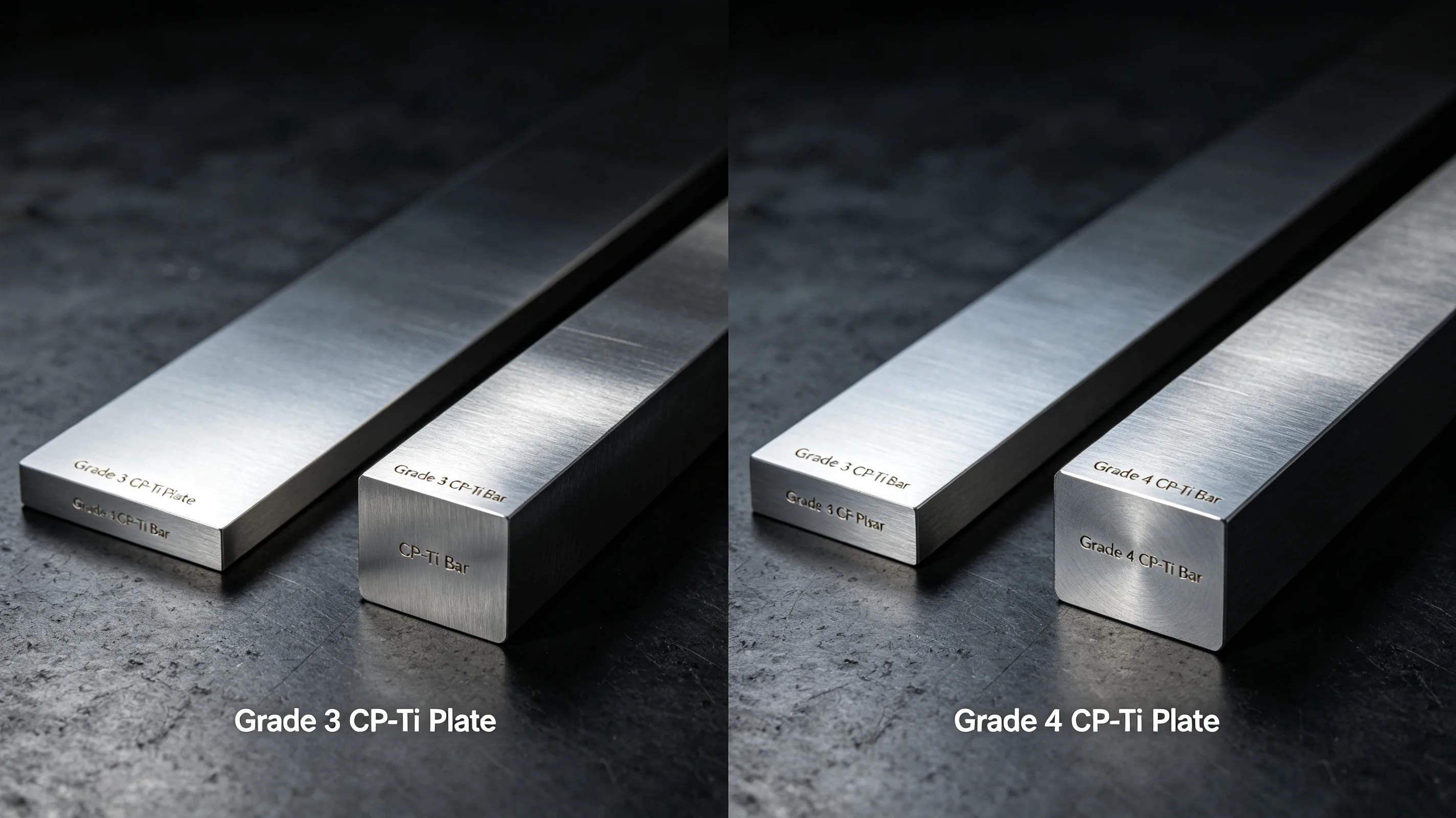
Grade 3 and Grade 4 titanium are adjacent commercially pure grades separated by 0.05 percent maximum oxygen content — Grade 3 allows 0.35 percent oxygen, Grade 4 allows 0.40 percent. This 0.05 percent difference produces approximately 100 MPa higher tensile strength in Grade 4 while reducing elongation by roughly 3 percentage points. The material cost difference is 8 to 15 percent per kilogram of raw material, with Grade 4 being the more expensive grade. But the practical selection between these two grades is driven less by the mechanical properties themselves and more by the formability requirements of the component geometry and the availability of the specified product form. In many procurement situations, the correct choice is neither Grade 3 nor Grade 4 — it is Grade 2 with an adjusted section thickness. Understanding when the Grade 3–Grade 4 boundary is truly relevant is the core of this comparison. For background on all CP grades and their relationship to the broader titanium classification system, see the CP titanium grades comparison guide and the titanium grades complete guide.
How Are Grade 3 and Grade 4 Defined?
Both grades are commercially pure alpha-phase titanium. Their properties are determined almost entirely by their oxygen content, which acts as a solid-solution strengthener in the hexagonal close-packed alpha lattice.
Grade 3 is defined by the following composition limits per ASTM B265 and ASTM B348:
- Oxygen: 0.35 percent maximum
- Iron: 0.30 percent maximum
- Carbon: 0.08 percent maximum
- Nitrogen: 0.05 percent maximum
- Hydrogen: 0.015 percent maximum
- Titanium: balance (99.2 percent minimum by difference)
Grade 4 is defined by the same impurity limits except oxygen, which is permitted to 0.40 percent maximum. No other element limit differs between the two grades. The entire mechanical property difference between Grade 3 and Grade 4 is therefore attributable to 0.05 percent additional oxygen in the alpha lattice.
What this means in practice
The mechanical property gap between Grade 3 and Grade 4 is the smallest between any two adjacent CP grades. The gap between Grade 1 and Grade 2 is roughly 100 MPa and 4 percent elongation. The gap between Grade 2 and Grade 3 is roughly 105 MPa and 2 percent elongation. The gap between Grade 3 and Grade 4 is roughly 100 MPa and 3 percent elongation. Each step is approximately equal in magnitude.
What distinguishes the Grade 3-to-Grade 4 step is its position at the top of the CP strength range. Grade 4’s 550 MPa tensile strength overlaps with the bottom of the Ti-6Al-4V range (895 MPa annealed), meaning that the user of Grade 4 is closer to alloyed titanium territory than any other CP grade user. Grade 3, at 450 MPa, is still firmly within the CP mechanical envelope. This positioning has implications for how each grade behaves during manufacturing and how suppliers treat it in their process planning.
Mechanical Property Comparison
Table 1: Grade 3 vs Grade 4 mechanical and physical properties
| Property | Grade 3 | Grade 4 | Difference |
|---|---|---|---|
| Max oxygen content (%) | 0.35 | 0.40 | +0.05 |
| Tensile strength, min (MPa) | 450 | 550 | +100 (22% higher) |
| Yield strength, 0.2% offset, min (MPa) | 380 | 485 | +105 (28% higher) |
| Elongation, min (%) | 18 | 15 | −3 (17% lower) |
| Typical hardness (HV) | 200–240 | 240–280 | +40 HV |
| Density (g/cm³) | 4.51 | 4.51 | Identical |
| Elastic modulus (GPa) | 103 | 104 | Negligible |
| Thermal conductivity at 20°C (W/m·K) | 16 | 15 | −1 |
| Relative material cost (per kg) | 1.0x (baseline) | 1.08–1.15x | +8–15% |
Interpreting the differences
The tensile strength difference of 100 MPa is mechanically significant in section-thickness-limited designs. A component designed to a 450 MPa allowable stress that is switched to Grade 4 can reduce section thickness by roughly 15 to 18 percent while maintaining equivalent load capacity. This weight saving is the primary engineering rationale for selecting Grade 4 over Grade 3.
The ductility reduction from 18 to 15 percent elongation is less significant for most structural applications but becomes decisive in forming operations. Grade 4’s 15 percent minimum elongation is near the practical forming limit for cold bending of titanium. Bend radii that are feasible in Grade 3 at 2.5 to 3 times sheet thickness may require 4 to 5 times sheet thickness in Grade 4, or may require warm forming at 200 to 300°C.
The hardness increase of approximately 40 HV has direct consequences for machining. Grade 4 produces shorter, more fragmented chips than Grade 3, which is an advantage for chip management, but the higher hardness increases tool flank wear by approximately 10 to 15 percent under equivalent cutting conditions. Shops transitioning from Grade 3 to Grade 4 typically see a 5 to 10 percent reduction in tool edge life if they do not adjust speeds.
Manufacturing Considerations
Formability
Grade 3 can be cold formed with moderate bend radii — typically 2.5 to 3 times sheet thickness for standard air bending. Grade 4 requires larger radii — 3.5 to 5 times sheet thickness — and the risk of cracking during severe forming operations is measurably higher.
For deep drawing operations, Grade 3 is clearly preferred. The 18 percent minimum elongation provides sufficient material flow for cup depths of approximately 0.5 to 0.6 times the blank diameter in a single draw. Grade 4, with its 15 percent minimum elongation, typically requires intermediate annealing for equivalent draw depths, adding a furnace cycle and additional handling cost.
For tube bending, Grade 3 can achieve centerline bend radii of 2 to 2.5 times tube diameter with standard mandrel tooling. Grade 4 requires 3 to 4 times tube diameter and a higher probability of wrinkle formation on the intrados. Tube suppliers that stock both grades report that Grade 3 tubing is used for approximately 80 percent of CP titanium bending applications, with Grade 4 reserved for applications where the formed component must carry higher service loads.
Machinability
Grade 3 and Grade 4 machine differently in ways that affect production planning.
Table 2: Recommended machining parameters for Grade 3 vs Grade 4
| Parameter | Grade 3 | Grade 4 |
|---|---|---|
| Cutting speed, carbide (m/min) | 50–65 | 40–55 |
| Feed rate, roughing (mm/rev) | 0.20–0.30 | 0.15–0.25 |
| Depth of cut, roughing (mm) | 2.0–3.5 | 1.5–3.0 |
| Coolant pressure (bar) | 10–20 (flood) | 10–30 (flood) |
| Expected tool edge life, roughing (min) | 20–30 | 18–25 |
| Chip breaker requirement | Standard | Recommended but less critical |
| Surface finish capability, minimum (Ra µm) | 0.4 | 0.4 |
Grade 4 requires cutting speeds approximately 15 to 20 percent lower than Grade 3 for equivalent tool life because the higher hardness generates more heat at the cutting interface. The 50 to 65 m/min range for Grade 3 is already slower than typical steel machining speeds, and dropping to 40 to 55 m/min for Grade 4 means that a given component will require roughly 15 to 20 percent more machine time.
However, Grade 4 produces better chip fragmentation naturally because the material is less ductile. Chip breaker tooling is less critical for Grade 4 than for Grade 3. In automated production environments where chip management directly affects machine uptime, this can offset some of the cycle time penalty from the lower cutting speed.
Welding
Both grades weld with standard CP titanium practices — inert gas shielding with argon or argon-helium mixtures, careful oxide layer removal before welding, and interpass temperature control below 150°C. Neither grade requires post-weld heat treatment for most applications.
The practical difference appears in weld joint efficiency. Grade 4 welds achieve approximately 85 to 90 percent joint efficiency relative to the base metal tensile strength, compared to 90 to 95 percent for Grade 3. This is because the higher oxygen content in Grade 4 reduces the ductility of the fusion zone, making it more susceptible to strain localization under tensile loading. For welded pressure vessels operating near the material’s strength limit, this difference should be factored into the design allowable stress.
Standards and Certification
Both grades are covered by the same ASTM standards, with the grade designation being the only difference in the specification.
Table 3: Applicable standards for Grade 3 and Grade 4
| Product form | ASTM standard | Grade 3 specification | Grade 4 specification |
|---|---|---|---|
| Sheet, strip, plate | ASTM B265 | Grade 3 per B265 | Grade 4 per B265 |
| Bar, billet | ASTM B348 | Grade 3 per B348 | Grade 4 per B348 |
| Seamless pipe | ASTM B337 | Grade 3 per B337 | Grade 4 per B337 |
| Welded pipe | ASTM B337 | Grade 3 per B337 | Grade 4 per B337 |
| Tube (heat exchanger) | ASTM B338 | Grade 3 per B338 | Grade 4 per B338 |
| Welding filler wire | ASTM B863 | ERTi-3 | ERTi-4 |
Procurement lead time differences
Grade 4 is stocked more widely than Grade 3 at metal service centers because it is the highest-strength CP grade and serves medical implant, aerospace fastener, and industrial pump applications that Grade 3 cannot meet. Grade 3 is stocked primarily by mills that serve the chemical processing industry and is less commonly carried by general-purpose service centers.
The practical consequence: Grade 4 sheet and bar are typically available off-the-shelf or within 4 to 6 weeks from most service centers. Grade 3 sheet and bar often require 8 to 16 weeks mill lead time. For procurement teams operating on standard delivery schedules, this availability gap alone can decide the grade selection regardless of mechanical property requirements.
Selection Logic by Application
The following decision matrix summarizes the engineering and procurement logic for choosing between Grade 3 and Grade 4 in common application categories.
Table 4: Grade 3 vs Grade 4 selection decision matrix
| Application scenario | Recommended grade | Rationale |
|---|---|---|
| Chemical processing vessel, moderate forming | Grade 2 or Grade 3 | Grade 3 if strength above 420 MPa required; Grade 2 otherwise |
| Chemical processing vessel, severe forming | Grade 2 with thicker section | Grade 3 may crack; Grade 4 more difficult to form |
| Marine component, moderate structural load | Grade 3 | Adequate strength, sufficient formability, good seawater corrosion resistance |
| Marine fastener | Grade 4 | Higher strength needed for threaded fastener applications |
| Medical implant, non-load-bearing | Grade 4 | 550 MPa strength preferred; low cytotoxicity of unalloyed titanium |
| Heat exchanger tube sheet | Grade 3 | Tube-to-tube-sheet joint strength benefit without over-hardening the material |
| Industrial pump housing | Grade 4 | Erosion resistance improves with higher hardness |
| Welded pressure vessel, 450 MPa allowable stress | Grade 3 | Better weld joint efficiency (90–95% vs 85–90%) |
| Deep drawn component | Grade 2 or Grade 3 | Grade 4 ductility insufficient for deep drawing without intermediate annealing |
| Cold-formed bracket, strength-critical | Grade 4 | Higher strength allows thinner section; formability adequate for simple bends |
Three Practical Rules for the Grade 3–Grade 4 Decision
Rule 1: Lead time availability often determines the correct grade before mechanical properties do.
Grade 4 is stocked material at most service centers. Grade 3 is campaign-rolled material at many mills. If the delivery window is under 8 weeks, Grade 4 is available and Grade 3 may not be. Procurement teams that specify Grade 3 without verifying stock availability frequently face delays during the material sourcing phase that could have been avoided by selecting Grade 4 from inventory.
Rule 2: If forming is involved, Grade 3 is almost always the safer choice.
The 3 percentage point elongation difference between Grade 3 (18 percent) and Grade 4 (15 percent) is modest in tensile test data but decisive in bending and deep drawing operations. Grade 4’s reduced ductility translates to larger bend radii, higher springback, and a measurable risk of cracking during severe forming. For any component that requires cold forming beyond simple bends, Grade 3 will produce a higher yield in fabrication.
Rule 3: Never default to Grade 4 for corrosion performance.
All CP grades have equivalent corrosion resistance in the same service environment. If the application is corrosion-critical and strength requirements are below 420 MPa, Grade 2 is the more cost-effective choice. If the environment is reducing acid above 5 percent concentration, Grade 7 or Grade 11 is required — neither Grade 3 nor Grade 4 is adequate.
For engineering teams deciding between Grade 3 and Grade 4, a procurement decision that accounts for material availability, formability requirements, and welding considerations in addition to mechanical properties will produce a more reliable specification than one based on strength data alone. A titanium CNC machining and fabrication supplier with documented experience across all CP grades can provide the process data needed to make this assessment.
For a grade-specific quotation on either Grade 3 or Grade 4 components, submit your requirements through our RFQ portal.