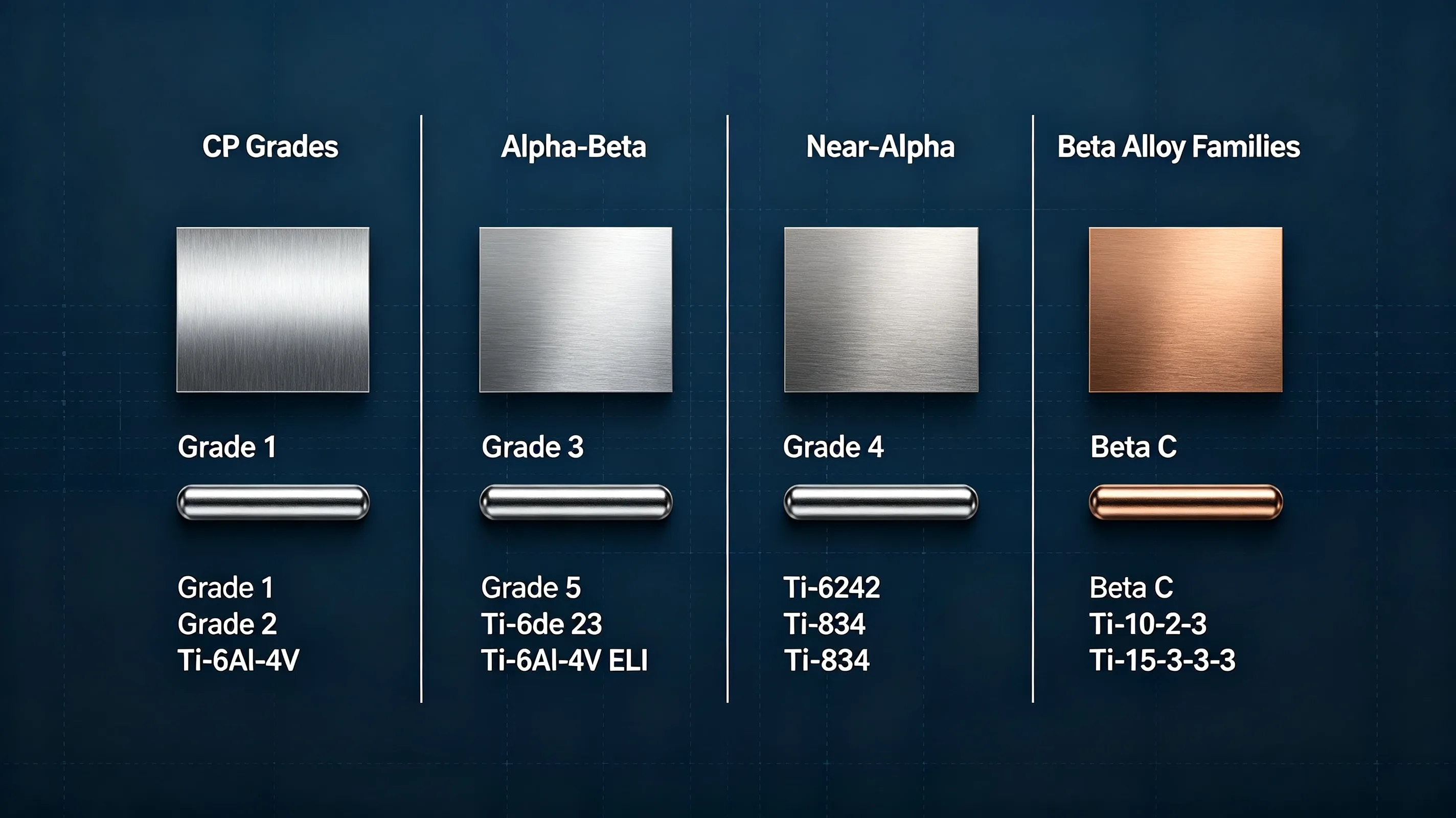
The titanium grade chart organizes alloys primarily by their microstructure — commercially pure (alpha), alpha-beta, near-alpha, and beta — rather than by a single numbering sequence that expresses increasing strength. This is different from the aluminum temper designation system (where higher numbers consistently indicate higher strength) or the steel grading system (where the number often correlates directly with carbon content and tensile strength). The titanium grade numbering system, developed under ASTM B265 and ASTM B348, assigns numbers 1 through 4 to commercially pure grades with increasing oxygen content and strength, then assigns separate grade numbers or alloy names to the compositionally distinct alloy families beyond CP. Understanding which axis of this classification matters for your specific application — strength, temperature capability, corrosion resistance, or formability — is the starting point for reading the grade chart correctly. For detailed comparison of specific grade families, see the CP titanium grades comparison and the titanium grades complete guide.
How the Titanium Grade Chart Is Structured
The titanium grade chart is not a single continuous ranking system. It consists of four separate families, each with its own logic.
Family 1 — Commercially Pure Grades (Grade 1 through Grade 4)
The CP grades are the only grades that form a continuous numerical sequence where higher numbers correspond to higher tensile strength. This works because the only significant compositional variable between them is oxygen content, which increases predictably from Grade 1 (0.18 percent max) to Grade 4 (0.40 percent max).
| Grade | Max oxygen (%) | Tensile strength (MPa) | Elongation (%) | Primary characteristic |
|---|---|---|---|---|
| Grade 1 | 0.18 | 240 | 24 | Maximum formability, deep drawing |
| Grade 2 | 0.25 | 345 | 20 | Best balance, most widely used CP grade |
| Grade 3 | 0.35 | 450 | 18 | Intermediate, available but less commonly stocked |
| Grade 4 | 0.40 | 550 | 15 | Highest CP strength, medical and fastener applications |
The steel and aluminum industries have numbered systems where each increment in grade number corresponds to a known and widely accepted performance increase. In many industrial contexts, engineers familiar with steel or aluminum numbering systems assume that “Grade 5” is simply a stronger version of Grade 4. That assumption is incorrect. Grade 5 is a fundamentally different material — not a higher CP grade but an alpha-beta alloy with aluminum and vanadium added. The jump from Grade 4 to Grade 5 is not a step in the same series; it is a change in alloy category.
Family 2 — Alpha-Beta Alloys (Grade 5, Grade 9, Grade 23)
Alpha-beta alloys contain both alpha-stabilizing elements (aluminum) and beta-stabilizing elements (vanadium, molybdenum) in sufficient quantities to retain a mixed microstructure at room temperature. These are the most widely used titanium alloys because they offer the best balance of strength, ductility, and manufacturability.
| Grade / Designation | Nominal composition | Tensile strength (MPa) | Key application |
|---|---|---|---|
| Grade 5 (Ti-6Al-4V) | Ti-6Al-4V | 895 | Aerospace structural, medical, general engineering |
| Grade 23 (Ti-6Al-4V ELI) | Ti-6Al-4V (extra-low interstitials) | 830 | Medical implants, fracture-critical aerospace |
| Grade 9 (Ti-3Al-2.5V) | Ti-3Al-2.5V | 620 | Hydraulic tubing, moderate strength applications |
Grade 23 is identical in nominal composition to Grade 5 except for tighter limits on oxygen (0.13 percent max versus 0.20 percent) and iron (0.25 percent max versus 0.40 percent). The lower interstitial content improves fracture toughness and damage tolerance at the cost of approximately 60 MPa tensile strength. It is not a different alloy — it is a tighter-specification version of the same alloy.
Family 3 — Near-Alpha Alloys (Ti-6242, Ti-6242S, Ti-1100)
Near-alpha alloys occupy the compositional space between CP alpha grades and alpha-beta alloys. They have higher aluminum content than CP grades (typically 6 percent) and small additions of beta stabilizers (molybdenum, vanadium) to improve forgeability while maintaining primarily alpha microstructure for creep resistance.
These are not numbered in the same sequence as CP grades. They are referred to by their nominal composition or by a grade designation that is specific to each alloy.
| Designation | Composition | Tensile strength (MPa) | Max service temp | Application |
|---|---|---|---|---|
| Ti-6242 | Ti-6Al-2Sn-4Zr-2Mo | 930 | 540°C | Gas turbine compressor components |
| Ti-6242S | Ti-6Al-2Sn-4Zr-2Mo-0.1Si | 930 | 540°C (enhanced creep) | Engine components above 480°C |
| Ti-1100 | Ti-6Al-2Sn-4Zr-6Mo-0.45Si | 950 | 600°C | Extended high-temperature service |
The distinction between a near-alpha alloy and the next category (alpha-beta) is not always sharp. Some alloys classified as near-alpha in the annealed condition transform to a structure with more beta phase during heat treatment, complicating the classification. For procurement purposes, the classification matters less than the specific mechanical properties and certification requirements listed in the applicable AMS standard for the required product form.
Family 4 — Beta Alloys (Ti-1023, Beta-C, Ti-15-3)
Beta alloys contain sufficient beta-stabilizing elements — typically vanadium, chromium, molybdenum, and iron — to retain 100 percent beta-phase microstructure at room temperature after rapid cooling from above the beta transus. They offer the highest tensile strength among titanium alloys but at the cost of density (slightly higher than CP and alpha-beta alloys) and significantly higher machining difficulty.
| Designation | Composition | Tensile strength (MPa, STA) | Key limitation |
|---|---|---|---|
| Ti-1023 | Ti-10V-2Fe-3Al | 1240 | High vanadium cost, difficult to weld |
| Beta-C | Ti-3Al-8V-6Cr-4Mo-4Zr | 1280 | Very high alloy content, limited formability |
| Ti-15-3 | Ti-15V-3Cr-3Sn-3Al | 1170 | Limited to sheet applications |
Beta alloys are rarely interchangeable with CP or alpha-beta alloys. They occupy a distinct application space where very high strength (above 1200 MPa) is required and some reduction in ductility, weldability, and fatigue performance is acceptable.
How to Read the Titanium Grade Chart for Procurement
The grade chart for titanium contains information that is not immediately visible in the mechanical property columns. The following factors affect procurement decisions as much as the listed strength values:
The oxygen-strength curve is linear only within each family
Within the CP series (Grade 1 through Grade 4), each 0.05 percent oxygen increase produces approximately 75 to 100 MPa additional tensile strength. This relationship does not transfer across families. Grade 5’s strength comes from alpha-beta microstructure and solution strengthening, not from oxygen content — its oxygen limit (0.20 percent) is actually lower than Grade 3 (0.35 percent) or Grade 4 (0.40 percent).
Availability varies by category, not by grade number
Grade 2 and Grade 5 are stock items at virtually every titanium service center worldwide. Grade 1, Grade 3, Grade 9, and most beta alloys are less commonly stocked and typically require mill orders with 8 to 20 week lead times. Grade 4 is stocked at centers serving the medical implant industry but may be less available in standard industrial plate thicknesses. Ti-6242 and other near-alpha alloys require mill sourcing with extended lead times (12 to 26 weeks for certified aerospace-grade material).
The procurement implication: the grade chart lists what is possible metallurgically, not what is available practically. Before specifying a less common grade, verify stock availability or budget for extended lead time.
Certification requirements are not uniform across the chart
ASTM B265 and ASTM B348 specify the same certification requirements for all CP grades — standard mill test reports with chemical composition and mechanical property data. However, aerospace applications of alpha-beta alloys (Grade 5, Grade 23) typically require additional certification: ultrasonic inspection per AMS 2630, traceability to the VAR ingot heat, and third-party verification of mechanical test results (EN 10204 Type 3.2).
Near-alpha alloys and beta alloys for engine-critical applications may require even tighter certification: microstructural evaluation per ASTM E3, fracture toughness testing per ASTM E399, and creep testing per ASTM E139 for each heat. The grade chart does not list these requirements. Each specification layer adds cost and lead time that are not captured in the material price per kilogram.
Table 4: Certification requirements by alloy category
| Alloy category | Standard certification (industrial) | Additional certification (aerospace) |
|---|---|---|
| CP grades (1–4) | EN 10204 Type 3.1 chemical + mechanical | Type 3.2, ultrasonic per AMS 2630 (limited) |
| Alpha-beta (Grade 5, Grade 23) | EN 10204 Type 3.1 | Type 3.2, AMS 2630 ultrasonic, VAR heat traceability |
| Near-alpha (Ti-6242, Ti-6242S) | EN 10204 Type 3.1 | Type 3.2, AMS 2630, microstructural per ASTM E3, creep per ASTM E139 |
| Beta (Ti-1023, Beta-C) | EN 10204 Type 3.1 | Type 3.2, AMS 2630, fracture toughness per ASTM E399 |
Machinability drops nonlinearly above the CP range
Grade 2 machines at approximately 60 to 80 surface feet per minute with carbide tooling. Grade 5 machines at 30 to 50 surface feet per minute — roughly half the speed. Ti-6242 machines at 25 to 35 surface feet per minute due to its higher work hardening rate. Beta alloys machine at 15 to 25 surface feet per minute, with tool edge life measured in minutes rather than tens of minutes.
The relationship between grade number and machinability is inverse: higher strength grades take longer to machine, and the time penalty is not proportional to the strength gain. The 22 percent strength increase from Grade 4 (550 MPa) to Grade 5 (895 MPa) comes with a 40 to 50 percent reduction in cutting speed. The strength gain from Grade 5 to Ti-1023 is roughly 35 percent, but the cutting speed reduction is 50 to 60 percent.
Selection Logic Summary
The titanium grade chart is useful as a first-pass reference, but the final grade selection depends on operating temperature, corrosion environment, forming requirements, machining volume, certification level, and material availability — none of which appear on the chart itself.
For procurement and engineering teams evaluating a specific application, the recommended sequence is:
-
Determine the required operating temperature range. Above 400°C continuous, eliminate all CP grades and standard alpha-beta alloys. Above 540°C, eliminate near-alpha alloys and move to nickel-based superalloys.
-
Determine the minimum tensile strength requirement after accounting for design safety factors. If the requirement is below 350 MPa, select from the CP family. If between 350 and 900 MPa, select from alpha-beta alloys. If above 900 MPa, evaluate beta alloys or STA heat-treated alpha-beta alloys.
-
Determine the forming severity. If the component requires deep drawing, severe bending, or extensive cold forming, select from the CP family or Grade 9. Avoid high-strength beta alloys for formed components.
-
Verify stock availability and certification lead time before finalizing the specification. The technical suitability of a grade is necessary but not sufficient for a deliverable procurement plan.
A titanium CNC machining manufacturing partner with documented experience across all four alloy categories can provide the machinability data, certification lead time estimates, and process capability information needed to map a grade chart entry to a producible component.
For a grade-specific quotation on any titanium alloy, submit your requirements through our RFQ portal.
Table 5: Complete titanium grade chart summary
| Category | Grade | Typical tensile strength (MPa) | Key strength | Key limitation | Typical application |
|---|---|---|---|---|---|
| CP alpha | Grade 1 | 240 | Maximum formability, ductility | Low strength | Deep-drawn chemical vessels |
| CP alpha | Grade 2 | 345 | Best balance, corrosion resistance | Moderate strength | Heat exchangers, marine piping |
| CP alpha | Grade 3 | 450 | Intermediate CP strength | Limited availability | Chemical processing, moderate-strength industrial |
| CP alpha | Grade 4 | 550 | Highest CP strength | Reduced formability | Medical implants, fasteners |
| Near-alpha | Ti-6242 | 930 | Creep resistance to 540°C | Machining difficulty | Gas turbine compressor components |
| Near-alpha | Ti-6242S | 930 | Enhanced creep above 480°C | Higher cost than Ti-6242 | Engine components above 480°C |
| Alpha-beta | Grade 5 (Ti-6Al-4V) | 895 | Balanced properties, established process knowledge | Temperature limited to 400°C | Aerospace, medical, general engineering |
| Alpha-beta | Grade 23 (Ti-6Al-4V ELI) | 830 | Improved fracture toughness | 60 MPa strength reduction from Grade 5 | Medical implants, fracture-critical |
| Alpha-beta | Grade 9 (Ti-3Al-2.5V) | 620 | Good formability, weldability | Moderate strength | Hydraulic tubing, moderate structural |
| Beta | Ti-1023 | 1240 | Highest strength (STA) | Very difficult to machine, weld | Landing gear, high-strength fasteners |
| Beta | Beta-C | 1280 | Very high strength, fatigue resistance | High alloy content cost | Springs, high-fatigue applications |
| Beta | Ti-15-3 | 1170 | Sheet formability | Limited to thin sections | Aerospace sheet components |