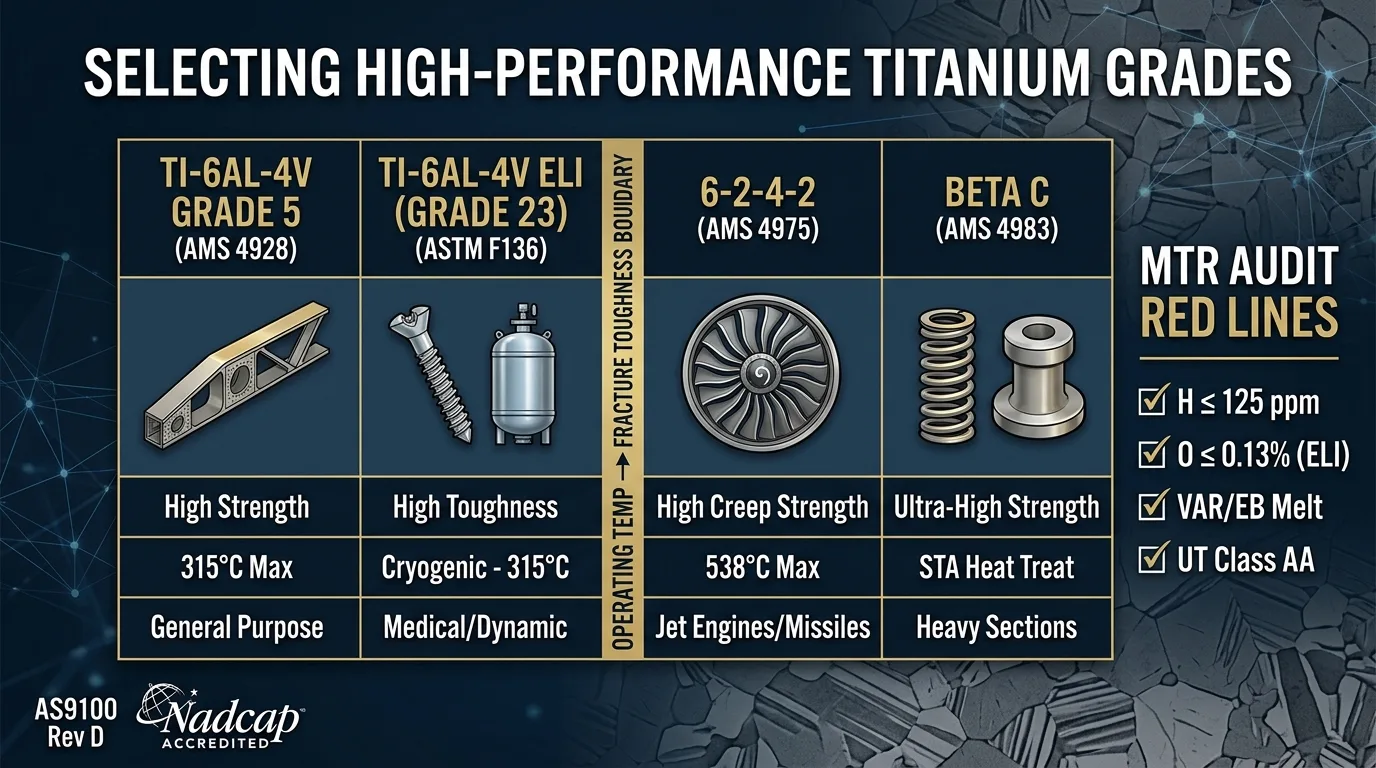
A Technical DFM, Metallurgical Evaluation, and Quality Assurance Guide for Aerospace, Defense, and High-Reliability Procurement.
Executive Summary & Procurement Risk Model
In mission-critical structural engineering — spanning aerospace airframes, missile propulsion systems, deepsea pressure hulls, and medical implantables — selecting the wrong titanium alloy grade introduces cataclysmic structural, compliance, and supply chain risks. While Grade 5 () represents over 50% of total global titanium usage, applying it outside its precise metallurgical operating window frequently leads to premature fatigue fracture, stress corrosion cracking (SCC), or excessive thermal creep.
For procurement managers, supplier quality engineers (SQEs), and manufacturing engineers, material selection must balance four competing variables:
- Microstructural Yield & Fatigue Limits under cyclic loading.
- Interstitial Oxygen Contamination Thresholds affecting fracture toughness ().
- Thermal Creep and Phase Degradation at elevated service temperatures.
- Machinability & Work-Hardening Rates during 5-axis CNC processing.
This guide provides a comprehensive engineering framework to evaluate Grade 5, Grade 23 (ELI), (6-2-4-2), and Beta alloys (e.g., Grade 19 / Beta C), accompanied by a 5-point Mill Test Report (MTR) audit checklist for AS9100 Rev D and NADCAP compliance.
For a broader overview of titanium alloy classification, see the titanium grades complete guide.
1. Metallurgical Foundations: Alpha, Beta, and Interstitial Oxygen Control
Titanium performance is governed by its crystallographic phase transformation. Pure titanium undergoes an allotropic transformation at 882°C (1620°F), transitioning from a hexagonal close-packed (HCP) -phase to a body-centered cubic (BCC) -phase.
       Alpha Stabilizers (Al, O, N, C)      Beta Stabilizers (V, Mo, Ta, Fe)
                   │                                     │
                   ▼                                     ▼
        ┌─────────────────────┐               ┌─────────────────────┐
        │ HCP Crystal Matrix  │               │ BCC Crystal Matrix  │
        │ High Creep Strength │               │ High Ductility      │
        │ Good Weldability    │               │ Deep Hardenability  │
        └──────────┬──────────┘               └──────────┬──────────┘
                   │                                     │
                   └──────────────────┬──────────────────┘
                                      │
                                      ▼
                        ┌──────────────────────────┐
                        │ Alpha-Beta Alloys        │
                        │ (Ti-6Al-4V, 6-2-4-2)     │
                        │ Optimized Strength/Tough │
                        └──────────────────────────┘
The addition of alloying elements alters these phase stability fields:
- -Stabilizers (e.g., Aluminum, Oxygen, Nitrogen): Expand the HCP phase field, increasing high-temperature strength and creep resistance.
- -Stabilizers (e.g., Vanadium, Molybdenum, Iron): Expand the BCC phase field, enhancing room-temperature workability, density, and heat-treatability (Solution Treating and Aging — STA).
Understanding Microstructural Morphology
The mechanical performance of alloys depends on the spatial distribution of equiaxed grains within a transformed matrix (containing acicular platelets).
The Role of Interstitial Elements (O, H, N, C)
Interstitial elements reside in the voids of the titanium crystal lattice. Oxygen acts as a potent solid-solution strengthener, but excess oxygen drastically reduces fracture toughness () and impact resistance.
The relationship between yield strength () and oxygen content () can be modeled as:
When oxygen exceeds 0.20 wt%, micro-cleavage initiation sites form under cyclic stress, accelerating fatigue crack growth rates. Conversely, reducing oxygen to yields Extra Low Interstitial (ELI) grades, such as Grade 23, critical for cryogenic and high-cycle fatigue environments.
2. Comprehensive Engineering Performance & Specification Matrix
The table below contrasts the mechanical, thermal, and specification parameters across primary structural titanium grades:
| Grade / Alloy | Microstructure | Tensile Yield Strength (MPa / ksi) | Max Continuous Operating Temp (°C / °F) | Fracture Toughness () | Primary Aerospace & Medical Specs |
|---|---|---|---|---|---|
| Ti-6Al-4V (Grade 5) | Duplex | 828 – 910 / 120 – 132 | 315°C / 600°F | 45 – 65 | AMS 4928 (Bars), AMS 4911 (Sheet), ASTM B348 |
| Ti-6Al-4V ELI (Grade 23) | Extra Low Interstitial | 758 – 828 / 110 – 120 | 315°C / 600°F | 75 – 100 | AMS 4930, ASTM F136 (Implants), ISO 5832-3 |
| 6-2-4-2 (Ti-6Al-2Sn-4Zr-2Mo) | Near- | 895 – 985 / 130 – 143 | 538°C / 1000°F | 55 – 70 | AMS 4919 (Sheet), AMS 4975 (Bars/Rings) |
| Beta C / Grade 19 (Ti-38644) | Metastable | 1100 – 1300 / 160 – 188 (STA) | 300°C / 570°F | 35 – 50 | AMS 4983, AMS 4984, ASTM B863 |
| Ti-3Al-2.5V (Grade 9) | Near- | 585 – 720 / 85 – 105 | 315°C / 600°F | 60 – 80 | AMS 4943, AMS 4944 (Hydraulic Tubing) |
For a detailed comparison of Grade 5 vs Grade 23, refer to the Grade 5 titanium guide and the Grade 23 ELI guide.
3. Thermal & Cyclic Fatigue Boundary Analysis
                OPERATING TEMPERATURE & STRESS BOUNDARIES

      0°C                      315°C                    538°C
  ────┴──────────────────────────┴────────────────────────┴────────► Temp
      │                          │                        │
      ├─────────────────────────►│                        │
      │  Ti-6Al-4V (Grade 5)     │                        │
      │  Max: 315°C (600°F)      │                        │
      │                          │                        │
      ├─────────────────────────►│                        │
      │  Ti-6Al-4V ELI (Grade 23)│                        │
      │  [Cryogenic - 315°C]     │                        │
      │                          │                        │
      ├──────────────────────────┴───────────────────────►│
      │  Ti-6Al-2Sn-4Zr-2Mo (6-2-4-2)                     │
      │  [Elevated Temp Creep Resistance to 538°C]        │
3.1 Ti-6Al-4V Grade 5: The Industry Workhorse & Thermal Creep Threshold
Ti-6Al-4V Grade 5 specified under AMS 4928 (annealed bars/forgings) offers a high strength-to-weight ratio and corrosion resistance. However, its structural utility degrades above 315°C (600°F).
Engineering Failure Mechanism: Above 315°C, oxygen diffuses into the subsurface layer forming an “Alpha Case” — a brittle, oxygen-enriched phase (). Alpha case acts as a severe notch factory, accelerating micro-cracking and causing thermal creep deformation under continuous stress. Learn more about alpha case formation, prevention, and removal.
3.2 Ti-6Al-4V ELI (Grade 23): Extra Low Interstitials for Cryogenic & Cyclic Fatigue
Grade 23 regulates oxygen (), iron (), and carbon (). By reducing interstitial strain within the HCP lattice, Grade 23 delivers superior damage tolerance and fracture toughness ( vs. for Grade 5).
Key Selection Scenarios:
- Cryogenic Pressure Vessels: At liquid nitrogen (-196°C) or liquid hydrogen (-253°C) temperatures, Grade 5 undergoes ductile-to-brittle transition. Grade 23 retains ductility ( elongation) and impact toughness.
- Aerospace Dynamic Structures: Component areas subjected to high cycle fatigue (HCF) — such as rotor hubs, landing gear hydraulic mounts, and wing spar attachment lugs — mandate Grade 23 to resist crack initiation.
3.3 Ti-6Al-2Sn-4Zr-2Mo (6-2-4-2): High-Temperature Creep Resistance up to 538°C
When jet engine compressor stages or missile control fins operate in ambient temperatures between 315°C and 538°C (600°F – 1000°F), Ti-6Al-4V experiences rapid strength degradation.
Ti-6Al-2Sn-4Zr-2Mo is a near- alloy engineered specifically for high-temperature stability:
- Tin (Sn) and Zirconium (Zr): Provide solid-solution strengthening of the phase without increasing density or promoting brittle intermetallic phase formation ().
- Molybdenum (Mo): Adds 2 wt% -stabilizer to improve forging workability while maintaining creep resistance.
3.4 Beta Alloys (Ti-38644 / Beta C): Ultra-High Strength & Deep Hardenability
Metastable alloys, such as Beta C (), contain high percentages of -stabilizing elements. Through Solution Treating and Aging (STA), phase precipitates uniformly throughout the BCC matrix, pushing yield strength above 1250 MPa (180 ksi).
Primary Uses:
- Heavy-section aerospace forgings requiring through-thickness hardness (where Ti-6Al-4V hardenability limits out beyond 25mm thickness).
- High-stress coil springs and fasteners, delivering up to 40% weight reduction over high-strength alloy steels (e.g., 4340 or 300M).
For more context on when to select specific alloy families, see the titanium alloy selection guide.
4. Design for Manufacturability (DFM) & Machining Risk Mitigation
Machining high-stress titanium alloys requires strict process parameters to avoid thermal damage, residual stress accumulation, and severe tool wear.
                   TITANIUM MACHINING CHALLENGES & DFM CONTROLS

   Physical Characteristic          Machining Consequence           Engineering Control
  ┌────────────────────────┐       ┌──────────────────────┐       ┌─────────────────────┐
  │ Low Conductivity       │──────►│ High Heat Buildup    │──────►│ High-Pressure Coolant│
  │ (~6.7 W/m·K)           │       │ at Cutting Edge      │       │ (70-100 bar)        │
  └────────────────────────┘       └──────────────────────┘       └─────────────────────┘
  ┌────────────────────────┐       ┌──────────────────────┐       ┌─────────────────────┐
  │ Low Elastic Modulus    │──────►│ Part Spring-back &   │──────►│ High-Rigidity Fixtures│
  │ (~110 GPa)             │       │ Vibration/Chatter    │       │ & Climbing Milling  │
  └────────────────────────┘       └──────────────────────┘       └─────────────────────┘
  ┌────────────────────────┐       ┌──────────────────────┐       ┌─────────────────────┐
  │ High Chemical          │──────►│ Tool Galling & BUE   │──────►│ AlTiN/TiSiN Coated │
  │ Reactivity             │       │ (Built-Up Edge)      │       │ Carbide Inserts     │
  └────────────────────────┘       └──────────────────────┘       └─────────────────────┘
Thermal Conductivity & Tool Wear Mechanics
Titanium’s thermal conductivity () is less than 15% that of carbon steel () and 4% that of aluminum. During CNC milling or turning:
- Over 80% of generated heat is absorbed directly into the cutting tool edge rather than dissipating via the chip.
- Cutting zone temperatures quickly exceed 900°C, causing rapid crater wear and plastic deformation of tungsten carbide tools.
Recommended DFM Cutting Parameters
| Parameter | Ti-6Al-4V Grade 5 | 6-2-4-2 / Beta C |
|---|---|---|
| Surface Speed (Vc) | 45 – 65 m/min | 25 – 40 m/min |
| Feed per Tooth (fz) | 0.08 – 0.15 mm/t | 0.05 – 0.10 mm/t |
| Coolant Delivery | High-Pressure ( bar / 1000 psi) | High-Pressure ( bar / 1450 psi) |
| Tool Substrate | Micrograin Carbide | Micrograin Carbide |
| Coating | AlTiN / TiSiN | nACo / PVD Physical |
For a more comprehensive guide on machining parameters, see the DFM guide for titanium parts and high-pressure coolant strategy.
Heat Treatment & Alpha Case Removal
When titanium parts undergo high-temperature solution treatment (e.g., 900°C – 955°C) or thermal stress relief without vacuum or inert argon shielding (), an alpha case forms on the exterior surface.
Mandatory DFM Requirement: Alpha case must be chemically removed via acid pickling ( solution) or chemical milling prior to component deployment. Failure to remove alpha case results in catastrophic surface micro-cracking during fatigue loading.
5. Quality Assurance & Mill Test Report (MTR) Audit Checklist
Procurement and SQE teams must audit every incoming raw material lot against mill certification test records.
                       5-POINT MTR AUDIT FLOWCHART

   [Incoming Lot] ──► (1. Chemical Analysis: H ≤ 125 ppm, O ≤ 0.20%)
                           │
                           ▼
                      (2. Heat Traceability: Melt Source / VAR Proof)
                           │
                           ▼
                      (3. Mechanical Testing: UTS, YS, Elongation)
                           │
                           ▼
                      (4. Microstructure & NDT: Ultrasonic Level II/III)
                           │
                           ▼
                      (5. Regulatory Compliance: DFARS / AS9100)
5-Point MTR Audit Rule for High-Stress Applications
1. Chemical Composition & Interstitial Thresholds
- Verify Hydrogen () content does not exceed 125 ppm (0.0125 wt%) for bars, or 150 ppm for sheet. Excess hydrogen induces time-dependent hydrogen embrittlement.
- Confirm Oxygen () content meets exact grade limits: Grade 5 (), Grade 23 ().
2. Melt Traceability & Processing History
- Audit the primary melting method: Aerospace structural grades require Double or Triple Vacuum Arc Remelting (VAR) or Cold Hearth Melting (PAM/EB) to eliminate High-Density Inclusions (HDI) like tungsten inclusions or Low-Density Inclusions (LDI) like nitrogen-rich hard alpha inclusions.
For further reading on material traceability, see the titanium material certification and traceability guide.
3. Mechanical Property Verification
- Check tensile yield strength (), ultimate tensile strength (), and elongation ().
- Ensure transverse direction (TD) properties match longitudinal direction (LD) properties; anisotropic variation should not exceed 10%.
4. Ultrasonic & Non-Destructive Testing (NDT)
- Confirm material has passed Ultrasonic Testing (UT) per AMS 2631 Class AA or Class A, ensuring freedom from internal voids, shrinkage cavities, or forge bursts.
5. Defense & International Compliance
- Verify compliance with DFARS Clause 252.225-7014 / 252.225-7009 (Specialty Metals Restrictions) requiring melting in qualified or non-embargoed nations.
- Ensure supplier holds active AS9100 Rev D certification and NADCAP accreditation for heat treating and testing laboratories. Learn more about AS9100D quality standards and NADCAP certification.
6. Frequently Asked Questions (FAQ)
Q1: Can Ti-6Al-4V Grade 5 be substituted for Ti-6Al-4V ELI Grade 23 in aerospace parts?
No. Substituting Grade 5 for Grade 23 ELI introduces severe engineering risk. Grade 5 contains higher oxygen content ( vs ), which significantly reduces fracture toughness () and impact resistance, especially in cryogenic environments or dynamic fatigue applications. Such substitutions violate AS9100 configuration controls and can lead to structural cracking.
Q2: What causes hydrogen embrittlement in high-stress titanium components?
Hydrogen embrittlement occurs when atomic hydrogen () concentration exceeds 125–150 ppm. Under mechanical stress, hydrogen migrates to stress concentration zones, precipitating as brittle titanium hydrides (). This leads to sudden, delayed brittle fracture without prior plastic deformation. Pickling and chemical milling processes must be followed by vacuum baking at 480°C – 590°C to degas absorbed hydrogen.
Q3: Why is 6-2-4-2 preferred over Grade 5 for high-temperature jet engine components?
(6-2-4-2) contains tin and zirconium, which strengthen the matrix without forming brittle intermetallic phases. This provides continuous thermal creep resistance up to 538°C (1000°F), whereas Grade 5 suffers from thermal oxidation, microstructural instability, and rapid creep deformation above 315°C (600°F).
For detailed engineering support on material selection or to discuss your specific application requirements, contact our engineering team for a comprehensive DFM review and material recommendations.