Boze Titanium Manufacturing Center | Yacht & Superyacht
Titanium CNC Machining for Superyacht & Yacht Refit Parts
AS9100D-controlled machining of Grade 2 commercially pure titanium and Grade 5 (Ti-6Al-4V) for superyacht refit and repair work — seacocks and through-hull fittings, seawater cooling and heat-exchanger components, wet exhaust parts, propulsion and shaft hardware, and performance sailing rig fittings. Full EN 10204 3.1 / 3.2 traceability with class-society-recognised specifications.
Read moreShow less
Grade 2 / 5CP-Ti & Ti-6Al-4V
EN 102043.1 / 3.2 MTR
1 pcPrototype MOQ
Ti-6Al-4V Grade 2 CP-Ti 5-Axis CNC Seawater Service MTR Traceable
Choosing Between Grade 2 and Grade 5 for Seawater Service
Grade 2 for corrosion containment, Grade 5 for strength, fatigue and cavitation — the two are not interchangeable, and specifying whichever grade was fitted last time is the most common reason a part fails again at the next survey. Most refit enquiries arrive as a drawing copied from the part that was removed, which is exactly the wrong starting point.
Duty-based selection between Grade 2 commercially pure titanium and Grade 5 Ti-6Al-4V for superyacht refit components
Service duty
Grade 2 commercially pure titanium
Grade 5 (Ti-6Al-4V)
Seacocks, through-hull fittings, sea chests and ballast valves
The normal selection. Excellent passive stability in seawater, easy to machine and weld, and the cheapest grade that will not pit.
Unnecessary. Higher strength adds nothing where the design limit is corrosion containment, and costs more per part.
Seawater piping, flanges and heat-exchanger tube plates
Preferred for rolled and welded tube, bends and flanged spool work. Formability matters more than strength in thin-wall pipe.
Use only where a flange face or bolt circle is load-bearing in a way Grade 2 wall thickness cannot carry.
Seawater pump impellers, waterjet impellers and rotating hardware
Acceptable for slow-running static pump casings that do not see sustained cavitation loading.
The correct selection. Sustained cavitation erosion and rotating bending fatigue demand the strength and the work-hardening response of Ti-6Al-4V.
Shaft sleeves, rudder stocks and rig load-bearing terminals
Not recommended. Yield strength is insufficient where fatigue or wear resistance governs service life.
Required. Fatigue-critical and wear-critical parts need the higher specific strength and the wear behaviour of Ti-6Al-4V.
Wet exhaust mixers, elbows and risers
Preferred. Resists acidic condensation from wet exhaust while remaining formable into elbows and mixers; continuous service below 300 degrees Celsius.
Only justified where the dry running section runs hot enough to exceed the Grade 2 continuous rating.
General refit fasteners, studs and deck hardware
Rarely the best answer. Commercially pure titanium is too soft for threaded structural fixings.
The normal selection for load-bearing fasteners and repeated-service rigging hardware.
Below the waterline
Seacocks and Through-Hull Fittings in Grade 2
These are the parts a surveyor opens the boat for. A seacock or through-hull fitting is inspected at every in-water survey, and a pitted or weeping seat is a scheduled replacement rather than a discretionary one. Grade 2 is the correct answer because the design limit here is corrosion containment, not strength.
Bodies, stems and seats machined to the bore and seating geometry of the part being replaced.
Machined as a closed body rather than a thin-wall casting, so sealing faces hold their form.
Galvanically compatible with bronze, steel and composite hulls, so no isolation kit is needed at the joint.
A waterjet impeller or a shaft that fails in service is a grounding, not an inconvenience. These are the most expensive and most consequential items a refit replaces, which is why yards scrutinise the material certification and the dynamic balance record before anything else — and why these are the parts where the specific strength of Ti-6Al-4V changes the design rather than merely replacing a material.
Waterjet and seawater pump impellers
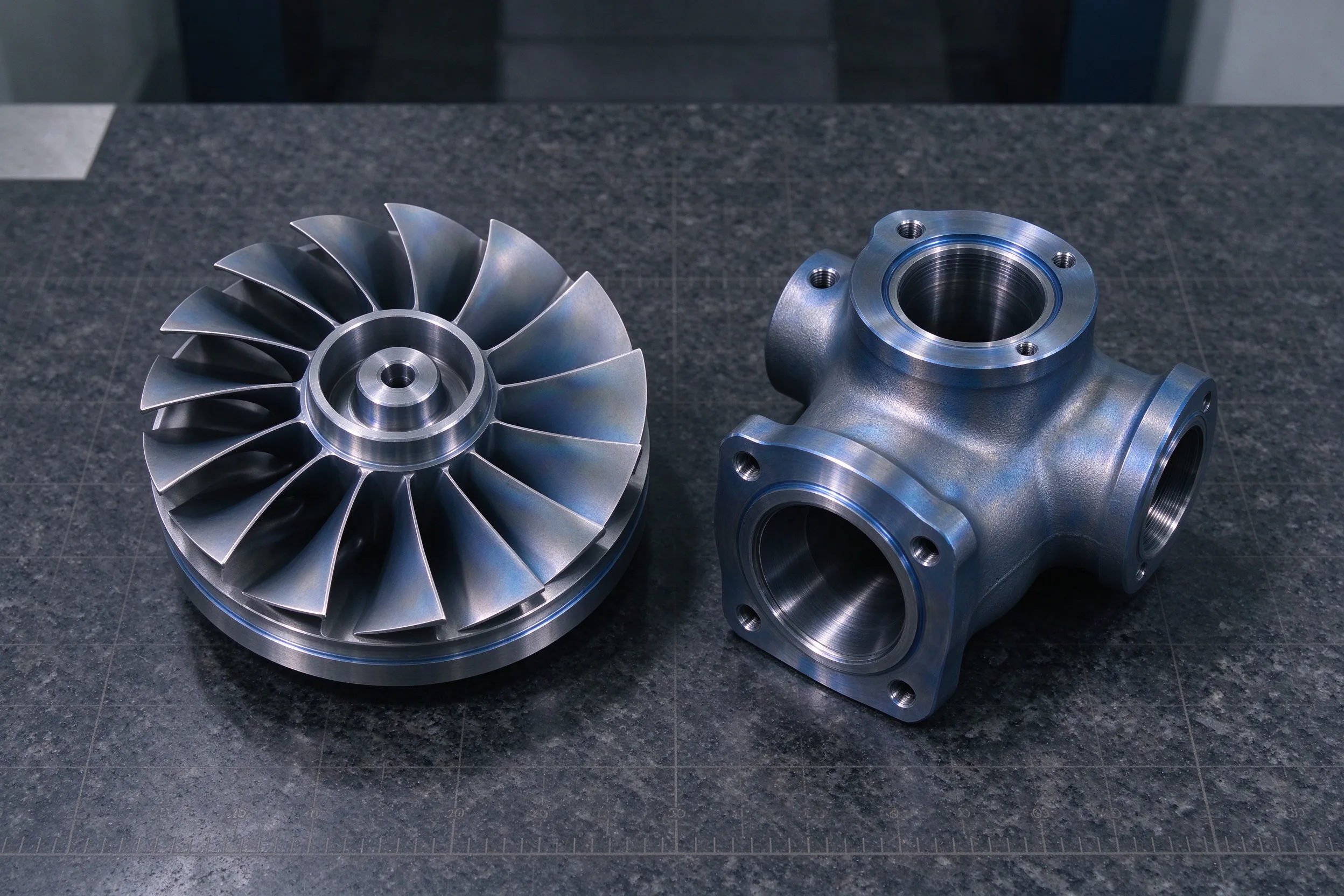
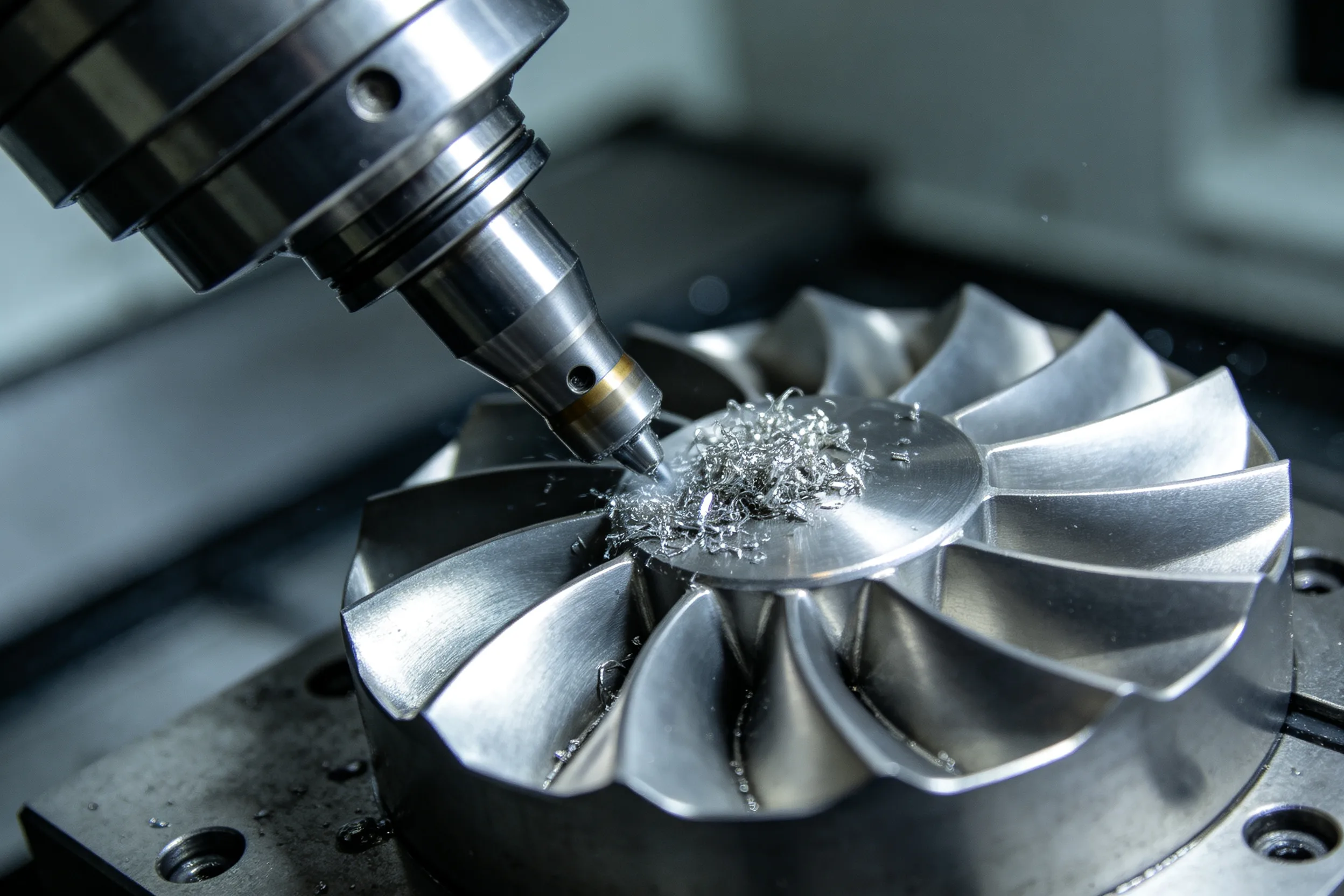
Five-axis machined Grade 5. Sustained cavitation erodes the passivation film on a passive metal and pits the blade profile; the working-hardened surface of Ti-6Al-4V recovers its film instead. Balanced to ISO 1940 G2.5 with a report supplied for each part.
Propeller and shaft components
High-speed propeller and tail-shaft hardware in Grade 5, where corrosion pits in a rotating shaft become the initiation site for rotating-bending fatigue failure. Nondestructive inspection is ultrasonic rather than magnetic particle, because titanium is non-magnetic and cannot be tested by magnetic methods at all.
Shaft sleeves and wear bushings
Grade 2 machined sleeves with an optional thermally sprayed hard carbide coating where the shaft runs against a rubber bearing. The sleeve is the sacrificial wear layer, so it is specified to be replaced rather than repaired, which suits a refit programme.
Rudder stocks and steering gear components
Grade 5 rudder stocks reduce the mass at the top of the rudder and the torque the steering gear must turn, and resist the crevice corrosion that initiates fatigue cracking at a stock sleeve joint.
Below-the-Waterline Fittings and Seacocks
Below-the-waterline failures are a sinking risk, so these parts are specified rather than substituted and they are the first items a surveyor opens. They are also the most repeatable order a refit yard places, because the same fitting types recur across essentially every vessel in the fleet.
Seacocks and through-hull fittings
Grade 2 bodies, stems and seats machined to the bore and seating geometry of the original. Machined as a closed body rather than a thin-wall casting, so the sealing faces and thread forms hold their form across a full refit campaign.
Seawater strainers and intake gratings
Grade 2 welded can bodies with perforated screen or mesh in the same grade. Galvanically compatible with aluminium bronze and steel hulls, and with composite hulls, without the selective leaching that condemns bronze components.
Ballast, bilge and transducer fittings
Frequently cycled valve bodies and low-profile transducer through-hulls, finished to flatness and thread tolerance so a transducer face stays in contact with the hull rather than standing proud into the flow.
Why these parts are re-ordered rather than substituted
Class societies require an in-water survey on a fixed cycle, and through-hull openings, seacocks and shaft sealing areas are inspected every time. Pitting, wall thinning or a failed seat found at survey turns a discretionary replacement into a scheduled one. That survey cycle, rather than any market forecast, is what generates repeat titanium orders from a refit yard, and it is why a yard that has taken delivery once tends to reorder.
Seawater Cooling and Wet Exhaust Systems
Seawater cooling and wet exhaust are the two systems where a yacht spends money on damage that is never visible from the deck. Cooling runs continuously at temperature against chloride-laden water and wet exhaust condenses acidic vapour inside the pipe; both are routine refit scope, and both are where conventional alloys fail earliest.
Heat exchanger tube and tube plates
Grade 2 tube to ASTM B338 with tube plates machined flat for a reliable seal. Nickel brass and steel tube alternatives are replaced far sooner in seawater service; titanium extends the interval between the dry-dock windows a yacht operator actually pays for.
Wet exhaust mixers, elbows and risers
Grade 2 formed and welded components that tolerate acidic condensation while staying formable through elbows and mixing chambers. Supplied with weld procedure qualification and post-weld penetrant inspection on the retained seams.
Seawater pump casings and valve bodies
Grade 2 casings where corrosion containment governs, with Grade 5 impellers where erosion governs, so the material follows the actual damage mechanism on each part rather than one grade being applied to the whole assembly.
Fasteners and refit consumables
Grade 5 studs, bolts and nuts. Refits strip and reassemble these assemblies, and titanium offers weight saving plus the absence of the stress-corrosion cracking that affects stainless fixings in chlorinated service.
Seawater systems
Pump and Waterjet Impellers in Grade 5
Impellers are where cavitation decides the material. Sustained cavitation strips the passive film off a corrosion-resistant metal and pits the blade profile within a fraction of a season. Ti-6Al-4V recovers its film instead, and its work-hardened surface resists the erosion that ruins the aerofoil.
Five-axis machined blade geometry in a single setup, with no lead-in witness marks on the flow surface.
Balanced to ISO 1940 G2.5, with the balance report supplied for each impeller.
Ultrasonic rather than magnetic particle inspection, since titanium is non-magnetic.
On a performance sailing yacht, galvanic compatibility with carbon fibre matters as much as strength — and it is what rules out several otherwise adequate alloys. Every metal fitting touching the rig is a potential corrosion cell, so material selection is driven by electrical compatibility with composite, not only by mechanical performance.
Standing rigging terminals and turnbuckles
Grade 5 forged and machined terminals, chosen for specific strength at the masthead where every kilogram is amplified into righting moment, and for a corrosion potential close to carbon fibre that keeps galvanic current low where the fitting meets the spar.
Mast steps and carbon-fibre interfaces
Grade 5 mast steps machined for the spar interface, supplied with insulating washers at the carbon-fibre contact face. Aluminium fittings at this joint corrode measurably faster than the surrounding spar, so the interface is designed rather than merely bolted.
Shackles, toggles and cleats
Grade 5 load-bearing rigging hardware in small, repeatable quantities. Pin bore condition and mating clearance are controlled, and titanium-on-titanium pivots are detailed with lubrication or a dissimilar hard facing to avoid galling.
Winch gears and spindles
Grade 5 machined winch components. Titanium cannot be case hardened, so tooth contact surfaces are specified with a hard coating where rope contact wear would otherwise outrun the base material.
Sailing rig
Rigging Terminals and Carbon-Fibre Interfaces
On a performance yacht the second constraint is galvanic, not mechanical. Carbon fibre and a metal fitting in contact form a cell, and the metal corrodes at the rate the dissimilar pair demands. Grade 5 sits close to carbon fibre in potential, which is why it is specified at the mast step and the standing-rigging terminals.
Rolled threads and machined conical seats for repeatable tension adjustment under load.
Insulating washers supplied at the carbon-fibre contact face as part of the interface design.
Titanium pivots detailed with lubrication or a dissimilar hard facing to prevent galling.
Certification and Traceability for Class-Approved Parts
A refit part is accepted on paperwork, not on appearance: the mill certificate, the heat number and the inspection records must together let a surveyor confirm what the metal is and how it was verified. EN 10204 3.1 is the routine requirement; 3.2 with third-party witness is specified where a part is load-bearing or pressure-retaining.
Why magnetic particle inspection cannot be used on titanium
Titanium is non-magnetic, so magnetic particle inspection has nothing to detect and must not be specified on a refit order. Surface-breaking indications are found by liquid penetrant testing, internal indications by ultrasonic testing, and tube by eddy current testing. Material verification is by positive material identification against the mill certificate, heat by heat.
Everything a Yacht & Superyacht engineering buyer needs to evaluate us in one place: materials, components, manufacturing capability, and quality compliance.
Why Titanium for Yacht & Superyacht
Passive stability in seawater — Grade 2 forms a self-repairing oxide film, so below-the-waterline parts resist pitting and do not need sacrificial anodes to survive.
Reduced mass where it counts — Grade 5 delivers the strength of a much heavier alloy, cutting weight at the masthead and on rotating hardware where every kilogram is amplified into a dynamic load.
Whole-life cost across survey cycles — a part that survives its design life removes two or three dry-dock windows, each of which costs berth time, crew time and lost charter availability.
Compatibility with the rest of the vessel — titanium sits close to bronze and composite in corrosion potential, so it avoids the galvanic coupling that condemns fittings at the joints.
Typical Yacht & Superyacht Titanium Components
Seacocks, through-hull fittings, sea chests and ballast valve bodies
Seawater pump and waterjet impellers, shaft sleeves and rudder stocks
Heat exchanger tube plates, seawater flanges and wet exhaust mixers
Standing rigging terminals, mast steps, shackles and deck hardware
Manufacturing Capability
5-axis CNC milling for impeller blades and multi-face through-hull geometry
Tolerances held to +/-0.005 mm on seat faces and thread-machined interfaces
Prototype MOQ of 1 piece, machined directly from your 3D CAD file
TIG welding with inert back-purge, and post-weld penetrant inspection
Submit your part drawings and specifications for an expert Design for Manufacturability (DFM) review. Our engineering team will assess your titanium component's machinability, tolerancing, and cost-optimization potential — with a detailed quotation within 24 hours.
Supported file formats: STEP, IGES, STL, PDF, DWG • NDA available on request
About Boze Titanium Manufacturing Center
One Metal. One Focus. Infinite Precision.
Founded in 2011 in Baoji's Titanium Valley, BOZE Metal is dedicated exclusively to titanium — from raw material to precision engineering.
AS9100D, & ISO 9001 certified
with 500+ clients across Aerospace, Medical & Motorsport industries, we deliver end-to-end precision titanium CNC machining with full material traceability from source to component.
Boze Titanium Manufacturing Center is operated by Baoji Boze Metal Products Co., Ltd.
Certifications verified by
ASTM International titanium material specifications (B265, B348, B381, F136, F2924) with full EN 10204 3.1 mill test certification. Our quality system is operated under AS9100D by Baoji Boze Metal Products Co., Ltd.
This website uses cookies to improve your browsing experience, analyze site traffic, and deliver personalized advertising. By clicking 'Accept All', you consent to the use of all cookies.