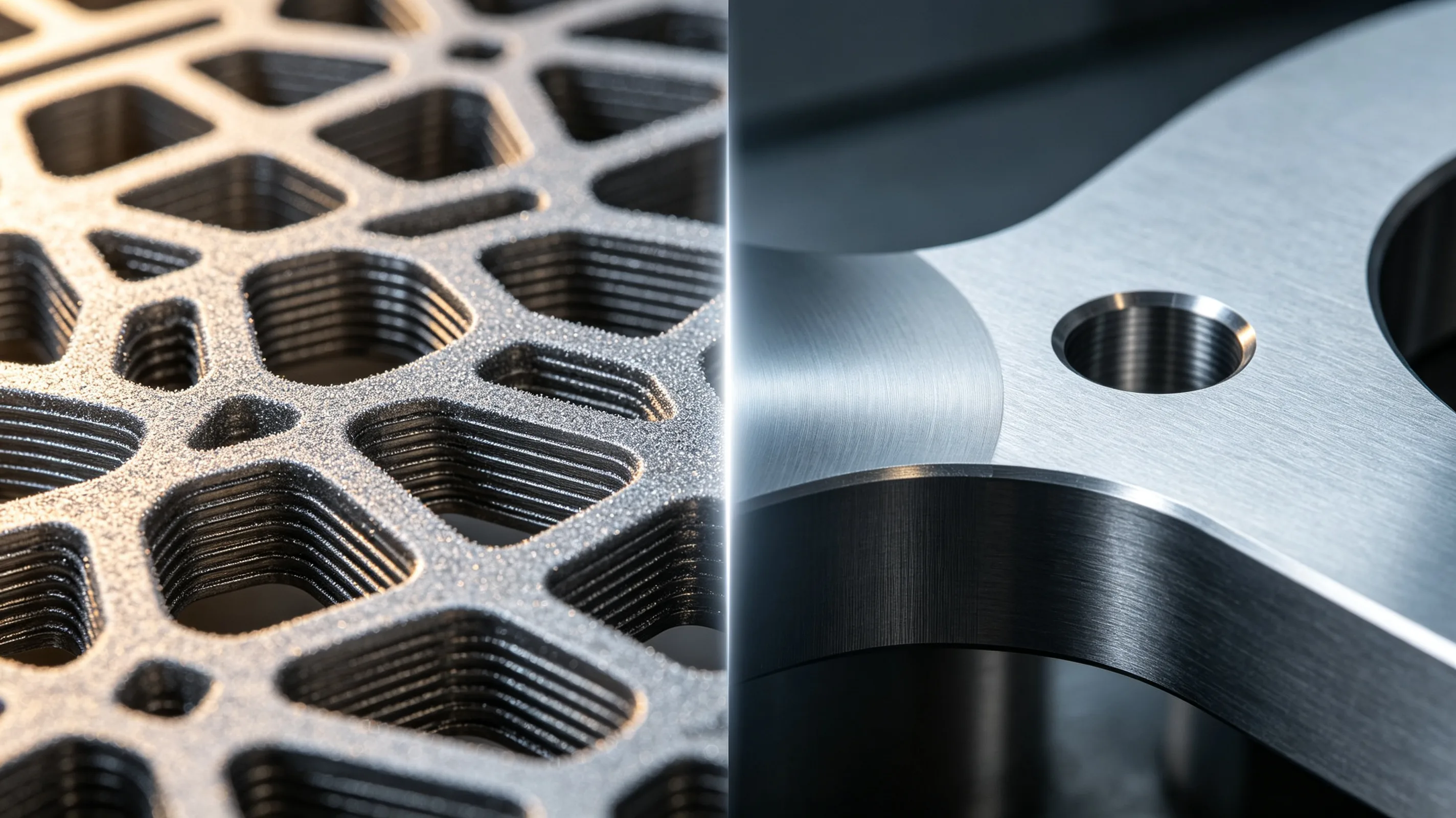
Additive manufacturing and CNC machining are often presented as competing technologies for titanium component production, but in practice they serve different geometric and production niches. Understanding the capability and limitations of each process is important for selecting the most cost-effective manufacturing approach for a given component. The machining challenges that apply to conventionally produced titanium also apply to post-processing of additively built components, as discussed in the article on why titanium is difficult to machine. For a comparison of our process capabilities, see titanium additive manufacturing and titanium CNC machining services.
Geometric capability comparison
Additive manufacturing can produce geometries that are impossible to machine — internal lattice structures, conformal cooling channels, organic lattice transitions, and monolithic assemblies that would require multiple machined components joined together. The geometric freedom of AM is its primary advantage over machining.
CNC machining can produce geometries that are difficult or impossible to build additively — deep pockets with tight tolerances, fine threads, precision sealing surfaces, and features that require specific surface finishes. Machining also produces components with no internal porosity and with a fully wrought microstructure.
The practical intersection is in components that combine complex geometry with precision features. An aerospace bracket with an organic topology-optimized shape and precision-machined mounting surfaces is a typical hybrid application — the complex shape is built additively, and the critical surfaces are finished by machining.
Material property differences
Titanium components produced by powder bed fusion additive manufacturing have a different microstructure from wrought material. The as-built microstructure consists of fine acicular alpha-prime martensite resulting from the rapid solidification and cooling rates inherent to the process. This microstructure has higher strength but lower ductility than wrought annealed Ti-6Al-4V.
Hot isostatic pressing after additive manufacturing eliminates internal porosity and transforms the as-built microstructure into a lamellar alpha-beta structure with improved ductility and fatigue properties. HIPed AM titanium has tensile properties that are comparable to wrought material, although the fatigue performance can still differ due to surface roughness effects.
The surface finish of as-built AM titanium is typically Ra 10 to 20 μm, compared to Ra 0.4 to 1.6 μm for machined surfaces. The rough as-built surface contains surface irregularities that can act as fatigue initiation sites. For fatigue-loaded components, the as-built surface must be improved by machining, polishing, or chemical milling.
Cost drivers
The cost structure of additive manufacturing and CNC machining is fundamentally different. AM cost is dominated by build time and machine utilization, with minimal tooling cost and no geometric complexity penalty. Machining cost is dominated by setup and cycle time, with increasing cost for complex geometries that require multiple setups, specialized tooling, or long machining cycles.
For low quantities — one to fifty components — additive manufacturing is often cost-competitive with machining for complex geometries. The absence of tooling and the reduced setup time offset the slower build rate. For higher quantities, the per-part cost of AM remains nearly constant while machining cost decreases as tooling and setup costs are spread across more parts.
Component size is a limiting factor for AM. Most powder bed fusion systems have build volumes of 250 to 500 mm in the largest dimension. Larger components must be built in segments and joined, or machined from solid stock. For large titanium components, machining is often the only practical option regardless of geometry complexity.
Hybrid approaches
Hybrid manufacturing — combining additive and subtractive processes — takes advantage of the strengths of each technology. The typical hybrid approach builds the near-net shape additively and finishes the critical surfaces by machining. This combination provides geometric complexity where needed and precision surfaces where required.
The hybrid approach requires coordination between the additive and machining processes. The additive build must include machining allowance on surfaces that will be finished. The component must be designed with fixturing features that allow it to be held during machining. The additive and machining operations must be planned as a single process rather than as independent operations.
Table 1: AM vs CNC machining for titanium
| Factor | Additive manufacturing | CNC machining |
|---|---|---|
| Geometric complexity | Unlimited | Constrained by tool access |
| Surface finish | Ra 10–0 μm (as-built) | Ra 0.4–0.6 μm (standard) |
| Tolerance capability | ±0.1–0.2 mm | ±0.025–0.05 mm |
| Material properties | HIP required for fatigue | Wrought properties as-machined |
| Cost for low volume | Competitive for complex parts | Higher due to setup |
| Cost for high volume | Higher per-part cost | Lower per-part cost |
| Maximum size | Limited by build volume | Limited by machine travel |
For guidance on whether additive, machining, or a hybrid approach fits your component, submit your requirements and our engineers will recommend the manufacturing route.