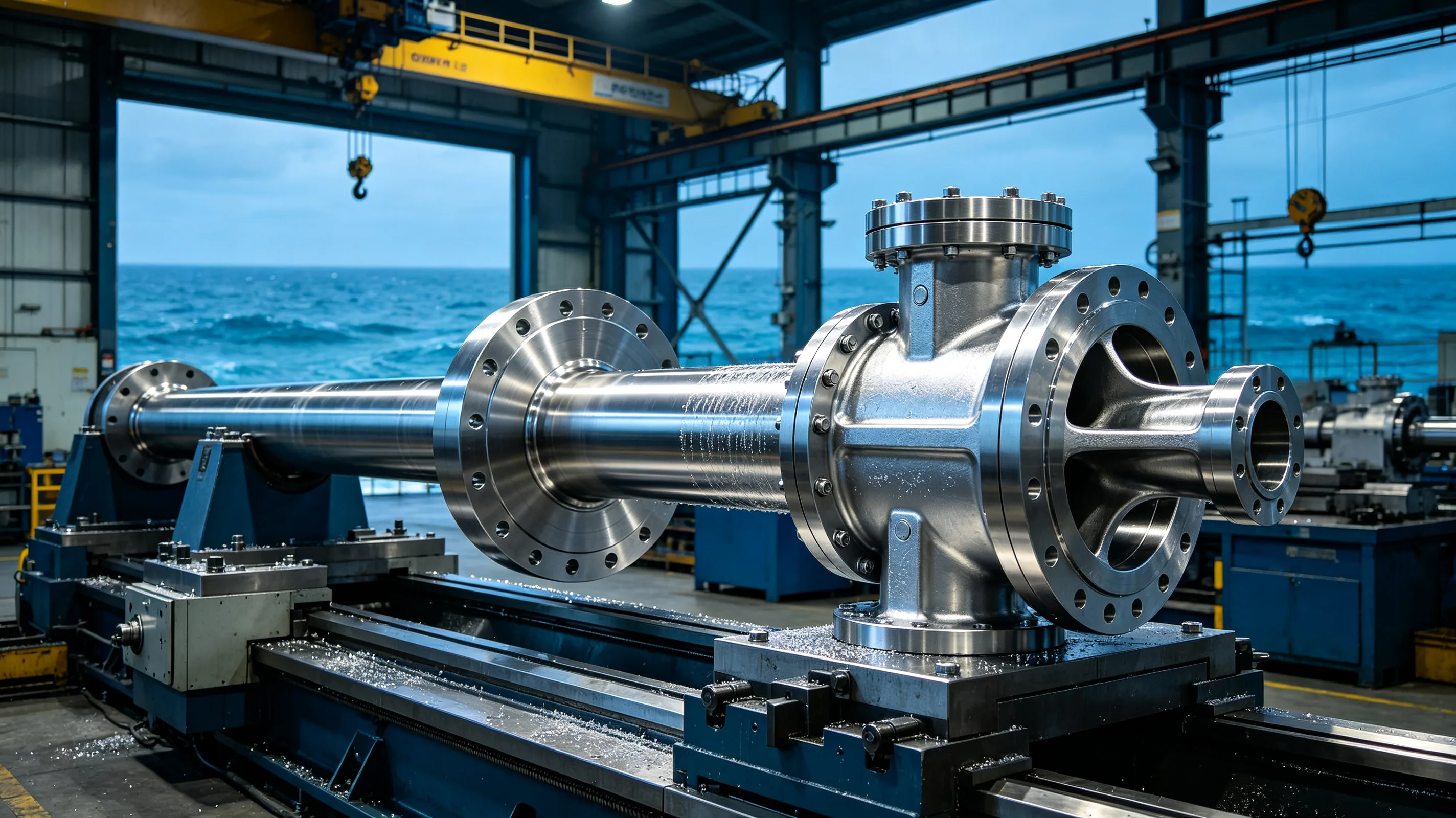
Titanium machining for marine components has become a critical capability in naval, commercial shipping, and offshore energy sectors as designers increasingly specify titanium for seawater-exposed parts that must outlast the service life of the vessel or platform. Marine components — propeller shafts, seawater valve bodies, heat exchanger tubesheets, hull penetrators, sonar equipment housings, and propulsion system impellers — benefit from titanium’s specific strength, erosion resistance, and immunity to pitting and crevice corrosion in chlorinated seawater. This article examines why material selection and machining process choices interact to determine the service performance of titanium marine components, and provides guidance for manufacturing engineers and procurement teams specifying CNC machining for these applications.
Executive summary
Titanium machining for marine components is not interchangeable with titanium machining for aerospace or medical applications, because the service environment imposes different material and process priorities. Marine titanium components face continuous seawater exposure, biofouling, erosion from suspended sediments, galvanic coupling with hull steel and cathodic protection systems, and — for naval applications — shock loading and acoustic signature requirements. The material selection decision between CP titanium grades and Ti-6Al-4V affects not only component strength but also machinability, weldability, and repairability. The machining process decisions — cutting speed, feed rate, tool coating, and coolant strategy — determine whether the component maintains its corrosion resistance through its intended service life or develops localised attack at machining-induced surface defects. Correct material and process selection, applied together, produces marine titanium components that deliver 30+ year service lives with minimal maintenance intervention.
Material selection for marine titanium components
The titanium alloy selection for a marine component depends on the balance between mechanical loading, corrosion exposure, and fabrication requirements. Three alloy families dominate marine titanium machining.
Commercially pure titanium (Grades 1, 2, 3, 4)
CP titanium grades are specified for marine components that require maximum corrosion resistance but have moderate mechanical loads. Grade 2 is the most widely used CP grade for seawater piping, valves, and pump components. Its yield strength of 275–410 MPa is sufficient for pressure-containing components up to Class 300 ratings, while its ductility (20–30% elongation) supports cold forming and flanging operations. From a machining perspective, CP titanium grades are more ductile than Ti-6Al-4V, producing long, continuous chips that require chip-breaking geometries and high-pressure coolant to evacuate. Positive rake inserts with sharp edges prevent built-up edge formation, which degrades surface finish and can introduce iron contamination that compromises corrosion resistance.
Ti-6Al-4V (Grade 5) is specified for marine components subject to higher mechanical loads — propeller shafts, high-speed impellers, structural brackets, and equipment mounts. Grade 5 provides approximately three times the yield strength of Grade 2, enabling weight reduction in components that must be handled during installation or that contribute to payload limits on vessels and platforms. The machining challenges of Grade 5 — low thermal conductivity causing heat concentration at the cutting edge, work hardening at the shear zone, and tool wear from abrasive oxide particles — require controlled cutting parameters and robust coolant delivery. The reward is a component that combines high strength with full seawater corrosion resistance, eliminating the need for coatings or corrosion allowance that add weight and maintenance requirements.
Specialty marine titanium alloys
Ti-6Al-2Nb-1Ta-0.8Mo (commonly referred to as Ti-6-2-4-2 S or marine-grade titanium) is specified for naval propulsion components and hull penetrations where resistance to stress corrosion cracking in seawater is critical. This near-alpha alloy offers improved creep resistance and fracture toughness compared to Ti-6Al-4V at temperatures up to 400 °C, making it suitable for components in engine-room seawater systems that see elevated temperatures. Machining of Ti-6-2-4-2 S requires lower cutting speeds (12–25 m/min) than Grade 5 due to its higher content of refractory alloying elements that increase abrasive wear on cutting tools. AlTiN-coated carbide inserts with micro-litre coolant delivery through the tool are standard.
| Titanium Grade | Yield Strength (MPa) | Typical Marine Application | Key Machining Consideration | Relative Machinability |
|---|---|---|---|---|
| CP Ti Grade 2 | 275–410 | Seawater piping, valve bodies, pump casings | Ductile chips, built-up edge risk | Moderate (chip control critical) |
| CP Ti Grade 4 | 480–550 | Flanges, instrument housings, tube sheets | Balance of ductility and strength | Moderate |
| Ti-6Al-4V Grade 5 | 830–900 | Propeller shafts, impellers, structural brackets | Low thermal conductivity, work hardening | Moderate-Low |
| Ti-6Al-4V ELI Grade 23 | 760–830 | Naval pressure housings, sonar equipment | Lower interstitial content, improved toughness | Moderate-Low |
| Ti-6-2-4-2 S | 930–1,050 | Propulsion shafts, hull penetrators | High abrasive wear, requires AlTiN tooling | Low |
| Ti-3Al-2.5V Grade 9 | 620–760 | Hydraulic tubing, heat exchanger tubing | Moderate strength, good formability | Moderate |
Process selection for marine titanium CNC machining
The CNC machining process for marine titanium components must be selected and parameterised to produce a component that meets drawing tolerances, maintains surface integrity for corrosion resistance, and conforms to marine classification society requirements.
Surface integrity requirements for seawater service
The most critical machining process parameter for marine titanium components is the surface integrity of features that contact seawater. Machining-induced surface damage — feed marks deeper than Ra 0.8 µm, torn or smeared material, microcracks, and embedded tool particles — creates initiation sites for pitting corrosion, crevice corrosion under biofouling deposits, and stress corrosion cracking in chloride environments. The machining process must be designed to produce a surface that supports the formation of a uniform, stable passive oxide film.
Finish machining passes for seawater-exposed surfaces should use feed rates no higher than 0.08 mm/rev with wiper geometry inserts that produce consistent surface finishes at Ra 0.4–0.8 µm. Cutting speeds in the 20–30 m/min range for Ti-6Al-4V provide a balance between tool life and surface quality. Coolant must be filtered to below 20 µm particle size to prevent recirculation of carbide fines that embed in the titanium surface and create galvanic cells. After machining, chemical passivation per ASTM F86 removes free iron contamination and promotes uniform oxide growth. For CP titanium components, passivation is equally important despite the lower alloy content, because iron contamination from tool wear or handling is more readily absorbed into the softer surface.
Tolerance specifications for marine components
Marine component tolerances are determined by classification society rules (ABS, DNV, Lloyds Register) and equipment standards (ISO, API, SOLAS). Typical requirements include the following.
Shaft and bearing journal tolerances for propeller shafts and pump shafts are specified at ISO IT6 to IT7 grade, corresponding to approximately ±0.012 mm for diameters in the 100–200 mm range. These tolerances are achievable on CNC lathes with live tooling and C-axis positioning, provided the workpiece is supported by steady rests that prevent deflection under cutting forces. Grinding is sometimes specified for final journal finishing on hardened marine shafts, but for titanium shafts in the as-machined condition, finish turning with wiper inserts at feed rates below 0.05 mm/rev produces consistent IT7 tolerance with surface finishes below Ra 0.4 µm.
Bolt hole patterns for marine flanges and equipment mounts follow dimensional standards that specify bolt circle diameter tolerances of ±0.2 mm and hole positional tolerances within 0.5 mm true position. These requirements are routinely achieved on 4-axis CNC machining centres with CMM-backed setup validation. For large fabrications that exceed machine travel capacity, portable boring bars and drilling fixtures are used, with dimensional verification by laser tracker.
Sealing surface requirements for marine valve bodies and pump housings follow API 600 or manufacturer standards. Flatness of gasket surfaces is typically specified at 0.1 mm per metre of flange diameter, with surface finish Ra 1.6–3.2 µm for spiral wound gaskets and Ra 0.8 µm for ring-type joint gaskets.
Coolant and chip management for marine titanium machining
Marine titanium components are frequently machined from large bar stock or forgings — shaft diameters exceeding 300 mm, valve bodies weighing over 500 kg, tubesheets up to 2 metres in diameter. The chip volume generated by roughing operations on these components can exceed 200 kg per part, and the chip morphology of titanium — short, segmented chips that pack densely — requires coolant systems designed for heavy metal removal.
Through-spindle coolant at 70–100 bar is the standard for marine titanium machining. The coolant performs three functions: heat removal from the cutting zone (critical for titanium’s low thermal conductivity), chip breaking through hydraulic pressure, and chip flushing to prevent recutting of debris that damages tool edges and surface finish. Coolant filtration systems for marine titanium cells should include magnetic separators and paper-bed filters rated to 10 µm to maintain fluid cleanliness. Coolant temperature control within ±1 °C of the metrology lab temperature prevents thermal drift during long machining cycles — a 300 mm titanium shaft expands 0.07 mm per 10 °C temperature change, which is significant relative to IT6 tolerance bands.
Quality standards and classification society requirements
Marine components are subject to classification society survey requirements that differ from customer-specific quality standards in aerospace or medical manufacturing. Understanding these requirements is essential for CNC machining suppliers serving the marine sector.
Classification society approvals
Components intended for use on classed vessels — cargo ships, tankers, naval vessels, offshore platforms — must be manufactured in facilities approved by the relevant classification society. ABS (American Bureau of Shipping), DNV (Det Norske Veritas), Lloyds Register, and BV (Bureau Veritas) each maintain requirements for manufacturing facility capability, quality management system certification, and product-specific type approval. For titanium components, the classification society survey typically covers material certification verification, dimensional inspection witnessing, and NDT procedure review.
Material certification for marine titanium
Marine titanium components require material certification that documents compliance with the relevant ASTM or API material specification, and additionally confirms seawater corrosion resistance where specified. The material test report must include chemical composition, tensile properties (yield, ultimate, elongation, reduction of area), and — for welded components — weld procedure qualification records. Hardness testing (Brinell or Rockwell C) is specified for components subject to wear, such as shaft bearing journals and valve seat faces. The material certification must be traceable to the specific component through a unique serial number or heat number applied by low-stress marking.
NDT requirements for marine components
Non-destructive testing requirements for marine titanium components are specified by the component standard or classification society rules. Dye penetrant inspection per ASTM E1417 is applied to all seawater-exposed surfaces after final machining to confirm absence of surface cracks and laps. Ultrasonic inspection per ASTM E2375 is specified for shafts, forgings, and heavy-wall pressure components to confirm internal soundness. Radiographic inspection is specified for welded marine components. NDT hold points must be integrated into the machining schedule so that inspection occurs before the component moves to the next manufacturing stage.