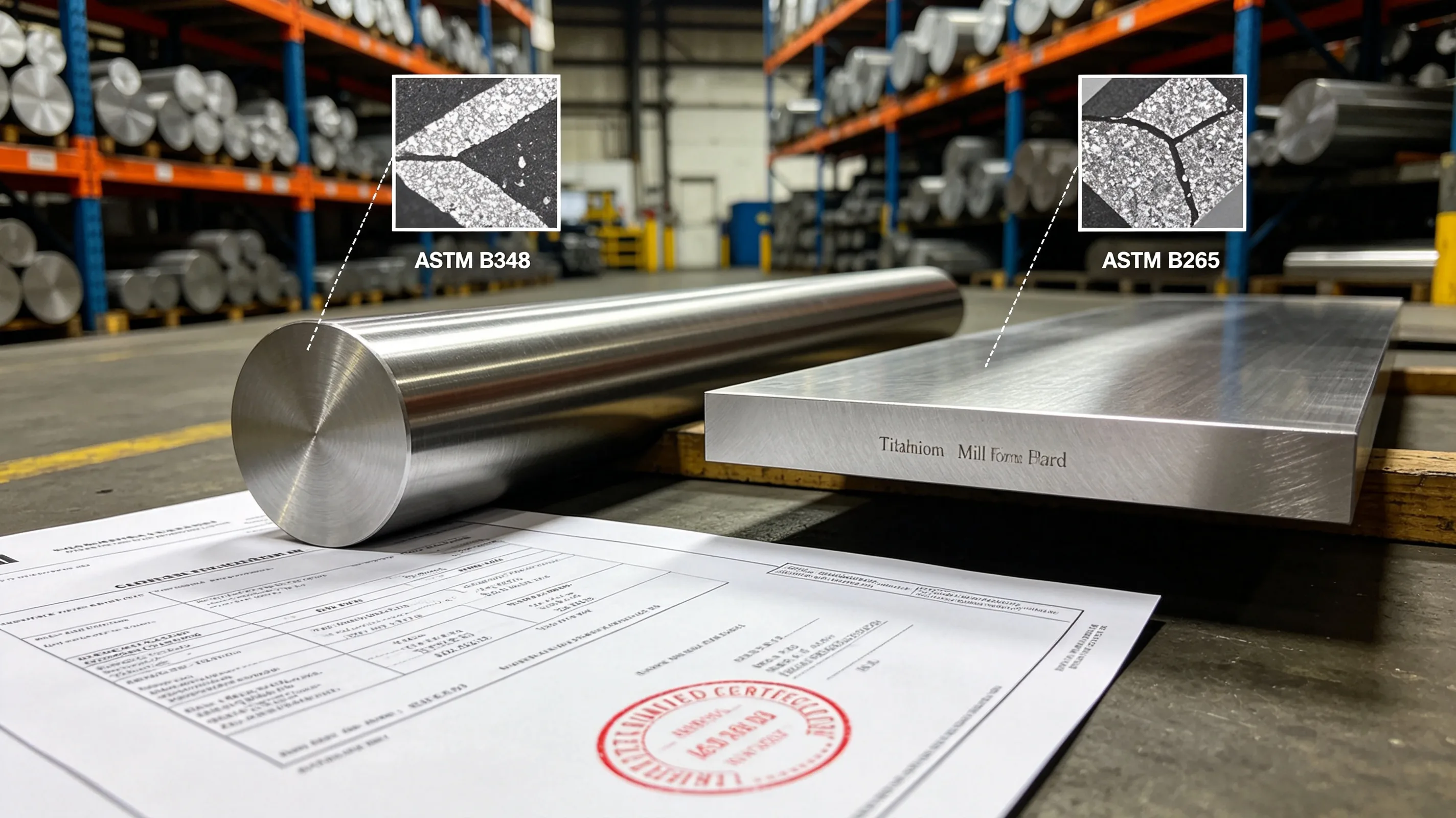
ASTM B348 and ASTM B265 are the two most commonly referenced material standards for titanium used in CNC machining. ASTM B348 covers titanium and titanium alloy bar and billet — round, square, and hexagonal cross-sections. ASTM B265 covers titanium and titanium alloy sheet, plate, and strip — flat-rolled products. Understanding the differences between these standards is important for material selection and procurement specification.
Product form coverage
ASTM B348 applies to bar and billet products with diameters or cross-sections from 6 mm to 250 mm and larger. Bar is typically used for machining components that are turned or machined from round stock. Billet is used for forging and for large components machined from solid material.
ASTM B265 applies to sheet, plate, and strip products. Sheet is defined as material less than 4.75 mm thick. Plate is 4.75 mm and thicker. The standard covers widths up to 3000 mm and lengths up to 12000 mm, depending on the mill capability.
The practical significance for component design is that the material product form determines the grain orientation relative to the machined features. Bar has a grain structure oriented along the length of the bar, which affects mechanical properties in the transverse direction. Plate has a grain structure oriented in the rolling plane, with different properties in the longitudinal and transverse directions.
Mechanical property requirements
Both ASTM B348 and ASTM B265 specify the same mechanical property requirements for each grade, with minor exceptions. Ti-6Al-4V Grade 5 per ASTM B348 requires a minimum tensile strength of 895 MPa and minimum yield strength of 828 MPa. The same grade per ASTM B265 requires the same minimum properties. For a broader comparison of how these grades fit into the titanium alloy family, see the titanium grades complete guide.
The difference in property requirements between bar and plate is primarily in the ductility and fracture toughness expectations. Plate products generally have more consistent through-thickness properties than bar products of equivalent diameter, because the rolling process produces more uniform deformation. Bar products may have different properties at the center and surface of the bar, particularly in larger diameters.
Testing and certification
Both standards require chemical analysis and tensile testing for each production lot. The testing frequency and acceptance criteria are defined in the standard. Additional testing — ultrasonic inspection, fracture toughness testing, or microstructure evaluation — may be specified by the purchaser as supplementary requirements.
The certification requirements for bar and plate are the same — the mill test report must document the chemical composition, tensile properties, and any supplementary test results. The material must be identified by heat number, and the certification must include the standard designation and grade.
Practical selection considerations
For components machined from round stock — shafts, pins, fittings, and fasteners — ASTM B348 bar is the appropriate material specification. The bar diameter is selected to provide sufficient stock for the component’s largest diameter plus machining allowance.
For components machined from flat stock — brackets, flanges, housings, and structural components — ASTM B265 plate is the appropriate specification. The plate thickness is selected to provide the required component thickness plus machining allowance from both sides.
For components that require material properties in multiple orientations — complex machined components with features in different directions — the material product form selection should consider the grain orientation effects. Plate typically provides more uniform properties across the component than bar of equivalent cross-section.
Table 1: ASTM B348 vs ASTM B265 comparison
| Aspect | ASTM B348 (bar and billet) | ASTM B265 (sheet and plate) |
|---|---|---|
| Product forms | Round, square, hexagonal bar; billet | Sheet (<4.75 mm), plate (–0.75 mm), strip |
| Typical diameter/thickness | 6 mm to 250+ mm | 0.4 mm to 100+ mm |
| Grain orientation | Longitudinal along bar axis | Rolling plane, in-plane properties |
| Typical components | Shafts, pins, fittings, turned parts | Brackets, flanges, housings, structural parts |
| Mechanical properties | Same grade requirements by standard | Same grade requirements by standard |
| Supplementary testing | Ultrasonic, fracture toughness (as specified) | Ultrasonic, fracture toughness (as specified) |
Specifying the correct ASTM standard, grade, and product form in your RFQ ensures the material is procured and certified to the right specification.