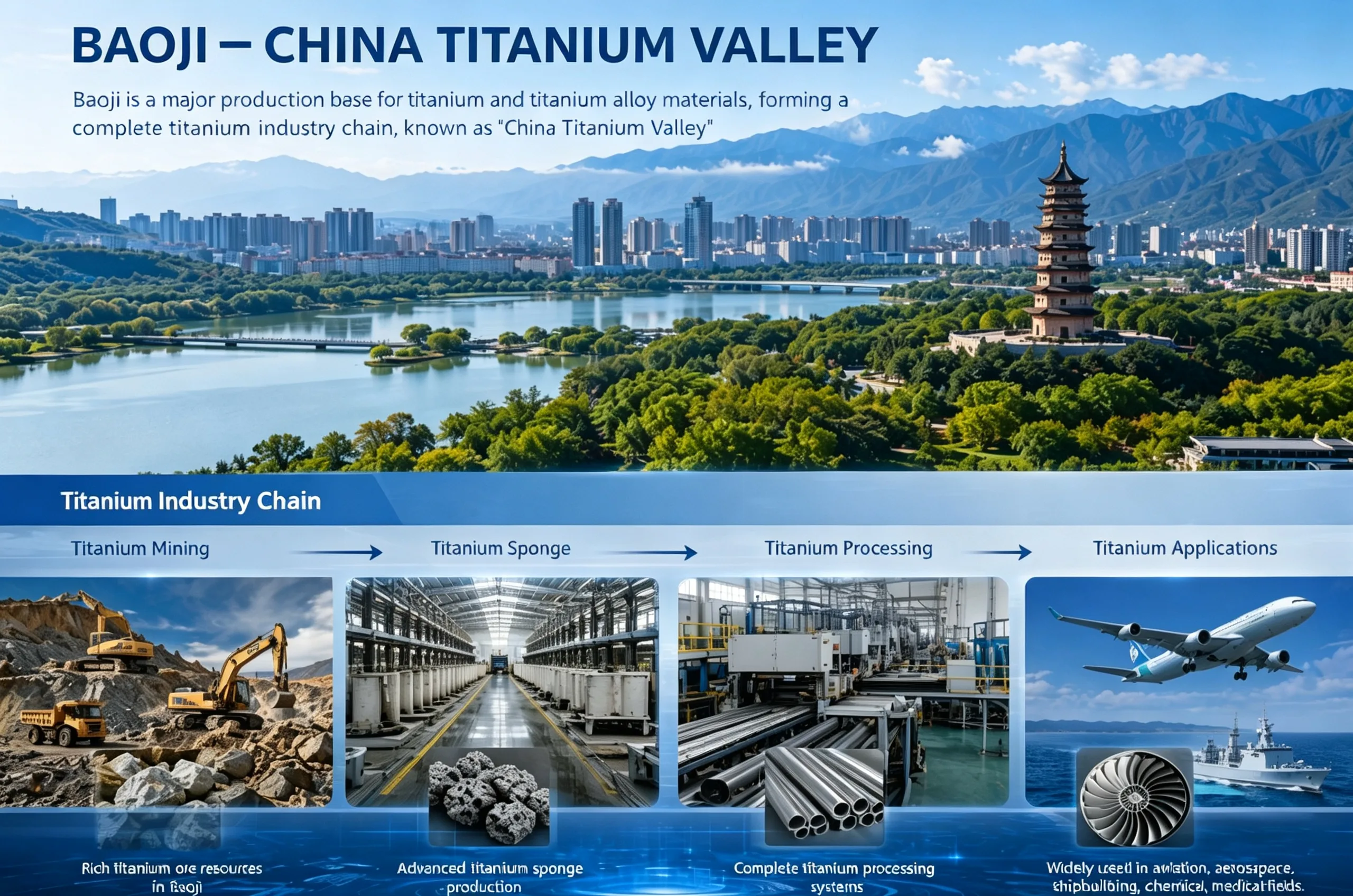
Baoji is known globally as China Titanium Valley because it concentrates the largest share of China’s titanium production and processing capacity into one region, a density that exists almost nowhere else at this scale. The label is earned at the level of the cluster: sponge supply, melting, forging, rolling, machining, and finishing all operate within a small geographic area, and that is why the city appears in nearly every global titanium sourcing discussion. The practical meaning for a buyer, however, is narrower than the title suggests. Geographic concentration describes the region, not any single supplier. Capability, certification, and material compliance vary sharply between companies in the cluster, and aggregate scale says little about whether a specific shop can hold your tolerances and deliver compliant traceability. The valley is a strong sourcing environment and a weak substitute for individual qualification.
What Turned a Central Chinese City into the Titanium Capital
The cluster exists because China placed its titanium research and early production base in Baoji in the 1960s, and the state-owned titanium works that followed later seeded a private ecosystem around it. Decades of melting, forging, and rolling expertise stayed in the same local labor pool, so when the domestic and export markets grew, new companies formed around existing skills rather than relocating them. The city’s location in central China also kept it close to raw material logistics while remaining far enough from coastal congestion to allow plant expansion over several decades.
The 1990s and 2000s converted that base into a dense industrial zone. Suppliers of sponge and ingot clustered together with machine shops, heat treaters, and test laboratories, and the concentration became self-reinforcing. A customer, a metallurgist, and a repair shop are all within a short drive, which shortens the feedback loop that keeps titanium processing knowledge inside the city rather than dispersing it.
That density carries a cost that buyers rarely anticipate. Land, skilled labor, and furnace capacity are shared across the whole cluster, so a demand spike moves prices and lead times upward across hundreds of companies at the same time. The valley behaves as one market rather than as a collection of independent shops, and procurement teams who assume regional slack will absorb their order are usually disappointed within one quote cycle.
For a buyer the practical takeaway is directional. If a program needs titanium in volume and expects an ecosystem — material in every product form, subcontract services, fast metallurgical support — Baoji is where that ecosystem exists. A titanium CNC machining manufacturer operating inside the cluster can draw on material, heat treatment, and inspection capacity that a shop in a dispersed market simply cannot access at the same speed.
What the Production Numbers Actually Do and Don’t Tell a Buyer
The scale claims are real, but they are statistical rather than engineering. China has grown into the world’s largest titanium sponge producer, and Baoji is commonly cited as accounting for a large share of the country’s titanium materials output — industry reports and trade media frequently mention around half, though the precise figure depends on the statistical scope. Sponge, ingot, mill products, and machined parts are counted differently, and reported percentages shift by year and by source.
The number matters for a different reason than most buyers assume. It predicts material availability and price competition, not component quality. A cluster consuming a large share of national sponge holds inventory across many private warehouses, and that inventory is what keeps machining lead times shorter than they are elsewhere in China. When a buyer’s order is one of many in a full material pipeline, the region absorbs schedule variation that a standalone shop cannot.
The limitation is that aggregate output says nothing about certified, traceable, aerospace-grade material. A substantial share of cluster production is industrial-grade product for chemical and general service; the certified fraction is smaller and carries a different price structure. Comparing the region’s total tonnage against your program’s requirement is comparing the wrong unit.
Use the numbers as a market signal, not as a specification. When a supplier quotes a capacity claim, ask which product form it covers, which year it refers to, and whether it includes certified material. The following table summarizes where the cluster’s volume concentrates at each supply chain stage, and where a buyer actually sees the effect.
| Supply chain stage | Where the risk concentrates | What a buyer typically sees |
|---|---|---|
| Sponge titanium | Global supply swings hit all mills at once | Price moves before any order is placed |
| Ingot melting | A limited number of furnaces with long cycles | Lead time is set by furnace queue, not by machining |
| Forging and rolling | Capacity shared across the whole cluster | Premium pricing during demand peaks |
| Machining | Skill and equipment vary by shop | Wide quote spread across the cluster |
| Certification and traceability | Documentation capacity, not machines | Delays at material release |
This table is a directional map, not a forecast. The degree of concentration varies with the global supply cycle; in a soft year, furnace queues shorten and certified material becomes easier to schedule, while in a tight year every row shifts together. Read the table as the sequence of pressure points to check when a lead time slips.
The “Valley” Label and the Supplier Reality Gap
The label describes geography, not quality. Two shops in the same industrial park can differ more in capability than a Baoji shop and a European specialist, because the valley’s density attracts both world-class processors and basic job shops. Treating “Baoji sourcing” as a single channel — one price level, one quality standard, one lead-time rule — is the most common mistake made by first-time buyers.
The cluster grew from a small number of large enterprises into several thousand private companies. Many are competent and some are excellent, but a meaningful number are general shops that took on titanium work because it was available locally. The regional brand and the individual company are different things, and conflating them converts a qualification problem into a lottery.
It is also worth noting the reverse assumption, which is equally wrong. Buyers who assume the valley produces only commodity material miss suppliers whose process documentation, inspection capability, and aerospace work would survive scrutiny anywhere in the world. The cluster’s spread is wide on both ends, which is precisely why individual verification is non-negotiable.
Qualification is therefore the whole game. A practical supplier evaluation guide is the right starting point, and the specific checks for this region are covered in the next two sections. Ask for heat numbers, material certificates, process records, and inspection capability, and treat a refusal to show them as disqualifying.
Which Titanium Materials and Standards the Cluster Handles Well
Baoji processes the full spectrum of commercial and aerospace alloys, but the grades international buyers encounter most are Grade 2 for corrosion and chemical service and Grade 5 for structural work, with Grade 23 reserved for medical and rotating components. Grade 5 titanium delivers roughly 895 MPa tensile strength, yet it machines at about half the speed of Grade 2 and concentrates cutting heat because its thermal conductivity near 6.7 W/m·K is only about a third of Grade 2’s — a tradeoff that shows up as tool wear and dimensional drift in long production runs.
The recurring pitfall is the specification gap between Chinese domestic orders and international drawings. Domestic orders are commonly quoted to GB/T standards — GB/T 3621 for plate and sheet, GB/T 2965 for bar and forgings — while international drawings call out ASTM B348, AMS 4928, or ASTM F136. The grades are close but not identical in every clause, and reconciling the two is documentation work that must happen before first article inspection, not after. A certificate that names a different standard than the drawing is a schedule risk hiding in a folder.
For aerospace, the governing system is AS9100D with full material traceability, and for medical devices it is ISO 13485 with raw material verification against the cited standard. Many cluster shops hold these certifications and many do not. Asking whether a supplier is AS9100D certified is only a start; confirming that the certificate’s scope covers the process being purchased is the actual check.
| Grade | Typical application | Strength characteristic | Main procurement constraint |
|---|---|---|---|
| Grade 2 | Chemical, marine, heat exchanger | Moderate tensile strength near 345 MPa | Unsuitable for high-load structural service |
| Grade 5 (Ti-6Al-4V) | Aerospace structural components | High tensile strength near 895 MPa | Cutting heat concentration and slower machining |
| Grade 23 (ELI) | Medical implants, rotating aerospace | High strength with improved fracture toughness | Longer lead times, stricter mill certification |
Mechanical values above are typical reference ranges drawn from ASTM material specifications and should be confirmed against the exact standard cited on the drawing. Grade 23 commands a premium over Grade 5 in most supply cycles, and the premium is justified by compositional control rather than by raw material cost alone.
How to Qualify a Baoji Supplier Without Getting Burned
Qualify the company, not the address. The evaluation should cover four areas: material specification compliance, process control, inspection capability, and documentary discipline. A supplier that passes all four is rare anywhere in the world, and the checks are the same regardless of region — what changes in a concentrated cluster is how easy it is to mistake proximity for proof.
Ask for recent parts similar in material and complexity rather than generic capability claims, and request the supporting records: material certificates with heat numbers, CMM reports on the tight features, and a written statement of which standard the material conforms to. A supplier who can answer in writing is genuinely valuable, because in titanium procurement the documentation is part of the deliverable, not an afterthought.
The cheapest quote in the cluster is usually quoting a different technical basis than the one you specified — a different standard, a different heat treatment condition, or a looser tolerance interpretation that only surfaces at first article. In a market this dense, price dispersion is normal; the skill is separating price differences that reflect process efficiency from price differences that reflect specification drift.
Work through the following checklist before award, and keep the evidence on file for the full program duration:
- Material grade and standard stated explicitly — GB/T, ASTM, or AMS, with the exact document number
- Heat-level traceability from mill certificate through finished component
- Inspection plan matched to critical tolerances, with metrology identified
- Process scope of certifications confirmed, including sub-tier heat treat and surface treatment
- Lead time separated into material, machining, and certification segments
| Evaluation area | What to verify | Warning signal |
|---|---|---|
| Material compliance | Heat number, mill certificate, standard match | Certificate in a different standard, no heat number |
| Process control | Work instructions, fixturing, machine load planning | Ad hoc production planning, vague method descriptions |
| Inspection | CMM capability, temperature control, calibration records | No metrology matched to your tolerance |
| Documentation | Traceability records, release paperwork | Incomplete or chronically delayed records |
| Capacity realism | Queue time against quoted lead time | Quoted lead time equals machining time only |
This matrix is a scoring aid rather than a pass-or-fail rule. Weight the rows by your industry — aerospace buyers should weight material compliance and documentation heavily, while industrial buyers may weight process control and capacity realism more. The same supplier can be an excellent choice for one weighting and a poor one for another.
Where the Real Risks Sit: Certification, Traceability, and Lead Times
Programs that run into trouble on Baoji-sourced material rarely fail at machining. The typical failure point is the hand-off: the material certificate arrives in GB/T terms, the drawing calls out AMS 4928, and reconciling the two consumes schedule nobody allocated for it. First article inspection is where the gap surfaces, which is why specification reconciliation belongs in the RFQ stage rather than at release.
Upstream, sponge titanium and ingot capacity move the entire market together. When sponge tightens, pricing shifts across the cluster before any order is even placed, and certified material substitutions require additional document review that delays inspection scheduling and production planning. A titanium material shortage rarely affects raw material pricing alone; in a concentrated supply chain it propagates into lead times, inspection queues, and delivery consistency at the same time.
Certification bottlenecks compound the problem. NADCAP audit capacity and AS9100D registration queues are finite, and a supplier can hold a certificate while its sub-tier processors — heat treater, passivator, tester — sit outside the certified scope. That reintroduces the very traceability risk the certificate was meant to control. For aerospace programs, verify the scope of the certification, not just its existence, against the requirements summarized in the aerospace supplier certification guide.
None of this makes Baoji a higher-risk source than any other titanium region; it makes it a region where risks are concentrated and therefore easier to miss under time pressure. Define the exact standard in the RFQ, require heat-level traceability, confirm sub-tier scope, and build schedule slack around certificate release. Buyers who do this routinely find that a well-qualified supplier in the valley performs as reliably as any qualified shop elsewhere, with the added advantage of a complete material ecosystem on site. If you need a direct review of how a Baoji-based manufacturer documents material compliance and inspection, submit a titanium RFQ for review.