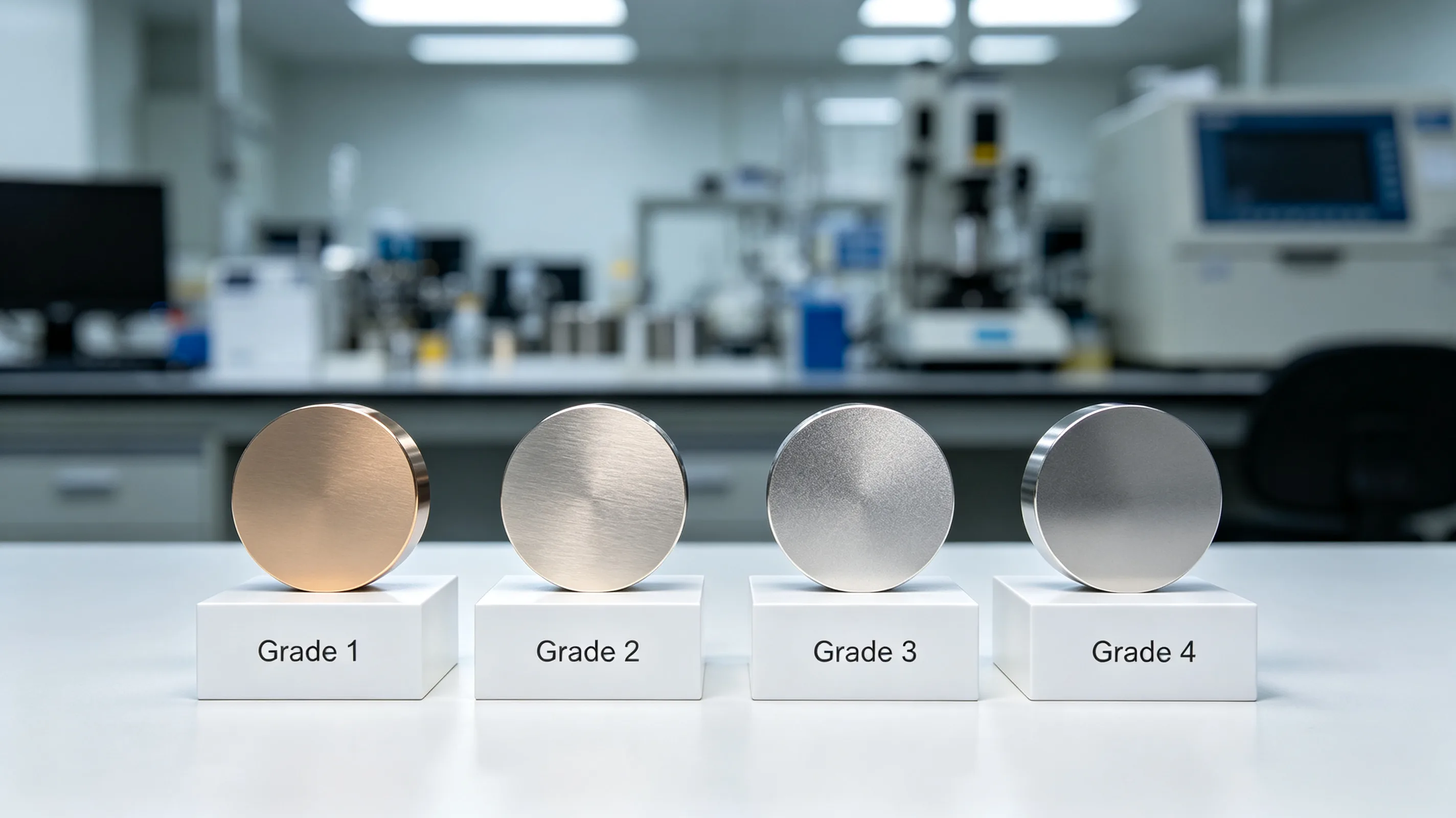
Commercially pure titanium grades 1 through 4 are distinguished primarily by their oxygen content, which controls the strength and ductility of the material. Unlike alloyed titanium grades, CP titanium cannot be strengthened by heat treatment — its mechanical properties are determined by the interstitial element content and the degree of cold work. The selection between CP grades is driven by the balance between strength requirements and formability. For context on how CP grades compare to alloyed grades in the broader titanium family, see the titanium grades complete guide.
How oxygen content determines grade and properties
The four CP grades are defined by their maximum oxygen content. Grade 1 allows 0.18 percent oxygen maximum. Grade 2 allows 0.25 percent. Grade 3 allows 0.35 percent. Grade 4 allows 0.40 percent. Oxygen strengthens titanium by solid-solution mechanism — oxygen atoms in the crystal lattice impede dislocation movement, increasing strength and reducing ductility.
The progression is continuous and predictable. Grade 1 has the lowest strength, approximately 240 MPa tensile, and the highest ductility, with elongation of 24 percent. Grade 4 has the highest strength among CP grades, approximately 550 MPa tensile, with elongation of 15 percent. Each grade increases in strength by approximately 50 to 70 MPa over the previous grade while ductility decreases correspondingly.
Grade 2 is the most widely used CP grade because it offers the best practical balance of properties. Its 340 MPa tensile strength is adequate for most industrial applications, and its 20 percent elongation provides sufficient formability for standard forming and bending operations. Grade 1 is specified where maximum formability is required. Grade 3 and Grade 4 are used where higher strength is needed but the application cannot justify the cost or complexity of an alpha-beta alloy.
Typical applications by grade
Grade 2 is the standard CP grade for chemical processing equipment, heat exchangers, piping systems, marine components, and architectural applications. It is also the most available CP grade in all product forms — plate, sheet, bar, tube, and wire. Its corrosion resistance in seawater, chlorides, and most industrial chemicals is excellent.
Grade 1 is used for applications requiring maximum formability, such as deep-drawn components, severe bends, and complex sheet metal parts. It is also specified for components that will be extensively cold worked, where the higher ductility reduces the risk of cracking during forming.
Grade 3 is the least commonly specified CP grade. It is used where slightly higher strength than Grade 2 is needed but the reduced formability of Grade 4 is not acceptable. Some heat exchanger applications specify Grade 3 for tube sheets where the tube-to-tube-sheet joint strength benefits from the higher material strength.
Grade 4 is used for medical implant components, particularly dental implants and non-load-bearing orthopedic devices. Its higher strength provides better mechanical performance than Grade 2 while maintaining the biocompatibility of unalloyed titanium. Grade 4 is also used in some aerospace and industrial fasteners where the strength of CP titanium is sufficient and the corrosion resistance is required.
Machining and forming characteristics
CP titanium grades are more difficult to machine than Ti-6Al-4V in some respects, despite their lower strength. The high ductility of CP grades produces long, stringy chips that are difficult to break and tend to wrap around the tool. Built-up edge formation is more severe than with alpha-beta alloys because the CP grades are more prone to adhesion at the cutting interface.
Cutting speeds for CP grades should be 10 to 20 percent lower than for Ti-6Al-4V to manage built-up edge formation. Higher feed rates help produce thicker, more manageable chips that break more easily. Chip breaker tooling designed for ductile materials is recommended. Coolant pressure and coverage requirements are the same as for alloyed titanium grades.
CP grades have excellent formability, particularly at elevated temperatures. Grade 1 and Grade 2 can be cold formed with standard equipment. Grade 3 and Grade 4 require more generous bend radii and may benefit from warm forming at 200 to 300°C for complex geometries. All CP grades weld readily with standard titanium welding practices and protective atmosphere.
Table 1: CP titanium grade comparison
| Grade | Max oxygen | Tensile strength (MPa) | Elongation (%) | Typical application |
|---|---|---|---|---|
| Grade 1 | 0.18% | 240 | 24 | Deep-drawn components, severe forming |
| Grade 2 | 0.25% | 340 | 20 | Chemical processing, marine, heat exchangers |
| Grade 3 | 0.35% | 450 | 18 | Moderate strength industrial applications |
| Grade 4 | 0.40% | 550 | 15 | Medical implants, fasteners, higher-strength needs |
To compare CP grades against alloyed titanium grades for your application, use the titanium grade finder.