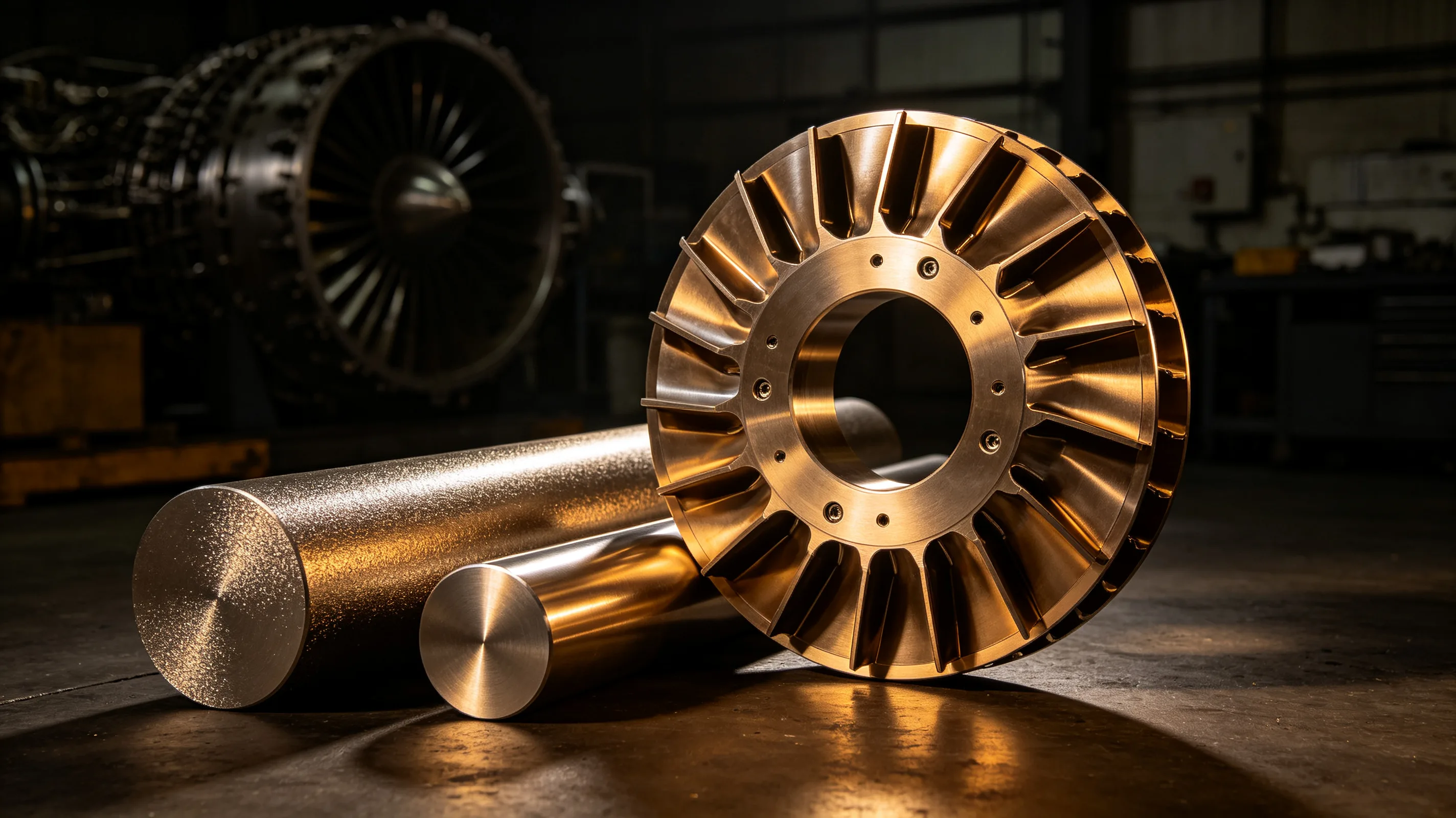
Ti-6242 (Ti-6Al-2Sn-4Zr-2Mo, UNS R54620, Grade 6242) is a near-alpha titanium alloy developed specifically for continuous service at elevated temperatures where Ti-6Al-4V begins to lose creep strength above 400°C. It maintains useful tensile strength and creep resistance up to 540°C, making it the standard material for gas turbine compressor components in many current-production engine platforms. Compared to nickel-based superalloys operating in the same temperature range, Ti-6242 offers approximately 40 percent weight reduction, though this advantage narrows as the material approaches its upper service limit. The alloy is not intended for room-temperature-optimized applications — below 300°C, Ti-6Al-4V provides equivalent mechanical properties with significantly lower material cost and better machinability. Understanding the specific temperature window where Ti-6242 delivers net engineering value is the first step in any procurement or design decision involving this material. For a complete overview of all titanium alloy categories including near-alpha, alpha-beta, and beta classifications, see the titanium grades complete guide.
What Makes Ti-6242 Different from Other Titanium Alloys?
Ti-6242 is classified as a near-alpha alloy because its aluminum equivalency — approximately 9 percent — is high enough to stabilize primarily alpha-phase microstructure while retaining a small volume fraction of beta phase (typically 5 to 15 percent) through molybdenum addition. This microstructural balance is what gives the alloy its elevated-temperature capability.
The alpha phase provides creep resistance and oxidation resistance at sustained high temperatures. The beta phase contributes room-temperature ductility and forgeability. Most existing titanium alloys optimize for one or the other. Ti-6242 occupies the narrow compositional window where both are present in useful proportions.
The silicide-containing variant, Ti-6242S (Ti-6Al-2Sn-4Zr-2Mo-0.1Si), is commonly specified for components operating above 480°C. The 0.1 percent silicon addition promotes precipitation of fine silicide particles at grain boundaries, which impede dislocation movement during creep. Without the silicon addition, the alloy’s creep resistance above 480°C drops measurably, though it remains better than Ti-6Al-4V at equivalent temperatures.
When Ti-6242 should not be specified
A common engineering error is specifying Ti-6242 for components that operate below 300°C. In this range, the alloy offers no mechanical advantage over Ti-6Al-4V — both have comparable tensile and yield strength at room temperature — but Ti-6242 costs 20 to 40 percent more per kilogram of raw material and machines 20 to 30 percent slower. For cold-section compressor components operating below 300°C, Ti-6Al-4V delivers equivalent performance at substantially lower total cost.
Another recurring mis-specification involves using Ti-6242 in welded assemblies without post-weld stress relief. The near-alpha microstructure is susceptible to residual stress cracking in the heat-affected zone if the component is not stress-relieved within 24 hours of welding. This is not a concern with Ti-6Al-4V, where post-weld stress relief is optional for most applications. Several in-service failure investigations have traced back to weld cracking in Ti-6242 components where the fabricator applied standard Ti-6Al-4V welding procedures without modification.
How Does Ti-6242 Compare with Ti-6Al-4V and Inconel 718?
The decision between Ti-6242, Ti-6Al-4V, and Inconel 718 is driven primarily by operating temperature and weight constraints, not by room-temperature strength. Inconel 718 can serve at temperatures up to 700°C but weighs nearly twice as much as Ti-6242. Ti-6Al-4V is limited to approximately 400°C continuous service. Ti-6242 sits between them.
The comparison is not always straightforward. Inconel 718 has higher absolute strength at any temperature within its operating range, but when specific strength (strength per unit density) is considered, Ti-6242 outperforms Inconel 718 up to approximately 540°C. Above that temperature, the nickel superalloy’s strength retention advantage becomes decisive regardless of weight penalty.
Table 1: Ti-6242 mechanical and physical properties compared with Ti-6Al-4V and Inconel 718
| Property | Ti-6242 (annealed + stabilized) | Ti-6Al-4V (Grade 5, annealed) | Inconel 718 (solution + aged) |
|---|---|---|---|
| Tensile strength (MPa) | 930 | 895 | 1240 |
| Yield strength, 0.2% offset (MPa) | 860 | 828 | 1030 |
| Elongation (%) | 10 | 10 | 12 |
| Max continuous service temp (°C) | 540 | 400 | 700 |
| Density (g/cm³) | 4.54 | 4.43 | 8.19 |
| Thermal conductivity at 20°C (W/m·K) | 6.6 | 6.7 | 11.4 |
| Coefficient of thermal expansion (µm/m·°C) | 9.6 | 8.6 | 13.0 |
| Relative material cost (per kg) | 1.2–1.4x Grade 5 | 1.0x (baseline) | 1.8–2.2x Grade 5 |
What the table does not show
The raw material cost comparison in Table 1 reflects only the mill product price. The total cost difference is larger. Ti-6242 requires vacuum arc remelting (VAR) or plasma arc melting (PAM) for aerospace-grade material, which restricts the number of qualified mills and extends lead times. During periods of elevated aerospace OEM demand — typically coinciding with new engine program ramps — Ti-6242 billet lead times can stretch to 20 weeks or more, compared to 8 to 12 weeks for Ti-6Al-4V. Procurement teams that do not account for this lead time gap often face program delays during the first-article phase.
Tooling cost is another factor that rarely appears in comparison tables. Ti-6242’s higher work hardening rate means that carbide tool edges degrade approximately 40 percent faster than when machining Ti-6Al-4V under equivalent conditions. For high-volume production runs, this translates to 40 to 60 percent more tool changes per shift, which affects both direct tooling cost and machine utilization.
What Are the Machining Challenges Specific to Ti-6242?
Ti-6242 machines differently from Ti-6Al-4V in several important ways, and shops that treat them as interchangeable usually experience higher scrap rates and longer cycle times than anticipated.
The primary machining difficulty stems from the alloy’s low thermal conductivity — approximately 6.6 W/m·K at room temperature, dropping further as the tool-workpiece interface temperature rises. Heat generated during cutting conducts primarily into the tool rather than being carried away by the chip. For a roughing operation on Ti-6242 using uncoated carbide at 30 m/min surface speed, the tool tip temperature can exceed 800°C within the first five seconds of engagement. The same operation on Ti-6Al-4V produces a tip temperature approximately 100 to 150°C lower.
Work hardening and its consequences
Ti-6242 work-hardens more aggressively than Ti-6Al-4V. Microhardness measurements in the deformed subsurface layer of a machined Ti-6242 surface typically show a 30 to 50 percent increase over the bulk hardness, compared to 15 to 25 percent for Ti-6Al-4V under identical cutting conditions. This means that if a cutting pass fails to remove the work-hardened layer from the previous pass — because the depth of cut is too shallow or the feed rate too low — the subsequent pass engages material that is significantly harder than the bulk alloy, accelerating edge wear and increasing the risk of chatter.
Several contract machining shops have reported that their standard titanium roughing parameters for Ti-6Al-4V produce inadequate tool life when transferred directly to Ti-6242. Tool changes that normally occur every 20 to 25 minutes on Ti-6Al-4V may need to be scheduled every 12 to 15 minutes on Ti-6242, depending on the depth of cut and coolant application method.
Coolant strategy matters more
Flood coolant is insufficient for Ti-6242 roughing operations. Through-tool high-pressure coolant at 50 to 70 bar, directed at the cutting interface, is necessary to prevent thermal buildup from reaching temperatures that accelerate diffusion wear. Shops without high-pressure coolant capability typically experience carbide tool edge life of 8 to 12 minutes in Ti-6242 roughing, compared to 18 to 25 minutes with high-pressure coolant at comparable cutting parameters.
Chip management is also more demanding. Ti-6242 produces segmented chips that are harder and more abrasive than Ti-6Al-4V chips. A production run of 100 Ti-6242 compressor blade forgings can generate enough chip volume to fill a standard 1m³ chip bin, and those chips are sharp enough to cut through standard coolant hoses. Some facilities have had to upgrade their chip conveyor systems specifically for Ti-6242 production.
Table 2: Recommended rough machining parameters for Ti-6242 (carbide tooling)
| Parameter | Ti-6242 | Ti-6Al-4V (for reference) |
|---|---|---|
| Cutting speed (m/min) | 25–35 | 40–55 |
| Feed rate (mm/rev) | 0.15–0.25 | 0.20–0.30 |
| Depth of cut (mm) | 1.5–3.0 | 2.0–4.0 |
| Coolant pressure (bar) | 50–70 (high-pressure required) | 20–40 (flood acceptable) |
| Expected tool edge life (min) | 12–18 | 20–30 |
| Tool coating recommendation | AlTiN or TiAlN | Uncoated or AlTiN |
What Standards Apply to Ti-6242 Components?
Ti-6242 is covered by multiple AMS and ASTM standards depending on product form. The applicable standard is not interchangeable — a component manufactured from AMS 4919 sheet may have different property minimums than one manufactured from AMS 4975 bar, particularly in ductility and fracture toughness.
Table 3: Applicable standards for Ti-6242 by product form
| Product form | ASTM standard | AMS specification | Key requirements |
|---|---|---|---|
| Sheet, strip, plate | ASTM B265 | AMS 4919 | Tensile: 930 MPa min; annealed + stabilized |
| Bar, wire, forgings | ASTM B348 / ASTM B381 | AMS 4975 | Tensile: 930 MPa min; elongation: 10% min |
| Rings (Ti-6242S, silicide variant) | — | AMS 4976 | 0.1% Si addition; enhanced creep above 480°C |
| Seamless tubing | ASTM B338 | — | Hydrostatic test required; 950 MPa min tensile |
Certification requirements that affect procurement
AMS 4975 and AMS 4919 both require that the material be produced by vacuum arc remelting or an equivalent method that ensures low interstitial content and homogeneous chemistry. This is not a trivial requirement. Not all titanium mills have VAR or PAM capability, which means that the pool of qualified Ti-6242 suppliers is substantially smaller than for Ti-6Al-4V.
For aerospace engine components, additional requirements typically apply:
- Traceability to the specific VAR ingot heat, not just the mill certificate lot
- Ultrasonic inspection per AMS 2630 or equivalent, with acceptance criteria specified by the engine OEM
- Mechanical property testing from each heat at the actual section thickness that will be used in production, not from a separately cast test coupon
- Microstructure evaluation per ASTM E3 to verify that the alpha-beta phase ratio falls within the specified range
Procurement teams that assume Ti-6242 certification follows the same documentation chain as Ti-6Al-4V often discover during supplier qualification that the required certification documents carry 4 to 8 week additional lead times. This is because some mills only perform VAR-to-certification runs on a campaign basis — typically quarterly — rather than maintaining continuous production.
How Should a Supplier Be Qualified for Ti-6242 Production?
Qualifying a supplier for Ti-6242 is not the same as qualifying a supplier for titanium machining in general. A shop that has successfully delivered thousands of Ti-6Al-4V aerospace components may lack the specific process knowledge and equipment capability required for Ti-6242.
What to verify before awarding a Ti-6242 contract
The following checklist covers the critical capability areas that should be confirmed before committing a Ti-6242 program to a supplier. Several procurement managers have reported that skipping any of these verification steps led to first-article failures or delivery delays.
Table 4: Ti-6242 supplier qualification checklist
| Capability area | Minimum requirement | Recommended for engine-critical components |
|---|---|---|
| AS9100D / AS9100 certification | Required | With NADCAP heat treat and NDT scope |
| High-pressure coolant system | 50 bar minimum | 70 bar through-tool |
| 5-axis CNC capacity | At least one machine | Multiple machines with in-process probing |
| Ti-6242 process history | At least one completed project | Five or more production programs |
| Tool coating capability | AlTiN or TiAlN coated carbide | Vendor-specific Ti-6242 grade geometries |
| Heat treatment furnace | Vacuum furnace with ±5°C uniformity | Certification traceable to AMS 2750 |
| Material traceability system | EN 10204 Type 3.1 MTR per heat | EN 10204 Type 3.2 with third-party verification |
| CMM inspection | Full 3D inspection capability | In-process + final inspection with SPC reporting |
| Welding qualification (if applicable) | AWS D17.1 certified | With specific Ti-6242 process qualification records |
A recurring issue in Ti-6242 supplier evaluation is over-reliance on general titanium experience. One aerospace Tier 1 supplier reported that three of their five qualified titanium machining vendors failed first-article inspection on a Ti-6242 compressor case program, despite all five having extensive Ti-6Al-4V production history. The failures were traced to inadequate coolant pressure and incorrect feed rate selection for the work hardening behavior of Ti-6242. Two of those vendors required capital investment in high-pressure coolant systems before requalification.
Raw material supply chain considerations
Ti-6242 billet availability is more constrained than the general titanium market. The alloy is produced by a limited number of mills — primarily in the United States, Russia, and Japan — and the geopolitical supply situation has introduced additional volatility in recent years. Lead times for certified Ti-6242 billet from Western mills have ranged from 12 to 26 weeks depending on the product form and certification level required.
For comparison, Ti-6Al-4V billet of equivalent size and certification is typically available in 6 to 10 weeks. Procurement teams that discover this gap after contract award often face program delays or are forced to accept alternative sourcing with extended material qualification cycles.
Why Ti-6242 Programs Sometimes Fail During First Article
First-article failures on Ti-6242 components follow patterns that are distinct from failures on other titanium alloys. Understanding these patterns helps both engineering teams and procurement professionals structure their qualification process to avoid the most common pitfalls.
Dimensional instability after heat treatment
Ti-6242 components that are rough-machined and then sent for vacuum stress relief can exhibit dimensional changes of 0.1 to 0.3 mm on critical features, depending on the as-machined residual stress state. This is more severe than what is typically seen with Ti-6Al-4V, where stress relief distortion is usually below 0.05 mm for equivalent section geometries. The cause is the higher stiffness and lower thermal conductivity of Ti-6242, which creates larger thermal gradients during furnace ramp-up and cool-down.
Some shops address this by incorporating a rough machining → stress relief → semi-finish machining → final stress relief → finish machining sequence that adds two to three weeks to the production cycle. Procurement schedules that do not account for this intermediate stress relief step often find that first-article parts are out of tolerance after heat treatment, requiring rework or scrapping.
Chip weld and surface integrity issues
Ti-6242 is more prone to chip welding on the cutting edge than Ti-6Al-4V, particularly when coated carbide tools are used at cutting speeds above 35 m/min. The welded chip fragment can detach from the cutting edge and become embedded in the machined surface, creating a surface defect that is detectable only after etching or fluorescent penetrant inspection.
A compressor blade manufacturer reported that approximately 6 percent of their Ti-6242 blades required rework due to embedded chip fragments during the first production run, compared to less than 1 percent for an equivalent Ti-6Al-4V blade program. The issue was resolved by reducing cutting speed from 38 to 30 m/min and increasing coolant pressure from 40 to 65 bar, but the initial production schedule did not account for the yield loss caused by these defects.
Four Procurement Rules for Ti-6242
The following rules summarize the practical experience of engineering teams and procurement professionals who have managed Ti-6242 programs through production.
Rule 1: Verify the temperature requirement before specifying Ti-6242. If the component operates below 300°C continuous or 400°C intermittent, Ti-6Al-4V is almost certainly the more cost-effective choice. The 20 to 40 percent material cost premium and 20 to 30 percent machining time penalty that Ti-6242 carries are not justified outside its operating temperature window.
Rule 2: Confirm high-pressure coolant capability before selecting a supplier. Shops without 50 bar minimum through-tool coolant will struggle to maintain acceptable tool life on Ti-6242 roughing operations. The risk of thermal damage to the workpiece surface also increases significantly when coolant pressure is insufficient. Verify this capability during the RFQ stage, not during first-article inspection.
Rule 3: Budget for intermediate stress relief in the production schedule. The rough machining → stress relief → finish machining sequence adds two to three weeks to the production cycle for Ti-6242 components. Procurement schedules that compress or eliminate this step often fail first-article dimensional inspection.
Rule 4: Require documented Ti-6242 process history, not general titanium experience. A supplier’s Ti-6Al-4V production history does not automatically qualify them for Ti-6242. Request evidence of at least one completed Ti-6242 program, including first-article pass rates, tooling consumption data, and certification documentation. For engine-critical components, five or more completed programs is a more reliable threshold.
For engineering teams evaluating a Ti-6242 application, reviewing grade-specific process qualifications and asking targeted questions about mill source relationships, certification lead times, and heat treatment cycle planning before committing to a delivery schedule will prevent the mismatches that otherwise emerge during first-article inspection. A titanium CNC machining manufacturer with documented near-alpha alloy experience demonstrates this evaluation in practice.
For a grade-specific quotation on Ti-6242 components, submit your requirements through our RFQ portal.
Table 5: Selection decision matrix — when to choose Ti-6242
| Operating condition | Recommended material | Rationale |
|---|---|---|
| Continuous service below 300°C | Ti-6Al-4V (Grade 5) | Lower cost, faster machining, equivalent strength |
| Continuous service 300–400°C | Ti-6Al-4V or Ti-6242 | Evaluate section thickness and creep requirements |
| Continuous service 400–540°C | Ti-6242 / Ti-6242S | Creep resistance required above 400°C |
| Continuous service above 540°C | Inconel 718 or equivalent | Ti-6242 creep strength drops above 540°C |
| Weight-critical, 400–540°C | Ti-6242S (silicide variant) | 40% lighter than Inconel 718 at equivalent temperature |
| Fracture-critical, elevated temperature | Ti-6242 with enhanced certification | Verify fracture toughness data from mill |
| Welded assembly, 400–540°C | Ti-6242 with post-weld stress relief | PWSR required within 24 hours of welding |