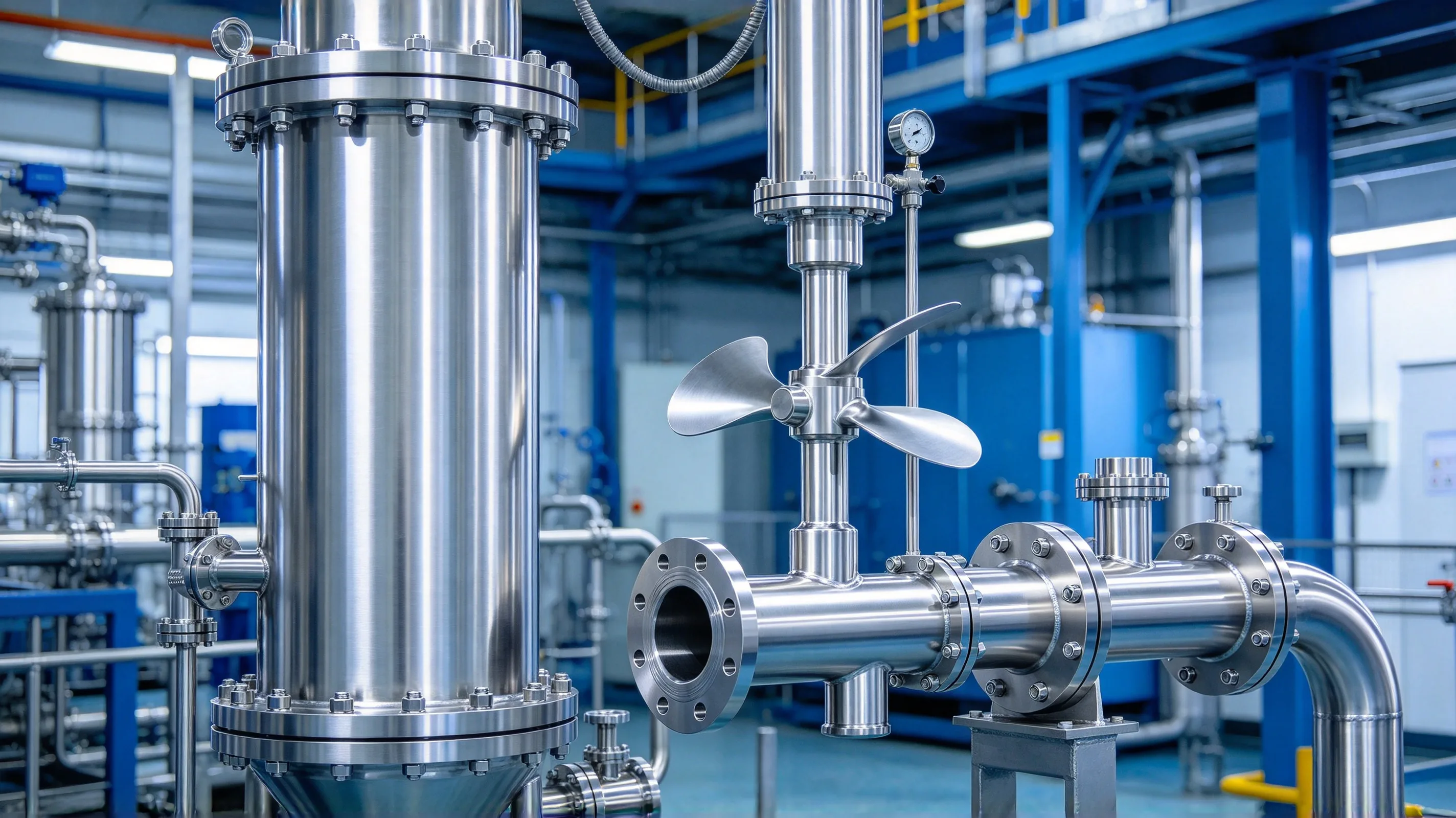
Titanium has been the material of choice for chemical processing equipment since the 1950s, and the reason is simple: it handles wet chloride environments, reducing acids, and oxidising media that would attack stainless steel within months, for decades. The CPA (Chemical Processing Industry) market for titanium is roughly 30% of the total titanium mill product market by volume, second only to aerospace. The components in a chemical plant — vessels, agitators, heat-exchanger tubesheets, pump casings, valve bodies, fittings, fasteners — are predominantly Grade 1, 2, 7, or 12, and the procurement specifications for these parts are different from the aerospace or medical specifications that the same shop may also produce.
This article works through the four procurement decisions that determine whether a titanium CNC component is correctly specified for a chemical processing application: material grade selection, the corrosion data that justifies the grade, the typical parts and their procurement specs, and the inspection requirements that go with the application. It assumes the general grade-selection guide and the corrosion-grade properties as background — those cover the broader grade landscape; here we focus on the chemical processing application. For the procurement process on titanium components, the general RFQ checklist is the cross-reference.
- Why titanium is the material of choice for chemical processing
- Grade selection for chemical processing: CP, Grade 7, Grade 12
- Corrosion data that justifies the grade
- Typical parts in a chemical plant
- Procurement specifications for chemical processing parts
- Inspection requirements for chemical processing parts
- Surface treatment and welding for chemical processing parts
- Chemical processing parts checklist
Why titanium is the material of choice for chemical processing
Three material properties make titanium the standard material for chemical processing equipment, and the combination is unique to titanium among the commercially available metals:
1. Passive oxide film that is self-healing in oxidising environments. Titanium forms a stable, adherent titanium dioxide (TiO₂) film on its surface within milliseconds of exposure to air or water. The film is typically 2–10 nm thick and is the reason titanium resists corrosion in the first place. The film is also self-healing: if it is mechanically damaged or chemically reduced, the film re-forms in the presence of even trace amounts of oxygen or water.
2. Resistance to chloride pitting and crevice corrosion. Titanium is essentially immune to chloride pitting and crevice corrosion at temperatures below about 80 °C for CP grades and 200 °C for Grade 7 (the palladium-stabilised grade). The chloride limit for titanium is roughly 10–100× the limit for 316 stainless steel, depending on the temperature and the pH.
3. Compatibility with the wet processes that destroy stainless steel. Titanium handles nitric acid, chromic acid, organic acids, and most chloride solutions. It does not handle hydrofluoric acid, concentrated hydrochloric acid, or strongly reducing acids — but for the wet processes where stainless steel fails, titanium is the standard replacement.
The procurement consequence is that titanium is specified for chemical processing as the engineering default for the wet, chloride-containing, oxidising processes. The cost difference per part is typically 3–5× the stainless steel cost, which is recovered by the elimination of one or two unplanned shutdowns over the part’s service life.
Grade selection for chemical processing: CP, Grade 7, Grade 12
The grade selection for chemical processing is simpler than the aerospace or medical selection, because the structural demands are lower and the corrosion demands drive the choice. The standard grades are:
CP Grade 1, 2, 3, 4 (commercially pure, unalloyed). The workhorse grades for chemical processing. The differences between CP grades are the strength (Grade 4 is the strongest, Grade 1 is the most formable) and the corrosion resistance (similar for all four in most environments). The standard procurement grade is CP Grade 2 (the most common CP grade, with a good balance of formability, strength, and corrosion resistance). CP Grade 1 is preferred for formed parts that require extensive bending (e.g., heat-exchanger tubes). CP Grade 4 is preferred for parts that require higher strength without alloying.
Grade 7 (Ti-0.15Pd). The palladium-stabilised grade for reducing-acid environments. Grade 7 is essentially CP Grade 2 with a small addition (0.12–0.25% Pd) that dramatically improves the corrosion resistance in reducing acids — particularly hydrochloric, sulfuric, and phosphoric acids at elevated temperatures. Grade 7 is specified where CP Grade 2 would be at risk of crevice corrosion or pitting in the specific service. The cost premium over CP Grade 2 is typically 2–3× the material cost, which is recovered by the longer service life in the reducing environment.
Grade 12 (Ti-0.3Mo-0.8Ni). The molybdenum-nickel-stabilised grade for hot brine and hot chloride environments. Grade 12 has corrosion resistance similar to Grade 7 in many environments, with a slight advantage in hot brine and a slight disadvantage in strongly reducing acids. Grade 12 is specified for heat-exchanger tubes and shell-and-tube heat exchangers that operate above 80 °C in chloride solutions, where CP Grade 2 is at the upper edge of its temperature limit.
Other grades (Grade 5, Grade 9, beta alloys) are rarely used in chemical processing. The structural demands of the application are typically below the yield strength of CP titanium, and the corrosion resistance of the alloyed grades is similar to or worse than CP Grade 2 in most chemical environments. The exception is Grade 9 (Ti-3Al-2.5V), which is occasionally specified for parts that require higher strength and CP-grade corrosion resistance — typically fittings and fasteners in higher-pressure systems.
| Grade | Composition | Strength (UTS, MPa) | Best environment | Cost premium |
|---|---|---|---|---|
| CP Grade 2 | Unalloyed Ti | 345–460 | General wet chloride, oxidising acids, seawater | 1.0× (reference) |
| CP Grade 1 | Unalloyed Ti | 240–310 | Formed parts, heat-exchanger tubes | 1.0–1.1× |
| CP Grade 4 | Unalloyed Ti | 550–680 | Higher-strength CP, no alloying | 1.0–1.2× |
| Grade 7 | Ti-0.15Pd | 345–460 | Reducing acids (HCl, H₂SO₄, H₃PO₄), hot chloride | 2.0–3.0× |
| Grade 12 | Ti-0.3Mo-0.8Ni | 480–620 | Hot brine, hot chloride above 80 °C | 1.5–2.0× |
| Grade 9 | Ti-3Al-2.5V | 620–790 | Higher-strength fittings, fasteners | 1.5–2.0× |
The grade selection should be tied to the specific environment the part will see, not to a generic “titanium” specification. A buyer who specifies “titanium” without a grade is asking the supplier to pick the cheapest grade (CP Grade 2) and accepting whatever corrosion resistance that implies. A buyer who specifies “Grade 7” for a chloride-only service is overpaying for a reducing-acid grade that is not needed.
Corrosion data that justifies the grade
The corrosion data for titanium in chemical processing is published by the International Titanium Association (ITA), by ASTM (in the annual Book of Standards volume 02.04 on reactive and refractory metals), and by the major titanium producers (TIMET, ATI, VSMPO, Baoji). The data is in the form of isocorrosion curves (lines of equal corrosion rate in mm/year on a plot of acid concentration vs temperature) for each grade in each environment.
The most important corrosion data for procurement purposes are:
- CP Grade 2 in nitric acid: corrosion rate < 0.05 mm/year at all concentrations up to 70% and all temperatures up to boiling. The reference for “titanium is immune to nitric acid.”
- CP Grade 2 in hydrochloric acid: corrosion rate < 0.5 mm/year at concentrations up to 1% and temperatures up to 60 °C. The limit drops rapidly above 3% HCl, and CP Grade 2 is not specified above 3% HCl without Grade 7.
- CP Grade 2 in sulfuric acid: corrosion rate < 0.5 mm/year at concentrations up to 1% and temperatures up to 60 °C. Similar to HCl, the limit drops rapidly above 1% H₂SO₄, and Grade 7 is specified for higher concentrations.
- CP Grade 2 in seawater: corrosion rate < 0.025 mm/year at all temperatures up to 80 °C. The reference for titanium as a seawater material.
- Grade 7 in hydrochloric acid: corrosion rate < 0.5 mm/year at concentrations up to 5% and temperatures up to 100 °C. The reference for Grade 7 as the reducing-acid material.
- Grade 12 in hot brine: corrosion rate < 0.05 mm/year at 100 °C and chloride concentrations up to 10%. The reference for Grade 12 as the hot-brine material.
The buyer who is specifying titanium for a chemical processing application should request the isocorrosion data for the specific grade in the specific environment from the supplier, and should compare the data to the design corrosion allowance (typically 0.1–0.5 mm/year for the part’s design life). A grade that meets the corrosion allowance with margin is the right grade; a grade that meets the corrosion allowance at the limit is the wrong grade (a process upset or a temperature excursion will push the part out of the safe envelope).
Typical parts in a chemical plant
The titanium components in a chemical plant fall into a small number of part categories, each with its own procurement specification and its own machining demands. The categories below cover roughly 80% of the titanium volume in a typical chemical plant.
Vessels and tank components. Reactors, storage tanks, mixing tanks, and process vessels with titanium linings or fully-titanium construction. The CNC-machined components are typically the flanges, nozzles, manway covers, baffles, and agitator mounting pads. CP Grade 2 is the standard for oxidising and chloride services; Grade 7 for reducing-acid services. The procurement spec is typically ASTM B348 (bar) for flanges, ASTM B265 (plate) for the shell and head, and B381 (forgings) for nozzle necks.
Agitators and impellers. The rotating components that mix the tank contents. CNC-machined from solid bar (for small impellers) or fabricated from plate + machined hub (for large impellers). CP Grade 2 is standard; Grade 7 for hot or reducing services. The machining demand is moderate — turbine, pitched-blade, or Rushton-type impellers require complex 3D contours and 5-axis machining. Surface finish typically Ra 0.8–1.6 µm to minimise crevices and fouling.
Heat-exchanger components. Tubesheets, baffles, channel covers, and floating-head covers. The tubes themselves are typically tube-rolled (not CNC machined), but the tubesheets and the covers are CNC machined. Grade 2 for general service, Grade 12 for hot brine service, Grade 7 for reducing-acid service. The machining demand is high — tubesheets require precision drilling of hundreds of holes, with tight positional tolerance (typically ±0.05 mm) and tight diameter tolerance (typically ±0.025 mm). The procurement spec for tubesheets is ASTM B265 (plate) for the as-cut blank, with the CNC machining done by the supplier.
Pump and valve components. Pump casings, impellers, valve bodies, bonnets, and trim. CNC machined from solid bar or casting + machining. CP Grade 2 for general service, Grade 7 for reducing-acid service, Grade 12 for hot brine. The machining demand is moderate to high, depending on the part complexity. Cast titanium components (per ASTM B367) are often specified for complex valve and pump bodies, with the casting supplier providing the near-net shape and the CNC supplier doing the finish machining and the critical-tolerance features.
Fittings and fasteners. Elbows, tees, reducers, flanges, bolts, nuts, washers. CNC machined from bar (fittings) or forged bar (flanges, bolts). CP Grade 2 for general service, Grade 7 for reducing-acid service, Grade 9 for higher-strength fasteners. The procurement spec is typically ASTM B363 (fittings) and ASTM B381 (forgings). The machining demand is low for fittings (simple OD/ID turning), moderate for flanges and fasteners.
Anodes and cathodes. In electrolytic processes (chlor-alkali, electrowinning), titanium is used as the substrate for dimensionally stable anodes (DSA) and as cathode plates. The CNC machining is limited to the dimensional features; the active coating is applied after machining. The procurement spec is typically ASTM B265 for plate, with the CNC machining done by the supplier.
Procurement specifications for chemical processing parts
The procurement specification for a titanium chemical processing part differs from the aerospace or medical specification in three ways: the grade and form (covered above), the corrosion data requirement, and the documentation scope.
Corrosion data requirement. For critical-service parts (e.g., parts in a reactor handling reducing acid, or in a heat exchanger in hot brine), the buyer should require the supplier to provide the isocorrosion data for the specific grade in the specific environment. The data is published by the major titanium producers and is available in the mill’s technical brochure or in the ITA’s published tables. The data should be referenced in the MTR or in a separate certificate.
Documentation scope. The standard documentation package for a chemical processing part is:
- MTR per EN 10204 3.1 (per the MTR field-by-field guide) with the chemistry and the mechanical properties.
- Dimensional inspection report with the critical features measured.
- Surface finish report (where Ra is specified).
- Pressure test report (for pressure-containing parts, per ASME BPVC Section VIII or equivalent).
- PMI (Positive Material Identification) report, where the part is in a critical-service environment.
- Welding procedure and welder qualification records (for welded fabrications, per ASME Section IX).
The documentation scope is lighter than for aerospace (no AS9102 FAI is required unless the part is also used in an aerospace program) but heavier than for general industrial (the pressure test and the PMI are not always required for general industrial). The buyer should specify the documentation scope at the RFQ stage to avoid the supplier’s quote missing a line item that the buyer’s quality team requires.
Inspection requirements for chemical processing parts
The inspection requirements for chemical processing parts are driven by the safety and the service-life demands, not by the dimensional tolerance demands. Three inspection categories:
Dimensional inspection. The standard is hand gauges and CMM on the critical features, with the FAI on the first article and sampling on production parts. The tolerance is typically ISO 2768-m (the default workshop band) unless the print specifies tighter. The tolerance cost article covers the tolerance selection in detail.
Pressure test (for pressure-containing parts). Pump casings, valve bodies, and tubesheets are typically pressure-tested before shipment. The standard test is hydrostatic at 1.5× the design pressure, held for 30 minutes, with no leakage or permanent deformation. The test is documented in a pressure test report that is part of the documentation package. The ASME BPVC Section VIII is the standard reference for pressure-vessel code stamping.
PMI (Positive Material Identification). For critical-service parts (typically Grade 7 or Grade 12 in a reducing-acid or hot-brine service), the buyer should require PMI on every part. The PMI is a portable XRF (X-ray fluorescence) or OES (optical emission spectroscopy) check that confirms the grade chemistry. The check is fast (1–2 minutes per part) and is the standard insurance against grade mix-up at the mill or at the supplier.
Surface finish. For parts that handle fouling-prone process streams (e.g., crystallisation, polymerisation), the surface finish is specified to minimise crevices and surface roughness. The standard is Ra 0.8–1.6 µm on the wetted surfaces, with the measurement recorded on the inspection report. The surface finish measurement article covers the surface finish measurement in detail.
Surface treatment and welding for chemical processing parts
The surface treatment for chemical processing parts is typically limited to pickling and passivation, which restores the protective oxide film after machining. The standard process per ASTM F86 is:
- Pickling: nitric-hydrofluoric acid solution (typically 15–25% HNO₃ + 1–3% HF), 5–10 minutes at room temperature. Removes the oxide scale, the alpha case, and any surface contamination from machining. Removes 0.01–0.05 mm of material per side.
- Passivation: nitric acid solution (typically 20–40% HNO₃), 20–30 minutes at room temperature. Restores and thickens the protective oxide film. Removes minimal material.
The passivation is critical for chemical processing service — a freshly machined titanium surface has a thinner oxide film than a passivated surface, and the thinner film is more vulnerable to reducing excursions in service. The surface treatment guide covers the surface treatment options in detail; the chemical processing application is the canonical use case for pickling + passivation.
Welding. Many chemical processing fabrications are welded (vessels, heat exchangers, piping). The welding must use a matching filler metal (CP Grade 2 filler for CP Grade 2 base metal, Grade 7 filler for Grade 7 base metal) and must be performed under inert gas shielding (trailing shield on the back side, argon-purged backing on the root). The weld zone has a slightly different microstructure than the base metal, and the corrosion resistance in the weld zone is typically 80–95% of the base metal — within the design allowance for most services, but a factor in critical-service specifications. The buyer should require the welding procedure specification (WPS) and the welder qualification (per ASME Section IX or equivalent) to be documented in the fabrication package.
Chemical processing parts checklist
- Specify the grade by ASTM grade designation (CP Grade 2, Grade 7, Grade 12) and the form by ASTM specification (B348 bar, B265 plate, B381 forging, B363 fitting). Generic “titanium” is not a procurement spec.
- Reference the isocorrosion data for the grade in the specific environment. The data is published by the major titanium producers and is available in the mill’s technical brochure.
- Specify the MTR format (EN 10204 3.1, per the MTR field-by-field guide) and the documentation scope at the RFQ stage.
- Specify the pressure test (ASME BPVC Section VIII or equivalent) for pressure-containing parts, and the PMI for critical-service parts.
- Specify the surface finish (Ra 0.8–1.6 µm is standard for wetted surfaces) and the surface treatment (pickling + passivation per ASTM F86) on the print.
- For welded fabrications, specify the welding procedure (matching filler, inert gas shielding, ASME Section IX) and the post-weld inspection (visual, dye-pen, radiographic as required).
- Specify the dimensional tolerance (ISO 2768-m default, tighter where functional) and the inspection scope (FAI on first article, sampling on production).
- For thin-wall or large components, follow the workholding guidance and the deformation prevention article to avoid distortion during machining.
- For machined surfaces that will be welded later, leave a 2–3 mm machining allowance on the weld prep surface to allow for weld-induced distortion and post-weld machining.
For a chemical processing parts review against a specific application, send the STEP file, the print, the environment specification, and the inspection scope to the RFQ intake; the engineering team returns a manufacturability feedback with grade, form, and procurement recommendations. The 5-axis titanium machining services and engineering review capability at Boze review every chemical processing RFQ against the checklist above before any tooling is ordered, and the typical outcome is a review that surfaces 1–2 procurement-spec gaps per program. For CP Grade 2 parts in particular, the procurement spec is what determines whether the part meets the design life — and that determination is what drives the buyer’s total cost of ownership over the plant’s service life.