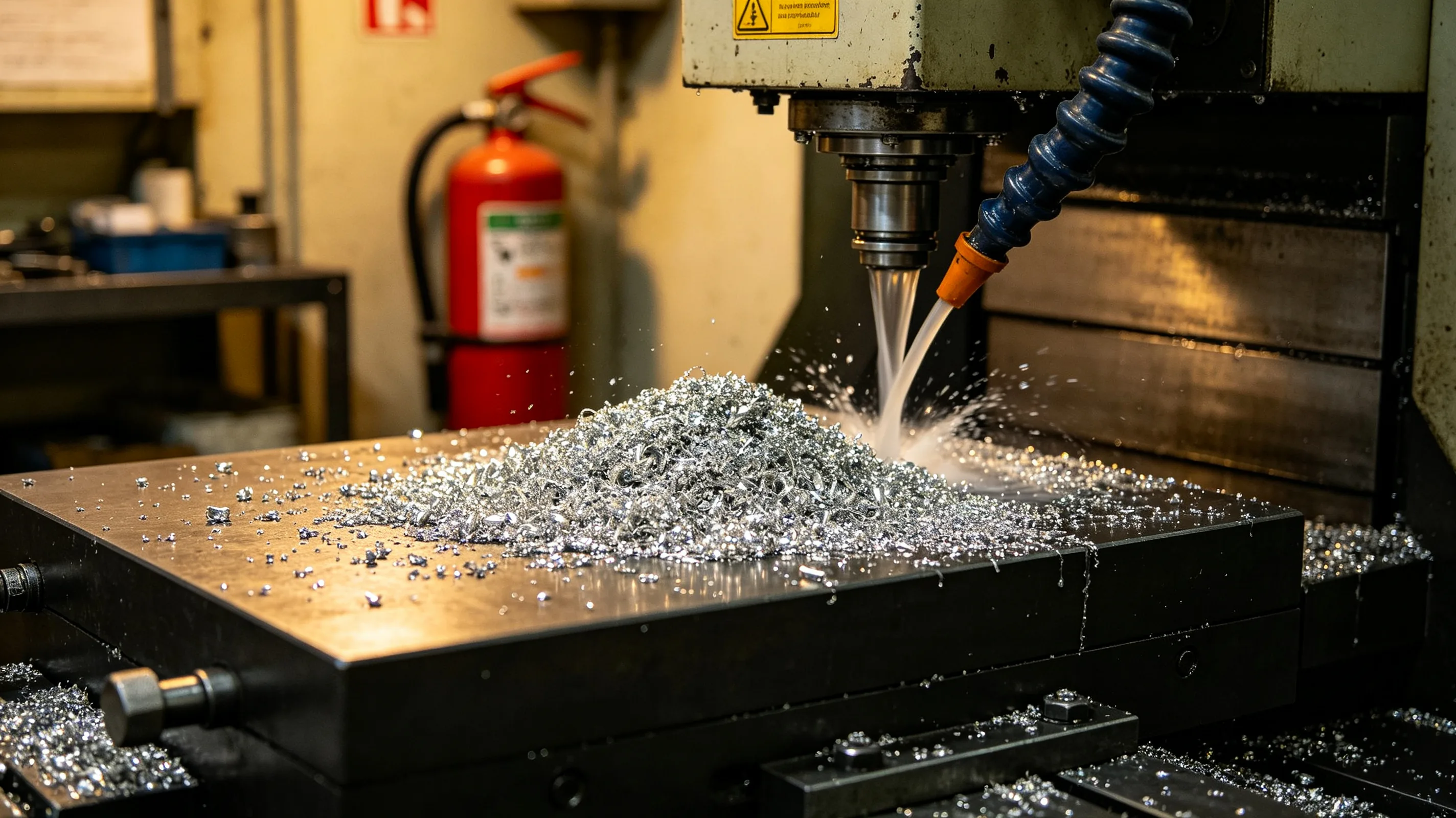
Titanium chip fires are a hazard that few other materials present in machining. The combination of high cutting temperatures, the chemical reactivity of fine titanium particles, and the oxygen-rich environment of the cutting zone creates conditions where chip ignition is a real possibility. Fire prevention in titanium machining is not a safety add-on — it is a process requirement that influences tool selection, coolant strategy, and machine configuration from the start of process planning.
- Why titanium chips are flammable and when ignition occurs
- Chip morphology and its role in fire risk
- Coolant system requirements for fire prevention
- Drilling and deep-pocket chip evacuation
- Machine configuration and housekeeping practices
Why titanium chips are flammable and when ignition occurs
Titanium chips ignite through a mechanism that is different from how cutting fluids or oil mists burn. The ignition event starts at the chip itself, not at the coolant. When a titanium chip is sheared from the workpiece, the freshly exposed surface is chemically active. If the chip is small enough and hot enough, the surface oxidizes rapidly in an exothermic reaction — the chip burns. The burning chip can then ignite the coolant mist or accumulated oil in the machine enclosure, but the primary ignition source is the chip, not the coolant.
The conditions that lead to chip ignition are well understood. Chip temperature at the moment of formation must be above approximately 800°C, and the chip must be small enough that the surface-area-to-volume ratio is high enough to sustain rapid oxidation. This temperature threshold is reached routinely in titanium machining, as the article on why titanium is difficult to machine explains in the context of thermal concentration at the cutting edge. Thin, stringy chips with large surface areas relative to their mass are the most dangerous. Heavy, thick chips from roughing operations are less likely to ignite because they have a lower surface-area-to-volume ratio and cool more slowly in a controlled way.
Cutting speed is the primary driver of chip ignition risk. At cutting speeds above 80 m/min for Ti-6Al-4V, the chip temperature at formation is consistently above the ignition threshold. Below 60 m/min, the risk is significantly lower but not zero — specific conditions such as tool wear, reduced coolant flow, or interrupted cuts can produce localized temperatures high enough for ignition even at lower average speeds.
Tool condition matters for fire risk because a worn tool generates higher cutting forces and higher chip temperatures than a sharp tool at the same cutting parameters. A tool that is approaching end of life can generate chip temperatures 100 to 200°C higher than a fresh tool under identical conditions. This means that a process that is safe with a sharp tool can become hazardous as the tool wears. Tool change intervals that are based on part quality criteria alone may not account for this shift in fire risk.
The type of cut also influences ignition probability. Interrupted cuts such as milling produce chips that are exposed to oxygen immediately after formation, and the chip trajectory through the air provides additional oxygen exposure before the chip lands in the coolant stream. Continuous cuts such as turning produce chips that stay in contact with the workpiece and tool longer, and they may be carried into the coolant stream more quickly, reducing the time available for ignition.
Chip morphology and its role in fire risk
The chip form produced during titanium machining directly determines the fire risk level. Long, continuous chips with thin cross-sections have the highest surface-area-to-volume ratio and the highest ignition potential. Short, segmented chips that break into small pieces have less surface area per unit mass and are less likely to sustain a combustion reaction.
In turning operations, chip form is influenced by feed rate, depth of cut, and tool geometry. Low feed rates produce thin, stringy chips that are more likely to ignite than the thicker, heavier chips produced at higher feed rates. This creates a tension between surface finish requirements — which typically call for lower feed rates — and fire risk management. In titanium turning, the feed rate should not be reduced below the point where chip breaking becomes ineffective unless coolant delivery is sufficient to quench the chips immediately.
In milling operations, chip thickness varies throughout the tool rotation, and the thinnest section of the chip — at entry or exit depending on the milling direction — has the highest ignition potential. Climb milling produces chips that start thick and thin toward exit, so the thinnest, most dangerous section is at the end of the cut where the chip is already separated from the workpiece. Conventional milling produces chips that start thin and thicken toward exit, so the most dangerous section is at the beginning of the cut where the chip is at its thinnest but still attached.
Chip breaker geometry on the tool insert promotes chip breaking by creating a localized stress concentration that fractures the chip into shorter segments. Effective chip breaking in titanium requires different geometry than chip breaking in steel because the chip is more rigid and requires a sharper stress concentration to fracture. Inserts designed specifically for titanium typically have more aggressive chip breaker geometry than general-purpose inserts.
Chip thinning at high radial engagement in milling can produce chips that are thinner than the feed per tooth would suggest. When the radial engagement is less than the tool radius, the maximum chip thickness is less than the feed per tooth, and the chip at the entry and exit points is very thin. These thin chip sections are the most likely to ignite because they heat up fastest and cool slowest. Reducing radial engagement to below 30 percent of tool diameter increases fire risk unless coolant delivery is sufficient to manage the thin chip sections.
Coolant system requirements for fire prevention
The primary function of the coolant system in fire prevention is not to extinguish fires after they start — it is to prevent the chip from reaching ignition temperature in the first place. This requires that the coolant reach the cutting edge at sufficient volume and pressure to remove heat from the chip at the moment of formation. The high-pressure coolant strategy article covers the specific pressure and flow requirements for effective thermal management in titanium operations.
For fire prevention, the critical coolant parameter is not pressure but coverage. The entire cutting zone must be flooded with coolant so that the chip is quenched immediately upon formation. Localized gaps in coolant coverage — areas where the coolant stream does not reach — create zones where dry chips can form and ignite. In five-axis machining where the tool orientation changes, maintaining continuous coolant coverage requires careful nozzle positioning and sufficient flow rate to follow the tool as it moves.
Through-spindle coolant delivery provides the most reliable coverage because the coolant exits the tool at the cutting edge, regardless of the tool orientation. External coolant nozzles can leave coverage gaps when the tool is in certain positions, particularly when machining internal features or using long tool extensions. For operations where through-spindle coolant is not available, multiple external nozzles positioned at different angles are necessary to maintain coverage across the expected range of tool orientations.
Coolant flow rate matters for fire prevention independently of pressure. A high-pressure stream that is narrow may provide good penetration but poor coverage. The coolant must provide both penetration to reach the cutting interface and volume to quench the chip after it leaves the cutting zone. A minimum flow rate of 20 liters per minute per nozzle is a reasonable guideline for titanium machining operations with fire risk.
Coolant concentration affects fire prevention indirectly through its effect on lubricity and heat transfer. Coolant with adequate concentration forms a better barrier film at the chip-tool interface, reducing friction and the heat generated at the chip formation zone. Coolant that is too dilute or degraded allows higher friction and higher chip temperatures, increasing fire risk. Maintaining concentration within the recommended range of 8 to 10 percent is part of fire prevention process control.
Drilling and deep-pocket chip evacuation
Drilling operations in titanium present a specific fire hazard because the chips are generated inside the hole where coolant access is restricted and the chips cannot escape freely. The confined space of the drill flute traps chips against the cutting edge, and the trapped chips continue to generate heat from friction and deformation.
Peck drilling cycles that retract the drill periodically to clear chips are standard practice for titanium. The peck depth — how far the drill advances before retracting — should be set to prevent chip packing in the flutes. For small-diameter drills below 6 mm, a peck depth of one to two times the drill diameter is typical. For larger diameters, the peck depth can be increased to three to four times the diameter, but this depends on chip form and coolant effectiveness.
Through-coolant drills that deliver coolant through the drill body to the cutting edge are strongly preferred for titanium drilling. The coolant exits at the drill point, providing cooling at the point of chip formation and hydraulic force to push chips up the flutes and out of the hole. Without through-coolant delivery, chips accumulate in the flutes and the drilling process becomes unreliable at depths beyond three times the drill diameter.
When a drill begins to produce continuous chips instead of broken chips, it is a sign that the cutting edge has worn and the chip breaking geometry is no longer effective. Continuing to drill with a worn drill in titanium increases fire risk because the continuous chips are hotter and more difficult to evacuate. Drill change intervals should be set conservatively for titanium, and drills should be replaced at the first sign of chip form change rather than waiting for measurable wear.
Deep-pocket milling requires similar attention to chip evacuation. Chips that accumulate at the bottom of a deep pocket block coolant access to the cutting edge and create a localized thermal environment that can lead to ignition. High-pressure coolant through the spindle, combined with toolpaths that allow chips to be flushed out of the pocket, is the standard approach. Toolpaths that work from the bottom of the pocket upward allow chips to fall away from the cutting zone rather than accumulating around the tool.
Machine configuration and housekeeping practices
Machine configuration for titanium machining should include fire prevention features that are not required for general machining. Chip conveyors should be designed to handle titanium chips, which are abrasive and can damage standard conveyor systems. Coolant filtration should remove fine titanium particles that can accumulate in the sump and create a fire hazard during maintenance.
Chip accumulation in the machine enclosure should not be allowed to build up over multiple cycles. Titanium chips that accumulate in corners or on horizontal surfaces can dry out and become a fire hazard, particularly when the machine is left idle with the coolant off. Chips should be removed from the machine after each production cycle, or at minimum at the end of each shift.
Coolant nozzles and delivery paths should be inspected regularly for blockages. A blocked nozzle that goes unnoticed can produce a localized dry cutting condition that leads to chip ignition. In machines with multiple coolant nozzles, a single blocked nozzle may not be detected by flow monitoring if the total flow rate is still within range.
Fire suppression systems are a standard requirement for machine tools used for titanium machining. CO— or inert gas systems that flood the machine enclosure are the most common, as they extinguish fires without damaging the machine tool or leaving residue. Dry chemical systems are also used but require thorough cleaning after activation to prevent corrosion of machine components.
The most effective fire prevention measure remains operator awareness. Operators working on titanium should be trained to recognize the conditions that lead to chip ignition — changes in chip color, chip form, or cutting sound — and to respond by stopping the cut and verifying coolant coverage before resuming. A culture of fire prevention that treats chip fires as a process control issue rather than a safety incident is the foundation of safe titanium machining operations.
Table 1: Chip fire risk by operation type
| Operation | Risk level | Primary hazard | Primary prevention |
|---|---|---|---|
| Turning, roughing | Low–moderate | Heavy chips, less ignition-prone | Adequate coolant coverage |
| Turning, finishing | Moderate–high | Thin, stringy chips | Chip breaker tools, high coolant flow |
| Milling, roughing | Moderate | Variable chip thickness | Through-spindle coolant |
| Milling, finishing | High | Thin chip sections at entry/exit | Climb milling, coolant coverage |
| Drilling, shallow (<3xD) | Moderate | Trapped chips in flutes | Peck cycles, through-coolant |
| Drilling, deep (>3xD) | High | Chip packing, restricted coolant | Through-coolant, conservative peck |
Table 2: Fire prevention checklist for titanium operations
| Control | Requirement | Verification method |
|---|---|---|
| Coolant coverage | Continuous flood at cutting zone | Visual confirmation each setup |
| Coolant pressure | 50+ bar for deep features | Pressure gauge at machine |
| Coolant concentration | 8–0% | Daily refractometer check |
| Chip form | Short, segmented chips | Visual inspection during cutting |
| Tool condition | Change at first chip form change | Documented tool life limits |
| Chip removal | After each cycle or end of shift | Housekeeping schedule |
| Fire suppression | CO— or inert gas system | Monthly system test |
| Operator training | Fire prevention awareness | Annual refresher |
For titanium programs where fire prevention is a process requirement, discuss your application with our engineering team.