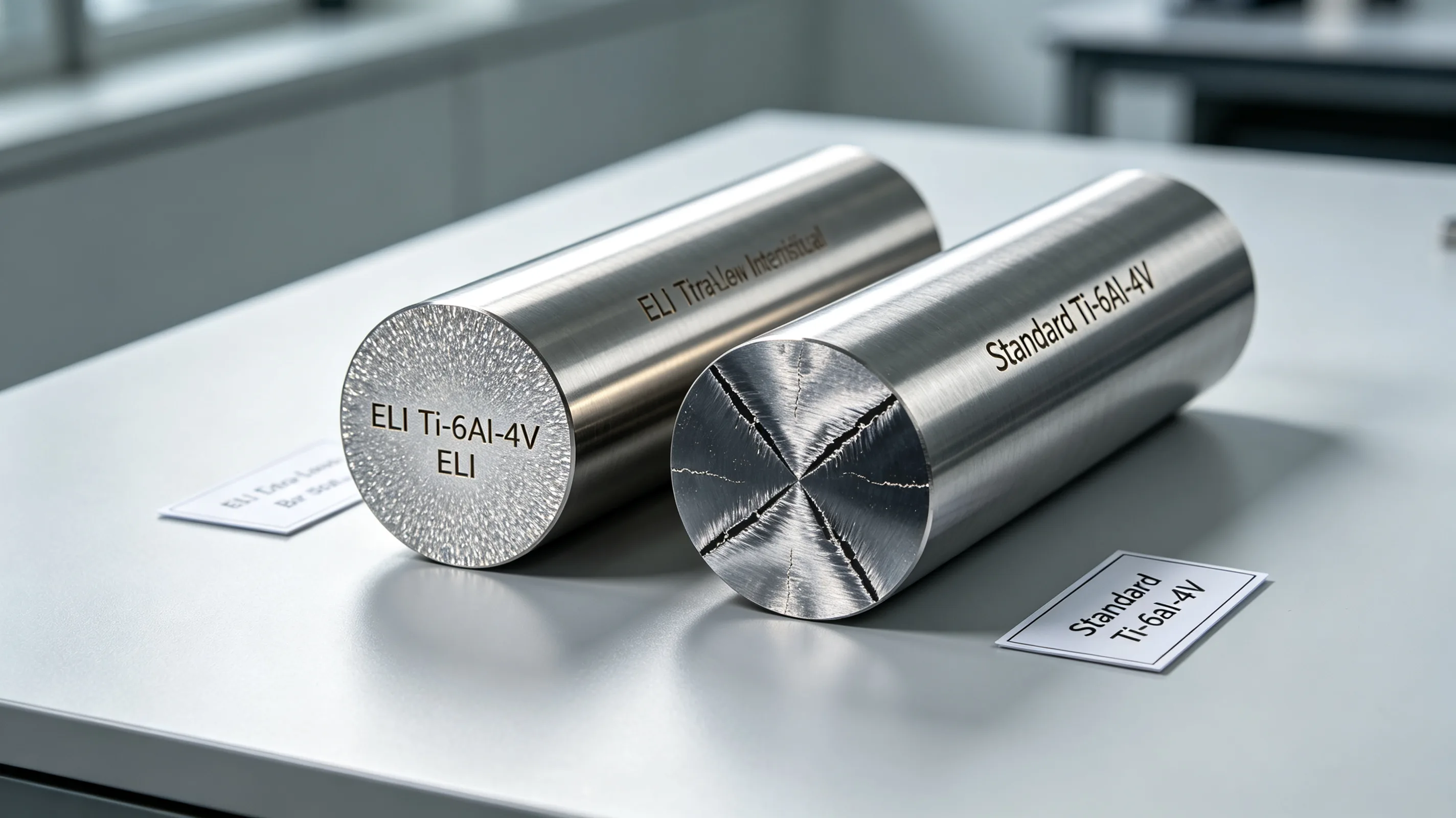
ELI — Extra Low Interstitial — is a material modification designation applied to titanium alloys and commercially pure (CP) titanium grades that have been produced with tighter-than-standard control of interstitial elements: oxygen, nitrogen, carbon, and hydrogen. The ELI designation signals that the material has a measurably lower interstitial content than its standard counterpart, which translates into improved ductility, fracture toughness, and fatigue crack growth resistance. ELI titanium is not a single grade — it is a modification available across multiple compositions, each with its own applicable standard and its own engineering rationale. The most widely specified ELI grade is Grade 23 (Ti-6Al-4V ELI) per ASTM F136, but ELI variants of CP-Ti Grade 4 (per ASTM F67) and, in some specifications, Grade 2 and Grade 3 are also available. Understanding which ELI grades exist, what property differences the ELI modification actually produces, and when the premium over standard-grade material is justified is essential for any engineer or procurement professional sourcing titanium for medical implants, cryogenic equipment, or fracture-critical aerospace components. For a complete overview of all titanium alloy categories, see the titanium grades complete guide. For the medical-specific context, see the ASTM F136 standard guide and the Grade 23 titanium guide.
What Interstitial Elements Are Controlled in ELI Titanium?
Interstitial elements in titanium occupy spaces between titanium atoms in the crystal lattice rather than substituting for titanium atoms on lattice sites. Because the atoms of oxygen, nitrogen, carbon, and hydrogen are smaller than titanium, they fit into interstitial sites and distort the lattice. This distortion — solid-solution strengthening — increases strength and hardness but reduces ductility and toughness.
The four interstitial elements controlled in ELI specifications are:
- Oxygen (O): The most influential interstitial. Each 0.01 percent increase in oxygen content raises tensile strength by approximately 8 MPa while reducing elongation by roughly 0.5 percentage points. Oxygen is the primary variable separating CP grades from each other and separating ELI variants from their standard counterparts.
- Nitrogen (N): Approximately twice as potent as oxygen per unit weight as a strengthener, but present in smaller quantities. Nitrogen content is typically limited to 0.03–0.05 percent in both standard and ELI specifications.
- Carbon (C): A mild strengthener with less effect than oxygen or nitrogen. Carbon limits are typically 0.08 percent in both standard and ELI grades.
- Hydrogen (H): The most tightly controlled interstitial because hydrogen embrittlement is a known failure mechanism in titanium. Hydrogen limits are typically 0.015 percent maximum and do not differ between standard and ELI specifications.
The meaningful difference between a standard grade and its ELI variant is almost entirely in oxygen content. The other interstitial limits are unchanged in most specifications.
Which Titanium Grades Have ELI Variants?
Not every titanium grade has an ELI counterpart. The ELI modification is applied only to grades where the oxygen content in the standard specification is high enough that a reduction produces a measurable engineering benefit.
Table 1: Titanium grades with available ELI variants
| Grade | Standard composition | ELI variant | ELI standard | Primary reason for ELI variant |
|---|---|---|---|---|
| CP-Ti Grade 1 | O ≤ 0.18% | No ELI variant | — | Oxygen already low; reduction yields minimal benefit |
| CP-Ti Grade 2 | O ≤ 0.25% | No ELI variant | — | Oxygen already low; reduction yields minimal benefit |
| CP-Ti Grade 3 | O ≤ 0.35% | ELI Grade 3 (limited availability) | Per ASTM F67 when specified | Improved ductility for cold forming |
| CP-Ti Grade 4 | O ≤ 0.40% | ELI Grade 4 | ASTM F67 (ELI), ISO 5832-2 | Ductility and fracture toughness for non-load-bearing implants |
| Grade 5 (Ti-6Al-4V) | O ≤ 0.20% | Grade 23 (Ti-6Al-4V ELI) | ASTM F136, ISO 5832-3 | Fracture toughness for load-bearing implants and cryogenic service |
| Grade 9 (Ti-3Al-2.5V) | O ≤ 0.15% | No standard ELI variant | — | Oxygen already low |
Grade 23 (Ti-6Al-4V ELI) is by far the most commercially significant ELI grade, accounting for the majority of ELI titanium consumption globally. ELI Grade 4 is the second most specified. ELI Grade 3 exists as a specialty product and is rarely specified outside of niche cold-forming applications.
Why Grade 23 is the dominant ELI grade
Grade 5 (Ti-6Al-4V) has a maximum oxygen limit of 0.20 percent — high enough that reducing it to 0.13 percent (the Grade 23 limit) produces a substantial improvement in fracture toughness and ductility. The 0.07 percent oxygen reduction in Grade 23 raises fracture toughness KIC from 50–65 MPa√m to 70–85 MPa√m — a 30–40 percent improvement. At the same time, the tensile strength drop is only 5–8 percent (860 MPa minimum versus 895 MPa for Grade 5), which is acceptable for virtually all implant applications. This favorable trade-off — large toughness gain for small strength loss — is what makes Grade 23 the standard material for load-bearing orthopedic implants, dental implants, and cryogenic equipment.
How ELI Changes Mechanical Properties
The property changes produced by the ELI modification follow a consistent pattern across all grades: reduced oxygen content lowers strength slightly, increases ductility, and improves fracture toughness significantly. The magnitude of the change depends on how much the oxygen limit is reduced relative to the standard specification.
Table 2: Property comparison — Standard Grade vs ELI variant
| Property | Grade 5 (O ≤ 0.20%) | Grade 23 ELI (O ≤ 0.13%) | Change | Practical significance |
|---|---|---|---|---|
| Tensile strength, min | 895 MPa | 860 MPa | −4% | Not critical for most applications |
| Yield strength, min | 828 MPa | 795 MPa | −4% | Not critical for most applications |
| Elongation, min | 10% | 10% | Same specification | ELI typically achieves 12–15% in practice |
| Fracture toughness KIC | 50–65 MPa√m | 70–85 MPa√m | +30–40% | Decisive for implant fatigue life |
| Fatigue crack growth rate | Baseline | Reduced by 20–30% | Significant | Longer inspection intervals |
| Notch sensitivity | Higher threshold | Lower threshold | Safer for threaded designs | Bone screws, dental abutments |
The fracture toughness improvement is the single most important engineering justification for specifying ELI titanium. In structural applications where crack propagation under cyclic loading determines component life — and in medical implants where that life must be measured in decades — a 30–40 percent improvement in KIC is not marginal; it is the difference between adequate performance and regulatory acceptance.
Why ELI Titanium Costs More
The ELI modification adds cost at the mill production stage because tighter interstitial control requires:
- Higher-grade sponge feedstock: The oxygen content of the input titanium sponge must be lower than for standard-grade production. Sponge with oxygen below 0.08 percent is produced using higher-purity rutile or synthetic rutile feedstock, which costs 15–25 percent more than standard-grade feedstock.
- More controlled melting: ELI specifications require tighter control of the melting process to prevent oxygen pickup from furnace atmosphere or electrode contamination. This typically means vacuum arc remelting (VAR) with stricter process monitoring rather than single VAR or non-vacuum melting.
- Additional testing: Each production lot must be tested for oxygen, nitrogen, carbon, and hydrogen content with tighter acceptance criteria than standard-grade material. If a lot exceeds the ELI limits, it cannot be downgraded easily — the material is typically scrapped or used for non-critical applications.
- Lower mill yield: ELI material that fails oxygen limits during processing can sometimes be blended with lower-oxygen material in subsequent melts, but the yield loss from rejected ELI heats is higher than for standard grades.
The total cost premium for ELI titanium over the equivalent standard grade ranges from 15 to 30 percent for Grade 23 versus Grade 5, and from 10 to 20 percent for ELI Grade 4 versus standard Grade 4. The premium is higher for small-diameter bar and thin-gauge sheet because the surface-to-volume ratio increases the risk of oxygen pickup during hot working.
Three Practical Rules for Specifying ELI Titanium
Rule 1: Do not specify ELI unless the application requires the toughness benefit.
ELI titanium costs 15–30 percent more and has 4–8 percent lower tensile strength than the equivalent standard grade. If your application does not involve cyclic fatigue loading, cryogenic temperature service, or implant biocompatibility requirements, the standard grade will perform identically at lower cost. The most common specification error we encounter is ELI being specified for surgical instruments — tools that are not implanted and do not experience cyclic fatigue loads. ASTM F1472 (standard Grade 5) is adequate for virtually all surgical instruments, saving 15–30 percent in material cost.
Rule 2: Verify the applicable standard — not all ELI material is the same.
Grade 23 per ASTM F136 and ELI Grade 4 per ASTM F67 are different materials with different properties, different certifications, and different regulatory acceptance profiles. A supplier that certifies material as “ELI titanium” without specifying the applicable standard may be supplying material that does not meet the requirements of your specific application. The purchase order must reference the full standard designation — for example, “ASTM F136 Grade 23 Ti-6Al-4V ELI” — not “ELI titanium” alone.
Rule 3: If cryogenic service is the application, ELI is not optional — it is required.
Standard Ti-6Al-4V (Grade 5) exhibits reduced fracture toughness at cryogenic temperatures, with KIC dropping below 40 MPa√m at −196°C. Grade 23 maintains KIC above 60 MPa√m at the same temperature. For LNG processing equipment, liquid hydrogen storage vessels, and cryogenic transport piping, standard Grade 5 is not an acceptable substitute for Grade 23 regardless of cost or lead time. The same applies to ELI Grade 4 versus standard Grade 4 for cryogenic CP-titanium applications.
For engineering teams evaluating titanium material specifications for medical, cryogenic, or fracture-critical applications, confirming that the ELI designation is justified by the actual service conditions — and verifying that the supplier can provide material certified to the correct standard with EN 10204 Type 3.1 documentation — will prevent the most common specification errors. A titanium CNC machining and fabrication supplier with documented experience across all ELI grades can provide the material procurement support and certification verification needed.
For a quotation on ELI-grade titanium components with correct standard designation and full certification, submit your requirements through our RFQ portal.