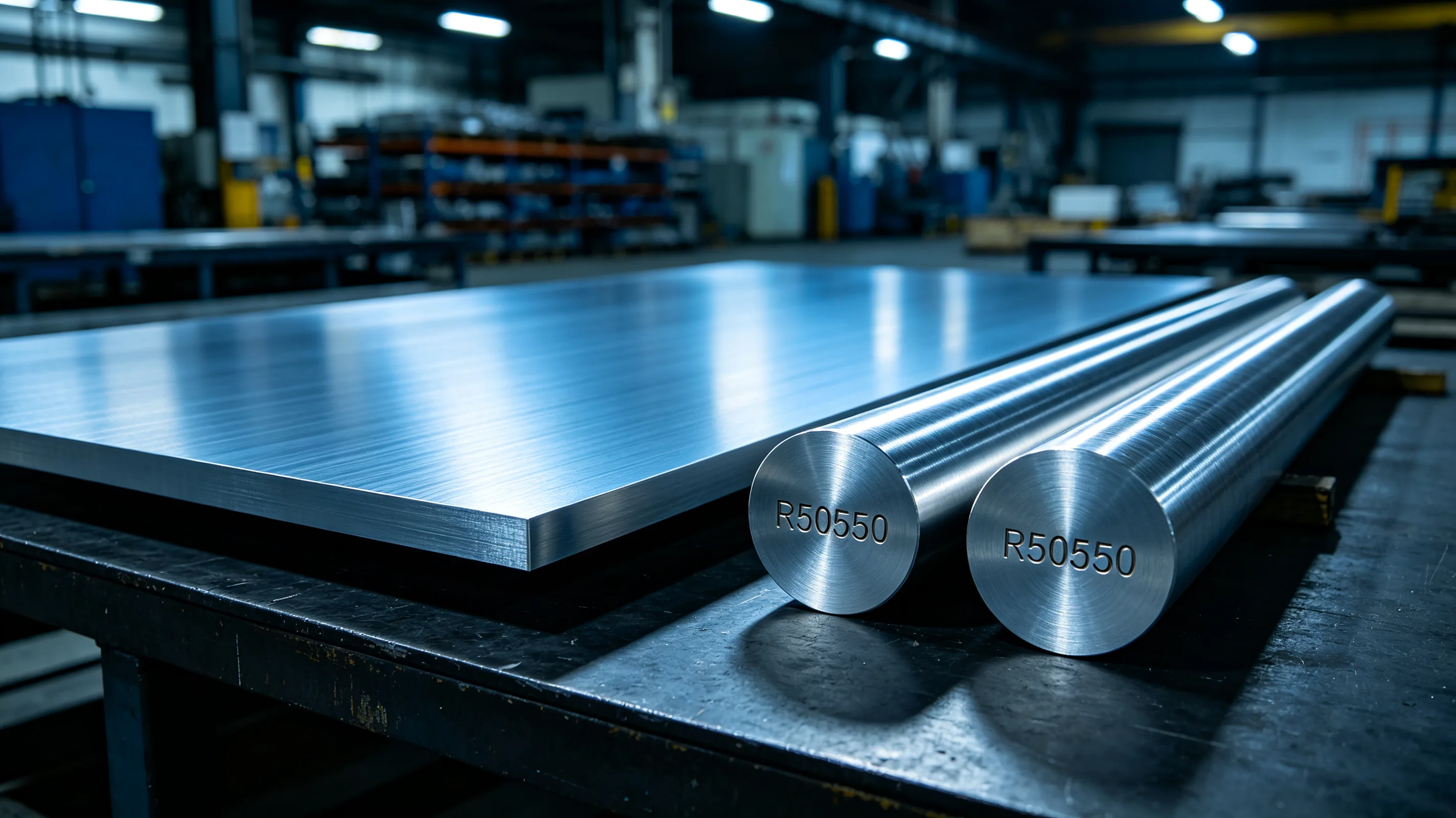
Grade 3 titanium (UNS R50550) is a medium-strength commercially pure titanium grade positioned between Grade 2 and Grade 4 in the CP family. Its tensile strength of approximately 450 MPa and elongation of 18 percent place it in a narrow performance band that many procurement and engineering teams overlook because Grade 2 is more widely available and Grade 4 offers higher strength for a modest cost increment. This intermediate position makes Grade 3 the least specified CP grade in most industries, but there are specific applications where it is the correct choice — applications that need more strength than Grade 2 while retaining better ductility than Grade 4. Understanding this narrow window is the difference between specifying Grade 3 correctly and defaulting to a grade that either underperforms or carries unnecessary cost. For a complete overview of all CP grades and their relationship to alloyed titanium grades, see the CP titanium grades comparison guide.
How Is Grade 3 Classified Among the CP Grades?
Grade 3 titanium is defined by its oxygen content, which is controlled to a maximum of 0.35 percent. Oxygen acts as a solid-solution strengthener in the alpha-phase titanium matrix — oxygen atoms in the interstitial sites of the hexagonal close-packed crystal lattice impede dislocation motion, increasing strength and reducing ductility in a predictable, continuous progression from Grade 1 through Grade 4.
The four CP grades form a continuous series:
- Grade 1: 0.18 percent oxygen max — approximately 240 MPa tensile, 24 percent elongation. Maximum formability.
- Grade 2: 0.25 percent oxygen max — approximately 345 MPa tensile, 20 percent elongation. The standard CP grade for most applications.
- Grade 3: 0.35 percent oxygen max — approximately 450 MPa tensile, 18 percent elongation. Intermediate strength between Grade 2 and Grade 4.
- Grade 4: 0.40 percent oxygen max — approximately 550 MPa tensile, 15 percent elongation. Highest strength among CP grades.
Each step increases tensile strength by approximately 100 MPa while reducing elongation by roughly 2 to 4 percent. Grade 3 sits exactly at the inflection point where the strength gain from Grade 2 begins to level off and the ductility loss toward Grade 4 becomes noticeable.
Why Grade 3 is specified less frequently
Grade 3 occupies what could be called a discontinuous availability band in the CP spectrum. For applications requiring 350 to 400 MPa tensile strength, Grade 2 is usually sufficient after accounting for typical design safety factors. For applications requiring 500 MPa or more, Grade 4 provides the necessary margin. Grade 3 serves the narrow region between these two points where the next-higher standard grade (Grade 4) would be over-specified and the next-lower standard grade (Grade 2) would be under-specified. This window exists, but it is narrower than most procurement guidelines acknowledge.
A secondary reason for Grade 3’s lower specification rate is that not all titanium mills carry Grade 3 in their standard product range. Many mills produce Grade 2 and Grade 4 as standard items and only roll Grade 3 on a campaign basis — typically with 8 to 16 week lead times compared to 4 to 8 weeks for Grade 2. Procurement teams under schedule pressure often default to Grade 2 for lower-strength applications or jump to Grade 4 for higher-strength ones, bypassing Grade 3 entirely because the lead time penalty does not justify the intermediate mechanical properties.
What Properties Does Grade 3 Titanium Deliver?
Grade 3’s mechanical and physical properties place it firmly between Grade 2 and Grade 4 in every relevant metric. The differences matter in specific design contexts.
Mechanical properties at room temperature
In the annealed condition — which is the standard supply condition for all CP grades — Grade 3 delivers 450 MPa minimum tensile strength and 380 MPa minimum yield strength, with 18 percent minimum elongation. The density is 4.51 g/cm³, essentially identical to other CP grades. The elastic modulus is 103 GPa, also comparable across the CP family.
Hardness is not normally specified for CP titanium grades in ASTM B265 or ASTM B348, but typical Vickers hardness for Grade 3 falls in the 200 to 240 HV range, compared to 160 to 200 HV for Grade 2 and 240 to 280 HV for Grade 4.
Corrosion resistance
Grade 3’s corrosion resistance is equivalent to Grade 2 and Grade 4 in most environments because corrosion performance in CP titanium is determined by the stable, self-healing oxide layer (primarily TiO₂) that forms on the surface, not by the oxygen content of the bulk material. In seawater, chlorinated solutions, oxidizing acids, and most organic chemicals, all CP grades exhibit comparable corrosion rates below 0.05 mm per year.
The difference appears in reducing acid environments. Grade 3’s slightly higher oxygen content does not measurably improve corrosion resistance in reducing media such as hydrochloric or sulfuric acid. If the application involves reducing acid exposure above 5 percent concentration or 80°C, none of the CP grades are adequate — a palladium-stabilized grade such as Grade 7 or Grade 11 should be specified instead.
Fabricability
Grade 3 can be cold formed, but the bend radius must be increased relative to Grade 2. For sheet thicknesses up to 6 mm, the minimum bend radius for Grade 3 is approximately 2.5 to 3 times the sheet thickness, compared to 1.5 to 2 times for Grade 2. For thicker sections or complex geometries, warm forming at 200 to 300°C is recommended.
Welding characteristics are similar across all CP grades. Grade 3 welds readily using standard titanium welding practices — inert gas shielding (argon or argon-helium mixtures), oxide layer removal before welding, and post-weld cleaning. No post-weld heat treatment is required for most applications, though stress relief may be beneficial for heavily cold-worked sections.
How Does Grade 3 Machine Compared to Other CP Grades?
Grade 3 presents machining characteristics that differ from both Grade 2 and Grade 4 in ways that are not immediately obvious from the mechanical property data.
Chip formation and control
Grade 3 produces chips that are less ductile and easier to break than Grade 2 chips but more ductile and more prone to built-up edge formation than Grade 4 chips. This middle behavior means that chip breaker tooling optimized for Grade 2 may produce insufficient chip fragmentation, while tooling optimized for Grade 4 may produce over-fragmentation with excessive tool vibration.
In production experience, shops that standardize on one CP grade — typically Grade 2 — and occasionally accept Grade 3 work orders often find that their standard feeds and speeds produce acceptable surface finish but higher than normal tool consumption. The adjustment required is modest: reducing cutting speed by 8 to 12 percent from Grade 2 parameters and increasing feed rate by 5 to 10 percent to maintain chip control. Operators who do not make this adjustment typically report tool edge life reductions of 15 to 25 percent on Grade 3 compared to Grade 2.
Surface finish capability
Grade 3 can achieve surface finishes down to Ra 0.6 µm with standard carbide tooling and appropriate finishing passes, which is comparable to Grade 2. The Ra 0.4 µm threshold requires careful process control — reduced feed rates, wiper geometry inserts, and stable coolant delivery — but is achievable on most modern CNC equipment. Below Ra 0.4 µm, the risk of smearing the surface rather than cutting cleanly increases, and process verification becomes dependent on surface integrity inspection rather than roughness measurement alone.
Coolant requirements
All CP grades generate less cutting heat than Ti-6Al-4V because their thermal conductivity is slightly higher — approximately 16 W/m·K for CP grades versus 7 W/m·K for Ti-6Al-4V. Flood coolant at 10 to 20 bar is sufficient for most Grade 3 machining operations, including roughing. High-pressure coolant above 40 bar provides measurable tool life improvement in deep-hole drilling and heavy roughing but is not required for standard turning and milling operations. This is a meaningful operational difference from near-alpha alloys such as Ti-6242, where high-pressure coolant is mandatory for roughing.
Table 1: Mechanical and physical properties of CP titanium grades
| Property | Grade 1 | Grade 2 | Grade 3 | Grade 4 |
|---|---|---|---|---|
| Max oxygen content (%) | 0.18 | 0.25 | 0.35 | 0.40 |
| Tensile strength, min (MPa) | 240 | 345 | 450 | 550 |
| Yield strength, 0.2% offset (MPa) | 170 | 275 | 380 | 485 |
| Elongation, min (%) | 24 | 20 | 18 | 15 |
| Hardness, typical (HV) | 120–160 | 160–200 | 200–240 | 240–280 |
| Density (g/cm³) | 4.51 | 4.51 | 4.51 | 4.51 |
| Elastic modulus (GPa) | 103 | 103 | 103 | 103 |
| Thermal conductivity at 20°C (W/m·K) | 17 | 16 | 16 | 15 |
| Relative material cost (per kg) | 0.8–0.9x Grade 2 | 1.0x (baseline) | 1.1–1.2x Grade 2 | 1.2–1.3x Grade 2 |
What Standards Apply to Grade 3 Titanium?
Grade 3 is covered by the same ASTM and AMS standards that apply to CP titanium grades generally, with the grade designation specified in the standard.
Table 2: Applicable standards for Grade 3 titanium by product form
| Product form | ASTM standard | AMS standard | Key requirements |
|---|---|---|---|
| Sheet, strip, plate | ASTM B265 | AMS 4900 series | 450 MPa tensile min; 18% elongation min |
| Bar, billet | ASTM B348 | — | 450 MPa tensile min; annealing optional but recommended |
| Seamless and welded pipe | ASTM B337, ASTM B338 | — | Hydrostatic or NDE test required |
| Tube, condenser and heat exchanger | ASTM B338 | — | Flattening and flaring tests required |
| Welding filler wire | ASTM B863 | AMS 4951 | Chemical composition per Grade 3 limits |
Certification considerations that affect procurement
ASTM B265 and ASTM B348 both require that the material supplier provide a certified test report documenting the chemical composition and mechanical properties for each lot. For most industrial-grade applications, an EN 10204 Type 3.1 certificate is sufficient. For aerospace applications requiring full traceability to the ingot, Type 3.2 certification with third-party verification may be required.
The practical issue for Grade 3 procurement is not the certification level itself — it is the availability of certified material. Because Grade 3 is a less commonly stocked grade, many metal service centers do not carry Grade 3 sheet or bar in their standard inventory. An order for Grade 3 plate may require a mill roll, which carries an 8 to 16 week lead time depending on the dimensions and quantity required. Procurement teams accustomed to Grade 2 availability — typically off-the-shelf from multiple suppliers — are sometimes caught by this lead time gap when they accept a Grade 3 specification without checking stock availability first.
When Should an Engineer Specify Grade 3 Instead of Grade 2 or Grade 4?
The decision to specify Grade 3 over adjacent CP grades depends on the specific combination of strength requirement, formability requirement, and material availability for the project.
Grade 3 is the correct choice when
The application requires tensile strength above 420 MPa but below 500 MPa, the component involves moderate forming that would be difficult with Grade 4’s reduced ductility, and the delivery schedule can accommodate the longer lead time for Grade 3 material.
Heat exchanger tube sheets in moderately corrosive environments are one example where Grade 3 sometimes outperforms Grade 2. The tube-to-tube-sheet joint requires enough material strength to maintain seal integrity under differential thermal expansion, and Grade 2 in thinner sections may creep at the joint interface over extended service. Grade 4 would provide more strength but its reduced ductility makes tube expansion more difficult during fabrication. Grade 3 provides the intermediate properties that match both requirements.
Grade 3 is not the correct choice when
The design can be adjusted to use Grade 2 with a modest section thickness increase. In most cases, increasing the wall thickness of a Grade 2 component by 10 to 15 percent achieves the same structural capacity as Grade 3 at equal or lower total material cost, because Grade 2 costs less per kilogram and is available from stock rather than requiring a mill roll. The 8 to 16 week lead time premium for Grade 3 often outweighs the modest strength advantage it offers.
Three Procurement Rules for Grade 3 Titanium
The following rules are based on recurring observations from engineering teams and procurement professionals who have managed Grade 3 specifications through production.
Rule 1: Check stock availability before writing the specification. Grade 2 and Grade 4 are stocked items at most metal service centers. Grade 3 is a campaign-rolled grade at many mills. If the delivery schedule does not allow for 8 to 16 week mill lead time, redesign to Grade 2 with increased section thickness or Grade 4 with component geometry adjustments.
Rule 2: Never specify Grade 3 for corrosion performance alone. All CP grades have equivalent corrosion resistance in the same environment. If the application is corrosion-critical but strength requirements are below 350 MPa, Grade 2 delivers the same service life at lower material cost and better availability. If the environment is reducing acid with concentration above 5 percent, switch to Grade 7 or Grade 11 — none of the standard CP grades are adequate.
Rule 3: Verify that your machining supplier has CP grade transition experience. A shop that runs Grade 2 continuously may not have process parameters dialed for Grade 3. The 8 to 12 percent cutting speed reduction and feed rate increase needed for optimal tool life on Grade 3 are small adjustments, but shops that do not make them will see 15 to 25 percent shorter tool edge life and may attribute the difference to material quality variation rather than process parameter mismatch.
For engineering teams evaluating whether Grade 3 is the correct specification for their application, a grade-specific cost comparison that accounts for material availability, machining speed differences, and certification requirements will produce a more reliable procurement decision than one based on mechanical property data alone. A titanium CNC machining manufacturer with documented CP grade transition experience demonstrates this evaluation process in practice.
For a grade-specific quotation on Grade 3 titanium components, submit your requirements through our RFQ portal.
Table 3: Grade 3 selection decision matrix
| Application scenario | Recommended grade | Rationale |
|---|---|---|
| Required tensile strength 350–420 MPa, delivery schedule standard | Grade 2 with increased section | Lower cost, immediate availability, equivalent functional performance |
| Required tensile strength 420–500 MPa, moderate forming required, flexible delivery | Grade 3 | Intermediate strength with adequate ductility |
| Required tensile strength 420–500 MPa, aggressive forming required | Grade 2 with thicker section | Grade 3 may crack under severe forming; thick Grade 2 is safer |
| Required tensile strength above 500 MPa, limited forming | Grade 4 | Higher strength at comparable cost to Grade 3 with better availability |
| Corrosion-critical, strength below 350 MPa | Grade 2 | Equivalent corrosion resistance, lower cost, better availability |
| Reducing acid environment above 5% concentration | Grade 7 or Grade 11 | CP grades not suitable regardless of grade number |
| Welded assembly, moderate strength required | Grade 2 | Better weld ductility, no post-weld heat treatment required |