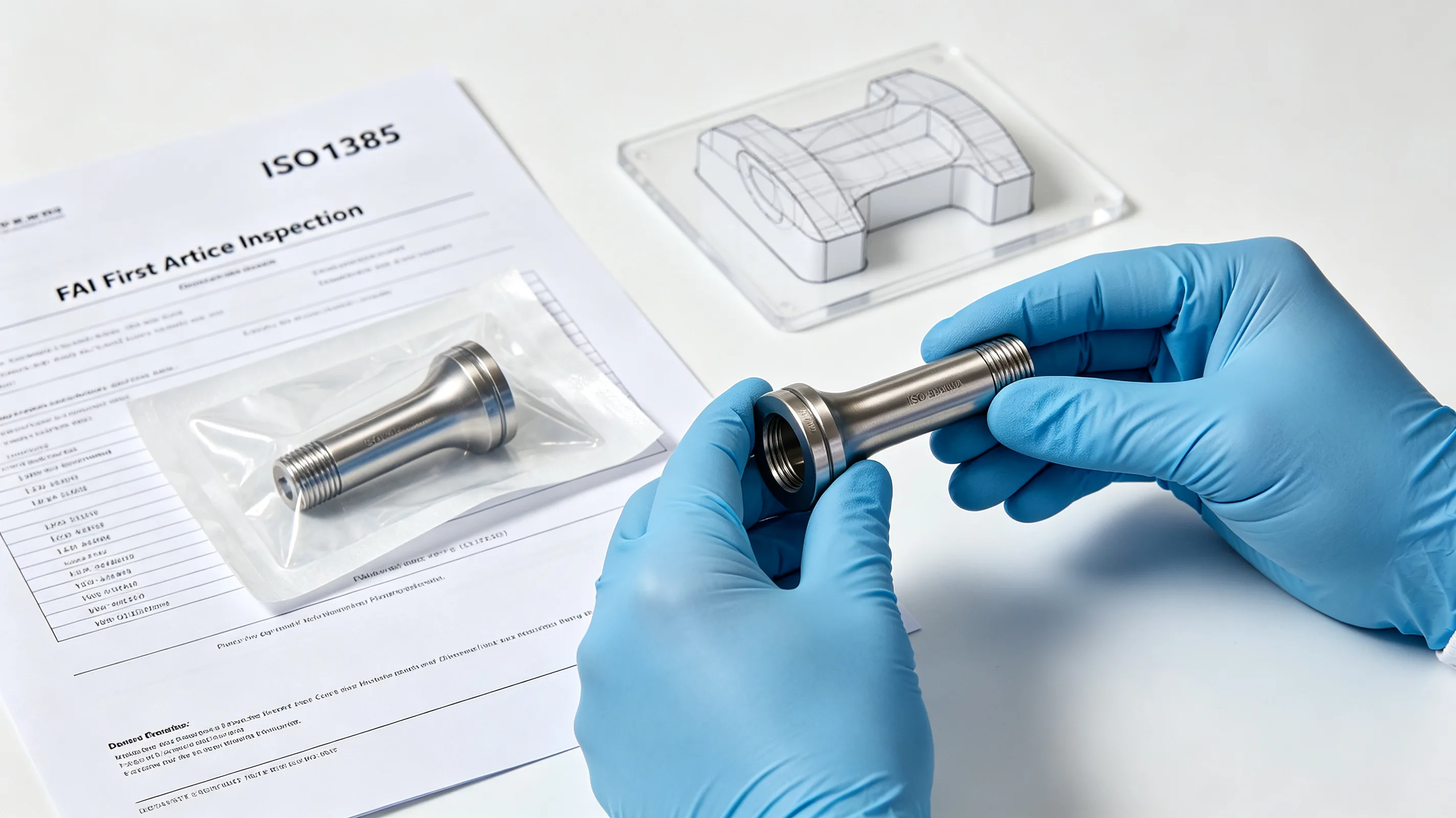
Component overview
The component was a femoral hip stem component machined from Ti-6Al-4V ELI per ASTM F136, Grade 23. The component had a complex contoured geometry with a polished articulating surface, a grit-blasted bone-ingrowth surface, and precision-machined taper and locking features. The overall length was approximately 150 mm, and the critical tolerances included a taper angle of 5° 42’ 30” ± 2’, a surface finish of Ra 0.05 μm maximum on the articulating surface, and a true position tolerance of 0.05 mm on the locking feature. The material selection and surface finish requirements are discussed in the Grade 23 guide and the surface finish guide.
Process validation requirements
The production process was developed under ISO 13485, requiring validation of all production processes. The validation included a process capability study for the taper machining operation, which demonstrated a Cpk of 1.45 based on 50 consecutive components. The tool life study established a maximum of 25 components per tool for the taper machining operation.
The cleaning process validation included challenge testing with artificially contaminated components to verify that the validated cleaning parameters removed machining residues to the required level. The cleaning process parameters — time, temperature, cleaning agent concentration, and ultrasonic power — were documented in the process specification.
Machining approach
The component was machined in three stages. Roughing was performed on a 3-axis machine tool with the component held in a custom fixture. The roughing operations removed approximately 70 percent of the starting stock, leaving 1.0 to 1.5 mm of stock on all surfaces.
Semi-finishing and finishing were performed on a 5-axis machine tool in a single setup. The 5-axis capability allowed the tool to maintain optimal orientation relative to the contoured surfaces, producing consistent surface finish across the complex geometry. The finishing passes were programmed with adaptive toolpaths that maintained constant chip load.
The polished articulating surface was produced by mechanical polishing after machining, using progressively finer abrasive compounds from 400 to 1200 grit. The polishing process removed approximately 0.01 to 0.02 mm of material from the surface, which was accounted for in the machining allowance.
Quality results
The first article inspection results showed all critical dimensions within specification. The taper angle measured 5° 42’ 35”, within the ±2’ tolerance. The surface finish on the articulating surface was Ra 0.04 μm. The true position of the locking feature was 0.03 mm.
Microscopic inspection of the machined surfaces at 100x magnification showed no embedded contaminants, no smearing, and no surface defects. The surface condition was consistent across all 50 components in the validation lot.
For medical implant components with similar material and validation requirements, request a process study and our engineers will outline the machining, polishing, and inspection plan for your geometry.