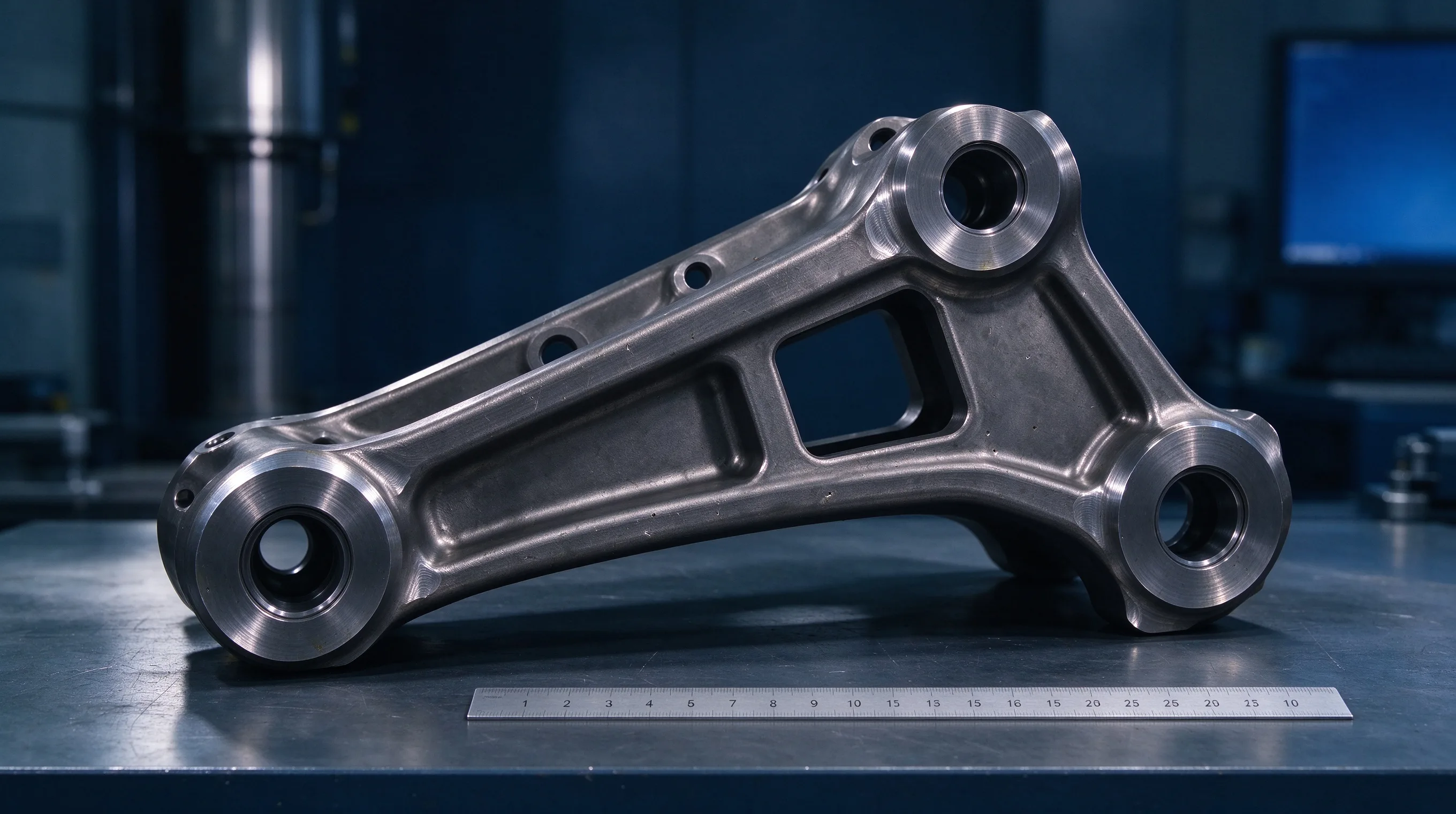
Beta titanium alloys are the highest-strength titanium alloys available for structural applications, with ultimate tensile strengths up to 1,400 MPa (200 ksi) in the solution-treated-and-aged (STA) condition — roughly 50% stronger than the workhorse Ti-6Al-4V (Grade 5) in the same condition. The combination of high strength, good fracture toughness, deep hardenability, and excellent fatigue performance has made beta alloys the material of choice for aerospace structural parts, landing gear components, high-strength fasteners, and downhole oil and gas tools. The cost of the performance is the machining: beta alloys are the most difficult titanium alloys to machine, with a machinability rating of roughly 50–60% of Ti-6Al-4V, and a tool-life reduction of 30–50% at the same parameters. A shop that runs beta alloys with the same discipline as Grade 5 will burn tools, produce out-of-tolerance parts, and reject the program. A shop that runs beta alloys with the discipline specific to the beta family will produce parts that meet the aerospace structural spec.
This article works through the four procurement decisions that determine whether a beta titanium CNC part is correctly specified: beta grade selection for the application, the metallurgy of the beta family and how it differs from alpha-beta, the machining discipline that compensates for the lower machinability, and the heat treatment that produces the high-strength condition. It assumes the general grade selection guide, the Grade 5 guide, and the machining processes guide as background — those cover the broader grade and process landscape; here we focus on the beta family specifically. For the tooling side, the tooling selection article is the cross-reference.
- Why beta titanium is the highest-strength titanium family
- The beta grade family: composition and properties
- How beta differs from alpha and alpha-beta in machinability
- Cutting parameters for beta alloys
- Tooling and workholding for beta alloys
- Heat treatment: solution treat and age (STA)
- Applications and procurement specifications
- Beta titanium machining checklist
Why beta titanium is the highest-strength titanium family
The titanium alloy family is divided into three metallurgical classes based on the phase stabilisers in the alloy:
- Alpha alloys (CP grades, Grade 9 / Ti-3Al-2.5V): stabilised by aluminium and oxygen, with the alpha phase dominant at room temperature. Alpha alloys are not heat-treatable — the strength is set by the composition and the cold work, not by heat treatment. The corrosion resistance is excellent, but the strength is moderate (UTS 240–620 MPa).
- Alpha-beta alloys (Grade 5 / Ti-6Al-4V, Grade 23 / Ti-6Al-4V ELI): stabilised by a combination of aluminium (alpha) and vanadium or molybdenum (beta). The alpha phase is dominant, with a small fraction of beta phase retained at room temperature. Alpha-beta alloys are heat-treatable to a moderate strength level (UTS 895–1,100 MPa in STA), and they are the workhorse titanium family for aerospace and medical.
- Beta alloys (Ti-10V-2Fe-3Al, Ti-5553, Ti-15V-3Cr-3Al-3Sn, others): stabilised by vanadium, molybdenum, chromium, and iron, with the beta phase dominant at room temperature. Beta alloys are heat-treatable to a very high strength level (UTS 1,100–1,400 MPa in STA), and they have deep hardenability (the strength is uniform through thick sections, unlike the alpha-beta alloys which require rapid quenching to retain the beta phase).
The beta phase at room temperature is what makes beta alloys both the strongest and the most difficult to machine. The beta phase is body-centred cubic (BCC), which is more ductile than the alpha phase (hexagonal close-packed, HCP), and the higher ductility means the cutting edge sees more plastic deformation per cut. The BCC structure also means the alloy work-hardens more rapidly than the alpha or alpha-beta alloys, with a work-hardened layer that can extend 0.10–0.30 mm below the machined surface. The work-hardened layer is what drives the lower machinability, and the work-hardened layer is also what drives the higher strength after heat treatment — the same metallurgical feature that makes beta alloys strong makes them difficult to cut.
The combination of high strength, deep hardenability, and high fracture toughness is what makes beta alloys the material of choice for aerospace structural parts. A landing gear forging in Ti-10V-2Fe-3Al can be heat-treated to UTS 1,200 MPa with 10% elongation, and the strength is uniform through a 200 mm cross-section.
The beta grade family: composition and properties
The beta grade family in production use is dominated by three grades, with two more in development or specialty use. The composition and properties of each:
Ti-10V-2Fe-3Al (Ti-10-2-3). The most widely used beta alloy for aerospace structural applications, including landing gear forgings, helicopter rotor hubs, and high-strength fasteners. Composition: 10% V, 2% Fe, 3% Al, balance Ti. UTS in STA: 1,100–1,250 MPa. Elongation: 8–15%. Fracture toughness: 50–80 MPa·m^0.5. Density: 4.65 g/cm³. Heat treatment: solution treat at 760–790 °C, water quench, age at 510–540 °C for 6–10 hours. The “workhorse” beta alloy.
Ti-5Al-5V-5Mo-3Cr (Ti-5553). A higher-strength beta alloy developed for aerospace structural applications that require higher specific strength than Ti-10-2-3. Composition: 5% Al, 5% V, 5% Mo, 3% Cr, balance Ti. UTS in STA: 1,250–1,400 MPa. Elongation: 6–12%. Fracture toughness: 40–60 MPa·m^0.5. Density: 4.65 g/cm³. Heat treatment: solution treat at 760–800 °C, water quench, age at 540–620 °C for 4–8 hours. The preferred alloy for the most demanding aerospace structural applications.
Ti-15V-3Cr-3Al-3Sn (Ti-15-3). A cold-formable beta alloy that is solution-treated in the mill, formed cold (sheet forming, plate forming), and aged after forming to the high-strength condition. Composition: 15% V, 3% Cr, 3% Al, 3% Sn, balance Ti. UTS in STA: 1,000–1,200 MPa. Elongation: 8–15%. The cold-formability is the key advantage — Ti-15-3 can be sheet-formed in the solution-treated condition and aged to the high-strength condition after forming. Used for aerospace sheet and plate components.
Beta 21S (Ti-15Mo-3Nb-3Al-0.2Si). A corrosion-resistant beta alloy developed for aerospace and chemical processing applications. Composition: 15% Mo, 3% Nb, 3% Al, 0.2% Si, balance Ti. UTS in STA: 900–1,100 MPa. The corrosion resistance is better than Ti-10-2-3 in reducing acids. Less common in CNC production than the three grades above.
Ti-6Mo-5V-3Al-2Fe (Ti-6522). A European-specification beta alloy for aerospace structural applications. Composition: 6% Mo, 5% V, 3% Al, 2% Fe, balance Ti. UTS in STA: 1,100–1,250 MPa. Less common in North American aerospace than Ti-10-2-3 or Ti-5553, but specified in some European aerospace programs (Airbus, Safran).
| Grade | Composition (wt%) | UTS STA (MPa) | Elongation (%) | Density (g/cm³) | Primary application |
|---|---|---|---|---|---|
| Ti-10V-2Fe-3Al | 10V-2Fe-3Al | 1,100–1,250 | 8–15 | 4.65 | Landing gear, helicopter rotor hubs |
| Ti-5553 | 5Al-5V-5Mo-3Cr | 1,250–1,400 | 6–12 | 4.65 | Highest-strength structural |
| Ti-15-3 | 15V-3Cr-3Al-3Sn | 1,000–1,200 | 8–15 | 4.65 | Sheet, plate, cold-formed |
| Beta 21S | 15Mo-3Nb-3Al-0.2Si | 900–1,100 | 10–15 | 4.94 | Corrosion + strength |
| Ti-6522 | 6Mo-5V-3Al-2Fe | 1,100–1,250 | 8–14 | 4.65 | European aerospace |
The grade selection for a specific application is driven by the strength requirement, the fracture toughness requirement, the section thickness (which drives the hardenability requirement), and the existing supplier base. Ti-10-2-3 is the default; Ti-5553 is specified for the most demanding structural applications; Ti-15-3 is specified for sheet and plate; Beta 21S for corrosion + strength; Ti-6522 for European programs.
How beta differs from alpha and alpha-beta in machinability
The machinability of beta alloys is roughly 50–60% of Ti-6Al-4V (Grade 5), which means that the cutting parameters must be reduced by 30–40% to achieve the same tool life. The reduction is driven by three metallurgical features that are common to the beta family:
1. Higher work-hardening rate. Beta alloys work-harden more rapidly than alpha-beta alloys, with a work-hardened layer that can extend 0.10–0.30 mm below the machined surface (versus 0.05–0.20 mm for Grade 5). The work-hardened layer increases the cutting force on the next pass, and the increased force accelerates tool wear.
2. Higher ductility. The BCC beta phase is more ductile than the HCP alpha phase, and the higher ductility means the cutting edge sees more plastic deformation per cut. The deformation is concentrated at the cutting edge, and the heat from the deformation is concentrated at the interface.
3. Higher dynamic recrystallisation temperature. Beta alloys do not soften at the cutting-interface temperatures the way alpha-beta alloys do. The dynamic recrystallisation that limits the work-hardening in alpha-beta alloys does not occur in beta alloys until much higher temperatures. The result is that the work-hardening accumulates, and the cutting force on a long cut is higher at the end of the cut than at the beginning.
The combined effect is that a beta alloy cycle needs Vc and fn reduced by 30–40% relative to Grade 5, ap reduced by 20–30%, and tool replacement frequency increased by 30–50%.
Cutting parameters for beta alloys
The cutting parameters for beta alloys are 30–40% lower than for Grade 5, with the same general trend (Vc 30–60 m/min for roughing, 50–80 m/min for finishing; fn 0.10–0.25 mm/rev for roughing, 0.05–0.15 mm/rev for finishing) but with the specific bands shifted down. The starting parameters for the three most common operations:
Milling (face and peripheral):
| Operation | Vc (m/min) | fn (mm/tooth) | ap (mm) | ae (mm) |
|---|---|---|---|---|
| Roughing, Ti-10-2-3 | 30–45 | 0.06–0.10 | 1.5–3.0 | 0.5–0.8×D |
| Roughing, Ti-5553 | 25–40 | 0.05–0.08 | 1.0–2.5 | 0.4–0.6×D |
| Finishing, Ti-10-2-3 | 50–70 | 0.04–0.08 | 0.3–0.8 | 0.05–0.15×D |
| Finishing, Ti-5553 | 40–60 | 0.03–0.06 | 0.3–0.6 | 0.05–0.15×D |
Turning:
| Operation | Vc (m/min) | fn (mm/rev) | ap (mm) | Insert class |
|---|---|---|---|---|
| Roughing, Ti-10-2-3 | 30–50 | 0.15–0.25 | 1.5–3.0 | K20–K30, AlTiN, MR chipbreaker |
| Roughing, Ti-5553 | 25–40 | 0.12–0.20 | 1.0–2.5 | S25–S35, AlTiN, MR chipbreaker |
| Finishing, Ti-10-2-3 | 50–75 | 0.08–0.12 | 0.3–0.6 | K10–K20, AlTiN, PM chipbreaker |
| Finishing, Ti-5553 | 40–65 | 0.06–0.10 | 0.2–0.5 | S05–S15, AlTiN, PM chipbreaker |
Drilling:
| Diameter (mm) | Vc (m/min) | fn (mm/rev) | Coolant pressure (bar) | Peck interval |
|---|---|---|---|---|
| 3–6 | 25–40 | 0.04–0.08 | 100–150 | Every 1.0–1.5×D |
| 6–12 | 30–50 | 0.08–0.15 | 130–180 | Every 1.5–2×D |
| 12–25 | 35–55 | 0.12–0.22 | 150–200 | Every 2–2.5×D |
The parameters are starting points; the actual setting depends on the specific part geometry, the machine rigidity, the tool selection, and the operator experience. The turning guide and the drilling guide cover the operation-specific discipline, with the beta-specific reductions layered on top of the Grade 5 baselines.
Tooling and workholding for beta alloys
The tooling for beta alloys is similar to the tooling for Grade 5, with two specific differences: the carbide grade and the tool-replacement frequency.
Carbide grade. Use S25–S35 grade (ISO 513) for roughing, S10–S20 for general work, and S05–S15 for finishing. The higher cobalt content of S30–S40 (10–15% Co) gives the edge the toughness to handle the higher cutting forces of beta alloys.
Coating. Use AlTiN or TiSiN for the high-Vc operations. TiAlN is acceptable for finishing at moderate Vc, but the higher temperature stability of AlTiN is the better choice for beta alloys where the cutting interface temperature runs higher than for Grade 5. The tooling selection article covers the coating selection in detail.
Tool-replacement frequency. Replace the tool at the first measurement of the wear limit, not at the end of the tool life. The wear on a beta-alloy cut is typically 2–3× the wear on a Grade 5 cut at the same parameters, and the wear limit is typically 0.10 mm of flank wear (versus 0.20 mm for Grade 5). The tool-replacement frequency is the single most important discipline for beta-alloy machining.
Workholding. Follow the workholding guidance for titanium, with the additional discipline of supporting the part at every critical feature to minimise deflection. Beta alloys are typically machined in the solution-treated condition (where the strength is lower and the ductility is higher), and the solution-treated condition is more prone to distortion than the aged condition. Soft jaws or vacuum chucks are the standard, with clamp pressure minimised to prevent distortion.
Heat treatment: solution treat and age (STA)
The high-strength condition of beta alloys is produced by a solution-treat-and-age (STA) heat treatment, with three steps:
-
Solution treat: heat the part to 760–800 °C (depending on the grade) and hold for 1–2 hours, then water quench. The solution treatment dissolves the alpha phase into the beta phase, leaving a fully-beta microstructure at room temperature. The water quench is critical — slow cooling produces alpha precipitation at the grain boundaries, which reduces the fracture toughness.
-
Cold work (optional): for some grades and some applications, the part is cold-worked between solution treatment and aging to increase the nucleation sites for the alpha precipitation. The cold work is typically 5–10% reduction in cross-section, applied by cold rolling, cold drawing, or shot peening. The cold work increases the strength by 5–10% relative to the non-cold-worked STA condition.
-
Age: heat the part to 510–620 °C (depending on the grade) and hold for 4–10 hours, then air cool. The age precipitates fine alpha phase particles within the beta matrix, and the alpha precipitates are what produce the high strength. The age temperature and time control the strength level: lower age temperature and longer age time produce higher strength; higher age temperature and shorter age time produce lower strength with higher ductility.
The heat treatment is typically performed by a specialist heat treater with vacuum or inert-atmosphere furnaces, not by the CNC shop. The CNC shop machines the part in the solution-treated condition (so the part is softer and easier to cut), the heat treater performs the STA, and the part is final-machined after aging to remove the alpha case and to bring the part to the final tolerance. The stress-relief article covers the related stress-relief discipline, and the surface treatment guide covers the alpha-case removal.
The STA cycle must be documented in the process plan for the part, with the temperature, time, and atmosphere recorded on the MTR. The documentation is required for AS9100D programs and is standard for any aerospace structural part.
Applications and procurement specifications
The beta alloys are specified in three application categories:
Aerospace structural parts. Landing gear forgings, helicopter rotor hubs, wing-fuselage attachment fittings, fuselage frames, and high-load structural components. The procurement spec is typically AMS 4980 (forgings), AMS 4981 (bars), or AMS 4990 (investment castings), with the MTR documenting the chemistry, the heat-treatment cycle, the mechanical properties, and the grain-flow direction (for forgings). The dimensional inspection is per AS9102, with the FAI on the first article and sampling on production parts.
Aerospace fasteners. High-strength bolts, screws, and pins (UTS 1,200–1,400 MPa). The procurement spec is typically AS7469 (bolts) or customer-specific. The fasteners are typically machined from bar in the solution-treated condition, aged to the high-strength condition, and then thread-rolled (not thread-cut) to preserve the surface integrity.
Oil and gas downhole tools. Components for downhole drilling and completion tools, where the combination of high strength, corrosion resistance, and non-magnetic properties is required. The procurement spec is typically API Spec 6A or customer-specific.
The standard documentation package for a beta-alloy part is:
- MTR per EN 10204 3.1 (per the MTR field-by-field guide) with the chemistry, the heat-treatment cycle, and the mechanical properties.
- AS9102 FAI report (per the FAI article) on the first article, with the heat-treatment cycle documented.
- Mechanical test report (tensile, fatigue, fracture toughness) for the production lot.
- Microstructure report for the heat-treated condition (alpha precipitate size, distribution, and grain-boundary character).
- Process documentation for the heat treater (STA cycle parameters, atmosphere, quench medium, age curve).
Beta titanium machining checklist
- Specify the beta grade by ASTM or AMS designation (Ti-10V-2Fe-3Al, Ti-5553, Ti-15-3, etc.), with the heat-treatment condition (STA, cold-worked STA, or solution-treated only) on the print.
- Reduce the cutting parameters for beta alloys by 30–40% relative to Grade 5, with Vc and fn at the lower end of the published band and the tool-replacement frequency at 0.10 mm of flank wear.
- Use S25–S35 carbide grade (ISO 513) with AlTiN or TiSiN coating for beta-alloy machining. The S range is the same as for Grade 5 STA, but the higher-Co grades are used more aggressively.
- Machine in the solution-treated condition when possible, with the final-machining pass after aging to bring the part to the final tolerance and to remove the alpha case.
- Specify the STA cycle (temperature, time, atmosphere, quench medium) on the print or in the process documentation, and require the heat-treatment record on the MTR.
- Specify the documentation scope (MTR, AS9102 FAI, mechanical test report, microstructure report) at the RFQ stage.
- For aerospace structural parts, follow the AS9102 article and the AS9100D quality management article for the quality system and the FAI discipline.
- For thin-wall or large components, follow the workholding guidance and the deformation prevention article to avoid distortion during machining.
For a beta titanium machining review against a specific aerospace structural program, send the print, the AMS or ASTM spec, the STA cycle parameters, and the inspection scope to the RFQ intake; the engineering team returns a manufacturability feedback with grade, machining, and heat-treatment recommendations. The 5-axis titanium machining services and engineering review capability at Boze review every beta-alloy RFQ against the checklist above before any tooling is ordered, and the typical outcome is a review that surfaces 1–2 specification gaps per program.